 0
0
 0
0
Dharamsala, Himachal Pradesh
DHARAMSALA — India’s largest and most influential health survey has arrived with a startling omission, sparking widespread debate among policymakers and health professionals. The sixth round of the National Family Health Survey (NFHS-6), released by the Union Health Ministry in late May 2026, has dropped 43 key public health indicators that were central to previous rounds. These omissions include long-standing metrics tracking anaemia, child mortality, sex ratio at birth, sanitation, clean cooking fuel access, cervical and breast cancer screening, and HIV awareness.
For public health experts, clinical researchers, and data analysts, the concern extends far beyond missing statistics. The shift has triggered a profound conversation about data continuity, policy transparency, and what happens to national welfare strategies when uncomfortable public health realities stop being measured by the nation’s premier demographic scorecard.
Key Findings: What is Missing from the National Factsheet?
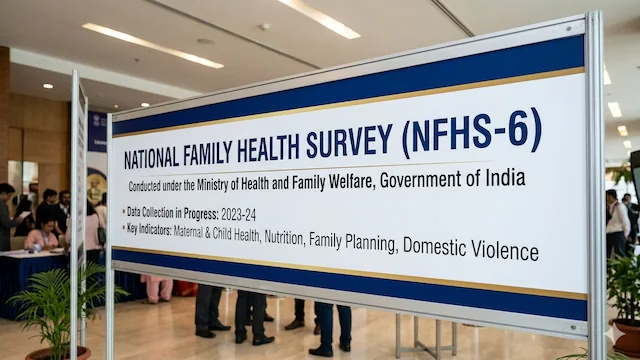
Conducted across approximately 6.79 lakh households spanning 715 districts during 2023–24, the NFHS-6 was highly anticipated as a post-pandemic evaluation of India’s health architecture. However, compared to the 131 key indicators detailed in the NFHS-5 factsheet (2019–21), the latest publication contains just 101.
The structural changes show that long-established benchmarks have been entirely severed from the primary dataset:
| Missing Indicator Group | Baseline Data (NFHS-5 / Prior) | Affected Public Health Initiative |
| Anaemia Prevalence | 67.1% of children under 5; 57% of women aged 15–49 | Anaemia Mukt Bharat (Anaemia-Free India) |
| Sex Ratio at Birth | Monitored annually to track regional gender gaps | Gender discrimination & female foeticide monitoring |
| Infant & Under-5 Mortality | Infant mortality at 24 per 1,000 live births (2024 SRS data) | Paediatric health & universal immunisation strategies |
| Sanitation Coverage | 70.2% of households using improved sanitation facilities | Swachh Bharat (Clean India) Mission |
| Clean Cooking Fuel Access | 58.6% of households utilizing clean fuels | Pradhan Mantri Ujjwala Yojana (PMUY) |
| Cancer Screening Uptake | 0.9% for breast/oral cancer; 1.9% for cervical cancer | Non-communicable disease (NCD) screening programs |
| HIV/AIDS Awareness | 4 distinct metrics tracking prevention knowledge | National AIDS Control Organisation (NACO) campaigns |
The wholesale removal of anaemia monitoring is drawing the sharpest criticism. All seven standalone anaemia indicators have vanished from the factsheet, leaving independent observers without updated, localized figures for vulnerable demographics, including adolescent girls, pregnant women, and infants.
Expert Commentary: The Problem with Invisible Data
Public health authorities argue that separating these indicators from India’s core multi-sectoral health survey fragments our understanding of overlapping health vulnerabilities.
“Anaemia remains one of the most stubborn and serious public health challenges in India,” says Poonam Muttreja, Executive Director of the Population Foundation of India. “Programs like Anaemia Mukt Bharat rely heavily on regular, comparable, and publicly accessible data to evaluate whether community-level interventions are actually working.”
Muttreja notes that when key health indicators are split across multiple disparate surveys rather than compiled in a single household assessment, drawing a coherent picture of human development becomes vastly more difficult.
“The risk is that critical conditions like anaemia become less visible in national policymaking precisely when they require the most urgent financial and strategic attention,” Muttreja warns. “This condition doesn’t exist in a vacuum; it directly impacts maternal mortality, birth weights, childhood cognitive development, school performance, and long-term economic productivity. What doesn’t get counted also does not get done.”
The Anaemia Methodology Debate
The decision to exclude anaemia from NFHS-6 follows a prolonged methodological dispute over the findings of the previous survey. When NFHS-5 revealed that childhood anaemia had risen significantly from 58.6% to 67.1%, the Union Health Ministry publicly questioned the data collection techniques.
Government advisors argued that the survey’s reliance on capillary blood sampling—commonly known as the “finger-prick” method—tended to yield lower, more variable hemoglobin estimations compared to venous blood sampling (drawn directly from a vein), thereby artificially inflating anaemia prevalence statistics.
Dr. Shamika Ravi, an economist and member of the Economic Advisory Council to the Prime Minister, has previously noted that structural flaws in the NFHS data collection framework compromised its accuracy. Following these deliberations, the International Institute for Population Sciences (IIPS) removed the anaemia module from NFHS-6 in 2023, announcing that the condition would instead be monitored via the dedicated Diet and Biomarkers Survey in India (DABS-I), overseen by the Indian Council of Medical Research (ICMR) and the National Institute of Nutrition (NIN).
While venous testing is globally recognized as the clinical gold standard for diagnosing anaemia, shifting the measurement to a completely new survey framework creates a significant hurdle: future DABS-I data cannot be directly compared with past NFHS datasets to plot long-term national trends. Public health researchers emphasize that without providing carefully calibrated “bridge estimates” to reconcile the two methodologies, a decades-long tracking baseline has effectively been broken.
Programme Accountability and the Outcome Gap
For decades, independent researchers have utilized the NFHS as an objective report card to evaluate flagship, multi-billion-dollar government welfare programs. For example, while the central government declared India “Open Defecation Free” in 2019, the independent findings of NFHS-5 served as a vital reality check, showing that 29.8% of households nationwide still lacked access to improved sanitation facilities.
A similar data gap now obscures the evaluation of clean energy initiatives:
-
Pradhan Mantri Ujjwala Yojana (PMUY): NFHS-4 recorded clean cooking fuel usage at 43.8%, which rose to 58.6% in NFHS-5. Because NFHS-6 excludes this metric, analysts cannot independently verify whether the distribution of millions of new gas connections has translated into sustained everyday usage.
-
The Input vs. Outcome Disconnect: Interestingly, NFHS-6 continues to track public health inputs—such as whether pregnant women receive iron and folic acid supplements—but it has stopped measuring the primary biological outcome: whether those supplements are successfully driving down anaemia rates.
Medical analysts warn that tracking inputs without measuring biological outcomes makes it incredibly difficult to judge if taxpayer-funded health programs are actually delivering results.
NFHS-6 Findings: A Polarized Health Profile
Despite the missing indicators, the remaining sections of NFHS-6 paint a complex, dual-burden health portrait of the Indian population, showcasing a phenomenon experts call “epidemiological polarization.” This occurs when severe undernutrition and rising metabolic diseases coexist within the very same communities.
The Rise of Metabolic and Non-Communicable Diseases (NCDs)
The newly released data underscores an expanding cardiovascular and metabolic health crisis across both urban and rural areas:
-
Obesity: Clinical obesity rates have climbed significantly. Approximately 31% of Indian women (representing an estimated 21.6 crore individuals) and 27.3% of men (approx. 20.4 crore individuals) aged 15 and older are now classified as overweight or obese.
-
Glycemic and Blood Pressure Burdens: Chronic disease burdens have reached unprecedented absolute numbers. The data shows that 8.15 crore men and 6.42 crore women exhibit high blood sugar levels. Concurrently, elevated blood pressure affects 12 crore men and 10.5 crore women, posing a severe long-term challenge to the country’s tertiary healthcare infrastructure.
Persistent Undernutrition
In stark contrast to rising obesity, roughly one in five Indian men and women remain chronically underweight. The steady decline in undernutrition that had been observed between NFHS-4 and NFHS-5 has flattened out or, in specific regional pockets, actively reversed.
Noteworthy Positive Gains
The survey is not without encouraging news. Preliminary reviews of the factsheet indicate steady positive trends in several foundational healthcare metrics, including:
-
Substantial expansions in universal childhood vaccination coverage.
-
Increases in institutional births and structured maternal healthcare utilization.
-
A steady rise in the percentage of households covered by public or private health insurance schemes.
Government Defense: Streamlining and Data Harmonization
Senior officials from the Ministry of Health and Family Welfare have strongly defended the changes to the survey layout. They argue that the restructuring is not an erosion of transparency, but rather a deliberate administrative effort to reduce institutional duplication and harmonize national data systems.
Ministry spokespersons emphasize that the missing indicators are being tracked through alternative, specialized government databases:
-
Mortality and Survival Metrics: Infant and under-five mortality statistics continue to be compiled through the robust Sample Registration System (SRS) managed by the Office of the Registrar General.
-
Nutritional Biomarkers: As noted, anaemia and detailed micronutrient deficiencies will fall under the purview of the specialized DABS-I project.
The Health Ministry maintained that NFHS-6 ultimately reflects the positive impact of sustained structural efforts to strengthen healthcare delivery across the country.
However, independent data scientists counter that the primary issue is not whether the data exists somewhere in the state apparatus, but rather its accessibility and granularity. The unique strength of the NFHS has always been its massive sample size, which allows researchers to cross-reference health outcomes against complex socio-economic factors such as household income brackets, maternal educational levels, caste, and rural-versus-urban locations. Standalone institutional registers or smaller specialized surveys rarely provide these vital cross-linkages.
Emerging Priorities: The New Indicators
To adapt to an evolving society, NFHS-6 introduced 13 new indicators aimed at capturing modern socio-economic and healthcare shifts. These include tracking the welfare of the population aged 60 and above, household bank account ownership, female land and property ownership, comprehensive antenatal care coverage, and the administration of the birth-dose Hepatitis-B vaccine.
While health researchers welcome these additions—particularly those tracking financial inclusion and an aging demographic—they caution that tracking new social priorities cannot substitute for losing foundational metrics that map a country’s core disease burdens and child survival rates.
Limitations of the Current Debate
Independent epidemiological observers note a crucial caveat: the current crisis of confidence is based entirely on the abbreviated national factsheets released to the public. Historically, the full, comprehensive NFHS volumes—which take significantly longer to compile and publish—contain hundreds of pages of supplementary data tables. It remains entirely possible that some omitted metrics may reappear in the final, comprehensive report.
Furthermore, while mortality statistics from the Sample Registration System (SRS) are reliable at the state level, they lack the district-level precision that local administrative bodies need to design targeted health campaigns.
Public Health Implications: The Cost of Missing Metrics
The unfolding debate surrounding NFHS-6 highlights a fundamental axiom of modern public health: data alone does not cure a disease, but a complete lack of data guarantees that you cannot track its spread or evaluate its remedy.
Without highly localized, district-level data, state health departments will find it increasingly difficult to discern whether local nutritional programs are succeeding, whether cancer screening initiatives are reaching vulnerable rural women, or if HIV awareness campaigns are effectively engaging high-risk communities. For over three decades, the NFHS provided those exact answers. Public health challenges do not disappear when they are removed from official questionnaires—only the empirical tools required to hold health systems accountable do.
Medical Disclaimer
Medical Disclaimer: This article is for informational purposes only and should not be considered medical advice. Always consult with qualified healthcare professionals before making any health-related decisions or changes to your treatment plan. The information presented here is based on current research and expert opinions, which may evolve as new evidence emerges.
References
- https://www.ndtv.com/health/missing-numbers-missing-accountability-why-nfhs-6-has-triggered-questions-about-indias-health-data-11600291