 0
0
 0
0
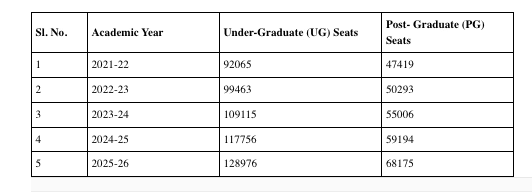
NEW DELHI — India has officially reached a historic milestone in its medical education landscape. According to the latest data from the National Medical Commission (NMC) presented by the Union Ministry of Health in Parliament, the country has approved a record 128,976 MBBS seats and 68,175 postgraduate (PG) seats for the 2025–26 academic year. While the expansion signals a robust effort to bolster the national healthcare workforce, the data also uncovers a deepening regional divide, with Karnataka emerging as the undisputed powerhouse of specialist medical training.
A Five-Year Growth Story
The scale of this expansion is significant. Just four years ago, in the 2021–22 academic cycle, India offered 92,065 MBBS seats. The jump to nearly 129,000 represents an approximately 40% increase in undergraduate capacity. Similarly, PG seats have climbed from 47,419 to over 68,000 in the same period, reflecting the government’s strategic focus on addressing the chronic shortage of specialists like surgeons, cardiologists, and pediatricians.
This growth is distributed across roughly 800 medical colleges nationwide. However, the distribution of these seats is anything but uniform.
The State Leaderboard: PG Seats (2025-26)
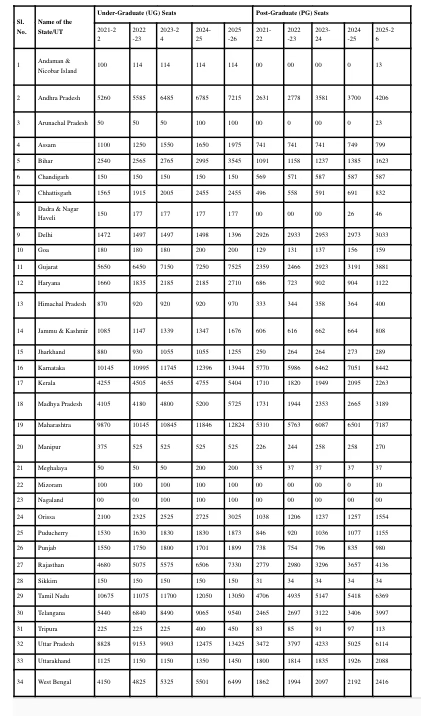
In stark contrast, several regions remain “medical deserts” for advanced training. Nagaland currently reports zero PG seats, while Mizoram and the Andaman & Nicobar Islands have only 10 and 13 seats, respectively.
Why Karnataka Tops the Charts
Karnataka’s dominance is not an overnight phenomenon but the result of decades of investment in healthcare infrastructure. The state currently hosts between 70 and 80 medical colleges, a mix of long-standing government institutions and well-funded private entities.
“The sheer number of medical colleges in Karnataka, combined with relatively advanced infrastructure in its teaching hospitals, allows more PG seats to be sanctioned under the NMC norms,” explains a senior medical educator formerly with the state’s medical education department.
However, this high capacity comes with a caveat. The educator notes that while the volume of seats is high, the concentration of talent means competition for top-tier residencies in Bengaluru and other Karnataka hubs remains among the steepest in the country.
The Workforce Paradox: More Seats vs. Local Shortages
From a public health perspective, the increase in seats is a victory, but the geographic concentration poses a challenge. While India is moving closer to the World Health Organization (WHO) recommended ratio of one doctor per 1,000 people, the “on-the-ground” reality varies wildly between urban and rural settings.
A 2025 analysis by the Indian Medical Association (IMA) highlighted that despite the surge in graduates, rural and northeastern regions continue to face a severe deficit of specialists. The concern is that doctors trained in high-capacity states like Karnataka or Maharashtra are less likely to migrate to underserved areas, leading to “over-doctored” cities and “under-doctored” villages.
Quality vs. Quantity: The Policy Debate
The rapid expansion has sparked a heated debate within the medical community regarding the quality of training. Some resident doctor groups and academic purists worry that the infrastructure—such as faculty numbers and laboratory equipment—is not keeping pace with the seat count.
“We are adding more seats, but many institutions are already operating near full capacity,” says a public health professor at a national institute. “If we don’t upgrade infrastructure and faculty, the benefit of extra seats may be diluted or even lead to a drop in training quality.”
Further controversy arose in recent years over the lowering of NEET-PG qualifying percentiles to fill vacant seats in private colleges. This move has split the community:
-
Proponents argue that every vacant seat is a wasted opportunity to produce a doctor.
-
Critics warn that “slashing cut-offs” could lead to a dilution of merit and clinical standards.
What This Means for Students and Families
For aspirants sitting for NEET-UG or NEET-PG, the “more is better” headline requires a nuanced look. High seat numbers in a state like Karnataka do not necessarily mean an easier path to admission; they often signal a more complex admissions landscape involving high-cost private seats and intense competition.
Guidance for Aspirants:
-
Look Beyond the Numbers: Evaluate the faculty-to-student ratio and the daily patient “in-flow” at the affiliated hospital. A seat in a college with low patient volume offers poor clinical exposure.
-
Cost vs. Quality: Many of the new seats are in private or “deemed-to-be” universities. Families must weigh the high tuition fees against the long-term ROI of the degree.
-
Consider Underserved Regions: Experts suggest that institutions in states with fewer seats may sometimes offer better hands-on clinical experience due to a higher patient-to-student ratio and less competition for “first-assistant” roles in surgeries.
The Path Forward
The Union Health Ministry maintains that this expansion is vital for achieving Universal Health Coverage. However, the next phase of India’s medical evolution will likely shift focus from quantity to equity.
Policymakers are now being urged to look at “seat-fill rates” and mandatory rural service incentives to ensure that the 1.28 lakh MBBS students currently entering the system eventually reach the populations that need them most. If India can successfully bridge the gap between its “medical hubs” and its rural heartlands, this record-breaking seat count could indeed transform the nation’s health future.
References
- https://medicaldialogues.in/news/education/128976-mbbs-68175-pg-medical-seats-in-india-highest-in-karnataka-health-ministry-gives-breakup-in-parliament-167906
Medical Disclaimer: This article is for informational purposes only and should not be considered medical advice. Always consult with qualified healthcare professionals before making any health-related decisions or changes to your treatment plan. The information presented here is based on current research and expert opinions, which may evolve as new evidence emerges.