 0
0
 0
0
Published: May 7, 2026
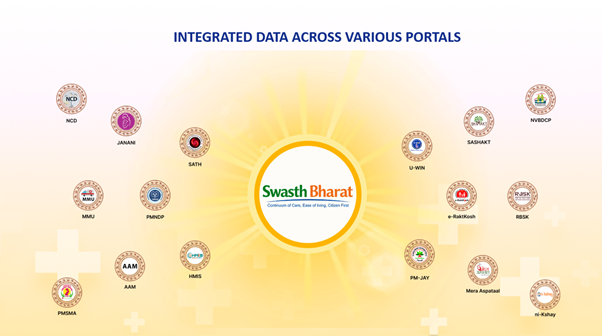
NEW DELHI — In a move set to redefine the landscape of public health administration, the Union Ministry of Health and Family Welfare (MoHFW) has officially launched the Swasth Bharat Portal. Unveiled by Union Health Minister Shri Jagat Prakash Nadda during the 10th National Summit on Innovation and Inclusivity, the platform acts as a sophisticated “aggregator,” designed to stitch together India’s previously siloed digital health programs into a single, interoperable ecosystem. By streamlining data entry and integrating with the Ayushman Bharat Digital Mission (ABDM), the portal aims to reduce administrative burdens on frontline workers by up to 40%, potentially accelerating clinical decision-making across the nation.
Moving Beyond “Digital Silos”
For over a decade, India’s digital health journey has been characterized by rapid but fragmented growth. National programs—ranging from maternal health tracking to tuberculosis monitoring—each utilized independent digital applications. While successful in capturing data, this “siloed” approach created a logistical nightmare for healthcare providers.
Frontline workers, including Accredited Social Health Activists (ASHAs) and Auxiliary Nurse Midwives (ANMs), frequently reported the need to log into multiple platforms to enter the same patient information. The Swasth Bharat Portal addresses this through an API-based federated architecture.
“This is the digital ‘glue’ the system has been waiting for,” says Dr. Anirudh Verma, a public health policy consultant not involved in the portal’s development. “By creating a unified digital layer, we are moving from a collection of isolated apps to a synchronized national health nervous system.”
Projected Efficiency Gains at a Glance
| Category | Projected Reduction in Burden/Cost |
| IT Infrastructure Load | 20% – 30% |
| Data Entry Effort | 20% – 40% |
| Human Resource Duplication | 20% – 40% |
| Decision-Making Speed | Significant Increase |
Reducing the “Data Tax” on Frontline Workers
One of the most significant implications of the portal is the reduction of “repetitive data entry.” Under the previous system, a single patient visit might require a Medical Officer to update three different registries. The Swasth Bharat Portal eliminates this by allowing data entered once to populate all relevant national programs simultaneously.
The Ministry anticipates that this will not only save time but also improve data accuracy. When healthcare workers spend less time on paperwork—or “screen-work”—they can devote more time to patient care. For the average citizen, this translates to shorter wait times at primary health centers and more focused attention from medical staff.
Interoperability and the Role of ABHA
Central to the portal’s success is its compliance with the Ayushman Bharat Digital Mission (ABDM). The portal integrates seamlessly with the Ayushman Bharat Health Account (ABHA), the unique 14-digit identification number that allows citizens to link their health records across different providers.
By leveraging the Healthcare Professionals Registry (HPR) and the Health Facility Registry (HFR), the portal ensures that the data being exchanged is verified and secure. This interoperability means that if a patient moves from a rural clinic to a city hospital, their medical history—immunizations, past surgeries, and chronic conditions—can theoretically follow them digitally, provided they give consent via their ABHA ID.
Expert Perspectives: A Balanced View
While the public health community has largely welcomed the initiative, some experts urge a cautious approach toward implementation and data privacy.
“The Swasth Bharat Portal is a massive leap toward ‘Data-Driven Governance,'” notes Sarah Joseph, a digital health equity researcher. “However, the success of an aggregator platform depends entirely on the ‘last-mile’ connectivity. In rural areas where internet stability is intermittent, we must ensure that the offline-to-online synchronization of this unified portal is seamless to avoid data loss.”
Furthermore, privacy advocates emphasize that while the federated architecture is designed for security, the centralizing of access points requires rigorous, ongoing cybersecurity audits to protect the sensitive health data of over a billion people.
What This Means for You
For the health-conscious consumer, the Swasth Bharat Portal may not be a tool you interact with daily, but its “under-the-hood” improvements will likely change your healthcare experience:
-
Faster Referrals: With unified data, the transition between primary and secondary care becomes smoother.
-
Accurate Health Records: Your ABHA-linked records will be more consistent across various government health schemes.
-
Evidence-Based Policy: Better data allows the government to identify disease outbreaks faster and allocate medicines more effectively to your local clinic.
As India continues to scale its digital public infrastructure (DPI), the Swasth Bharat Portal stands as a testament to the shift from merely collecting data to intelligently utilizing it.
References
Official Sources & Statistics:
-
Press Information Bureau (PIB) Delhi. “Swasth Bharat Portal Unveiled: Unifying Fragmented Health Systems.” Posted 06 May 2026. [Release ID: 2026/MoHFW/SBP01]
Medical Disclaimer: This article is for informational purposes only and should not be considered medical advice. Always consult with qualified healthcare professionals before making any health-related decisions or changes to your treatment plan. The information presented here is based on current research and expert opinions, which may evolve as new evidence emerges.