 0
0
 0
0
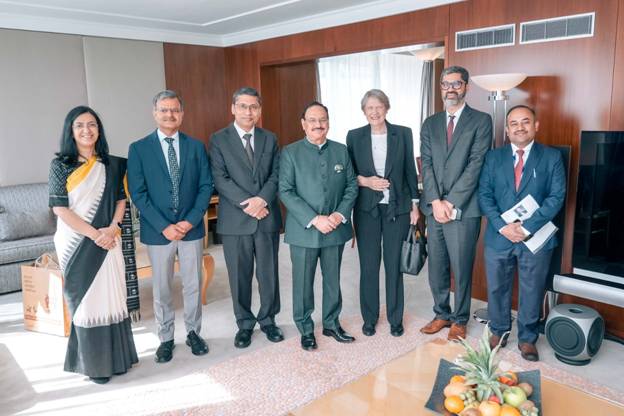
GENEVA — On the sidelines of the 79th World Health Assembly, India’s Union Minister of Health and Family Welfare, Jagat Prakash Nadda, met with Helen Clark, the Board Chair of the Partnership for Maternal, Newborn and Child Health (PMNCH). The high-level bilateral meeting, held on May 20, 2026, served as a platform for India to reaffirm its commitment to the global health agenda for women, children, and adolescents, while showcasing its domestic success in rapidly reducing maternal and infant mortality rates.
During the session, Minister Nadda emphasized India’s evolving role from a nation implementing large-scale public health interventions to a global provider of technical guidance and digital health goods. Former New Zealand Prime Minister Helen Clark acknowledged India’s critical leadership within the broader global health architecture, particularly its active contributions as Vice Chair of the PMNCH Board.
Accelerating the Decline: Maternal and Infant Mortality Trends
A central focus of the bilateral discussions was India’s trajectory in improving survival outcomes for mothers and newborns. According to the Ministry of Health and Family Welfare, India has achieved reductions in both the Maternal Mortality Ratio (MMR) and the Infant Mortality Rate (IMR) at a pace that surpasses general global trends.
Understanding the Metrics
-
Maternal Mortality Ratio (MMR): The number of maternal deaths per 100,000 live births during pregnancy, childbirth, or within 42 days of termination.
-
Infant Mortality Rate (IMR): The number of deaths of children under one year of age per 1,000 live births.
Data from successive rounds of India’s National Family Health Survey (NFHS) and the Sample Registration System (SRS) outline this steady downward trajectory. Analysts attribute these shifts to targeted institutional schemes designed to remove financial barriers to healthcare access.
| Key Public Health Program | Primary Strategy & Mechanism |
| Janani Suraksha Yojana (JSY) | A conditional cash transfer scheme that incentivizes pregnant individuals to opt for institutional deliveries rather than home births. |
| Pradhan Mantri Surakshit Matritva Abhiyan (PMSMA) | Provides free, assured, and comprehensive antenatal care (ANC) packages to pregnant women on the 9th of every month. |
| Poshan Abhiyaan | A multi-ministerial convergence mission tackling malnutrition, stunting, and anemia in pregnant women and young children. |
Independent global health experts note that while the rate of decline is noteworthy, regional disparities remain an ongoing challenge.
“The structural acceleration in institutional deliveries across India is a major public health achievement,” says Dr. Arisitha Sen, an independent maternal health researcher and policy consultant. “However, the next frontier for the country is closing the equity gap. Maternal survival rates in urban centers or economically advanced states differ markedly from those in remote, tribal, or historically under-resourced districts. Scaling interventions is the first step; ensuring uniform quality of care across all tiers of the health system is the second.”
Pioneering Adolescent Healthcare Models
Minister Nadda also highlighted India’s early policy focus on young demographics, noting that the country was among the first globally to launch a dedicated national framework for adolescents in 2014: the Rashtriya Kishor Swasthya Karyakram (RKSK).
Unlike traditional programs that focused narrowly on reproductive clinical care, the RKSK model expanded the definition of adolescent health. It integrated a community- and school-based approach targeting individuals aged 10–19 years across six strategic priorities:
-
Nutrition (specifically addressing iron-deficiency anemia)
-
Sexual and reproductive health
-
Mental health challenges
-
Injuries and violence (including gender-based violence)
-
Non-communicable diseases (NCDs)
-
Substance misuse
By training peer educators (Saathis) and establishing Adolescent Friendly Health Clinics (AFHCs), the strategy attempted to destigmatize youth healthcare access. Public health assessments indicate that embedding health workers within local schools and community structures significantly improves health literacy and nutritional adherence among teenagers.
Digital Public Goods and Global South Cooperation
A key development arising from the Geneva meeting is India’s intention to transition into a net provider of technical expertise for other developing nations. Minister Nadda indicated that India is finalizing an annual grant contribution of USD 2 million in perpetuity to support PMNCH’s global operations.
Furthermore, India offered to share its “digital public health goods” with the international community. Infrastructure systems developed domestically—such as the CoWIN platform utilized for massive vaccine distribution and the eSanjeevani telemedicine system—are being positioned as open-source blueprints. These technologies can potentially be adapted by low- and middle-income countries (LMICs) to optimize their own healthcare supply chains and remote diagnostic capabilities.
This cooperative approach aligns with the philosophical framework of Vasudhaiva Kutumbakam (“the world is one family”), which the minister invoked to describe India’s public health diplomacy strategy.
Remaining Challenges and Future Hurdles
Despite the optimistic tone of the bilateral meeting, international health observers emphasize that India faces significant headwinds, particularly concerning the dual burden of disease. While traditional infectious diseases and maternal health challenges are declining, the country is experiencing a sharp rise in non-communicable diseases (NCDs) such as diabetes, hypertension, and cardiovascular disorders.
Furthermore, emerging global data from the World Health Organization (WHO) cautions that the long-term disruptions to routine immunization and antenatal care caused by the COVID-19 pandemic required years of corrective campaigns to steady. Sustaining the downward momentum of infant and maternal mortality requires resilient primary healthcare infrastructure capable of weathering future environmental or epidemiological shocks.
As the 79th World Health Assembly progresses, India’s model of combining digital innovation with grass-roots community workers (such as Accredited Social Health Activists, or ASHAs) will likely continue to be analyzed as a case study in implementing public health interventions at a population scale of over 1.4 billion people.
References
Policy and Institutional Sources
-
Ministry of Health and Family Welfare (MoHFW), Government of India: Official Press Communiqué, published via Press Information Bureau (PIB) Delhi, May 20, 2026.
Expert Frameworks
-
Rashtriya Kishor Swasthya Karyakram (RKSK): Operational Guidelines for Adolescent Health, MoHFW, Government of India (Launched 2014).
Medical Disclaimer: This article is for informational purposes only and should not be considered medical advice. Always consult with qualified healthcare professionals before making any health-related decisions or changes to your treatment plan. The information presented here is based on current research and expert opinions, which may evolve as new evidence emerges.