 0
0
 0
0
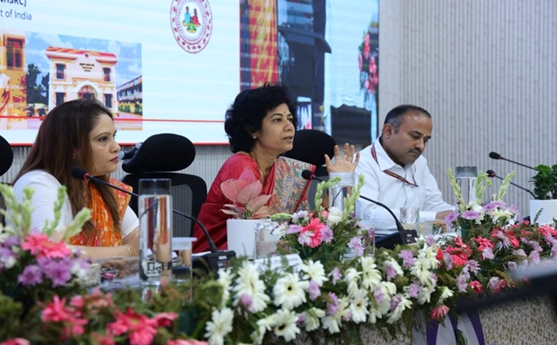
NEW DELHI — In a major bid to overhaul its grassroots medical system, the Union Ministry of Health and Family Welfare (MoHFW) has successfully concluded a intensive, two-day National Training of Trainers (NToT) program in the capital. The initiative aims to standardize and elevate care for hundreds of millions of citizens by systematically retraining all five core cadres of frontline workers operating within India’s massive network of Ayushman Arogya Mandirs (AAMs).
The central government’s rollout of its newly developed Integrated Training Strategy (ITS) marks a shift away from traditional, program-specific textbook learning. Instead, the country is transitioning toward a patient-centric, competency-based framework designed to merge rigorous technical expertise with deep behavioral empathy.
Retraining the Frontline: A Cascade Model
Presided over by Smt. Aradhana Patnaik, Additional Secretary and Mission Director of the National Health Mission (NHM), the national training session brought together more than 110 elite national and master trainers at the National Health Systems Resource Centre (NHSRC).
Starting in August 2026, this core group will lead a decentralized, “cascade mode” rollout across more than 100 specially identified Regional Training Institutes nationwide. The initiative directly targets the five primary pillars of India’s rural and semi-urban health infrastructure:
-
Medical Officers (MOs): Physicians managing primary health centers.
-
Staff Nurses: Clinical caretakers providing advanced bedside and procedural care.
-
Community Health Officers (CHOs): Mid-level providers bridging the gap between doctors and villages.
-
Auxiliary Nurse Midwives (ANMs): Village-level female health workers focusing on maternal and child health.
-
Accredited Social Health Activists (ASHAs): Community health volunteers who serve as the first point of contact for families.
“Ensuring the availability of a skilled and quality health workforce across public health facilities is critically important,” Patnaik emphasized during the session. She added that technical knowledge alone is no longer the sole benchmark. The modern primary healthcare worker must possess “behavioral competencies, empathy, and effective communication” to establish genuine community trust and deliver truly compassionate care.
Why a Paradigm Shift Matters for Public Health
For decades, primary healthcare training globally has operated in siloes—a worker might receive independent training for tuberculosis monitoring, followed months later by a separate seminar on maternal nutrition. The Integrated Training Strategy, originally unveiled on April 30, 2026, by Union Health Minister Shri Jagat Prakash Nadda at a National Summit in Chandigarh, dismantles this fragmented approach.
Public health experts not connected to the ministry’s blueprint view this as a long-overdue evolution.
“Primary healthcare is the bedrock of any robust medical system. If a patient encounters an empathetic, highly competent provider at their local clinic, they are far more likely to seek early intervention for chronic diseases like diabetes or hypertension,” says Dr. Ramesh Krishnan, an independent public health policy analyst based in New Delhi. “Shifting training to focus on how a worker interacts holistically with a single human being, rather than checking off boxes for isolated health programs, is crucial for improving patient outcomes.”
To ensure the training translates into practical ability, the NToT incorporated immersive learning experiences. Trainers underwent classroom sessions, analyzed complex case-based histories, and engaged in hands-on practical training at the specialized Skill Lab within the National Institute of Health and Family Welfare (NIHFW).
Statistical Context and the Scaling Challenge
The sheer scale of India’s public primary health network highlights both the necessity and the immense challenge of this undertaking. According to data from the Ministry of Health and Family Welfare, India has operationalized over 170,000 Ayushman Arogya Mandirs (formerly known as Ayushman Bharat Health and Wellness Centres) across the country.
These centers serve as the frontline defense against both infectious diseases and the rising tide of non-communicable diseases (NCDs), which the World Health Organization (WHO) estimates account for over 60% of all deaths in India. Retraining a workforce responsible for a population exceeding 1.4 billion requires flawless execution across regional lines.
| Healthcare Cadre | Primary Focus Area | Estimated Footprint |
| Medical Officers / CHOs | Clinical diagnosis, NCD screening, and facility management | Over 170,000 centers |
| Staff Nurses / ANMs | Immunization, maternal care, and reproductive health | Village & sub-center level |
| ASHAs | Home visits, health awareness, and community mobilization | Over 1 million volunteers |
Potential Hurdles: The Implementation Gap
While public health professionals widely praise the curriculum’s modern emphasis on soft skills and standardized technical competencies, some caution that institutional friction could slow down progress.
The secondary and tertiary stages of a “cascade” training model always present a risk of informational dilution. What is taught perfectly to 110 master trainers in New Delhi must be successfully transferred across hundreds of languages and dialects to over a million grassroots workers. Furthermore, maintaining high behavioral standards like “empathy” is notoriously difficult in understaffed rural clinics where a single worker might see upwards of 70 patients a day.
To counter these limitations, the ministry is leaning heavily on inter-agency cooperation. The presence of senior officials from the Directorate General of Health Services (DGHS), the National Medical Commission (NMC), and Mission Karmayogi Bharat—the government’s flagship capacity-building initiative—indicates an intent to continuously monitor and backstop the training quality over the long term.
What This Means for Everyday Citizens
For health-conscious consumers and families relying on public health facilities, this strategy promises a noticeably different experience at local clinics. The ultimate goal of the training is to establish a culture of quality certification across all AAMs.
For the average patient, this should ideally manifest as shorter wait times, clearer instructions on how to take medications, more respectful and dignified interactions during check-ups, and a significantly higher standard of accurate diagnostic care closer to home—minimizing the need to travel to expensive, overcrowded city hospitals for basic medical needs.
Reference Section
Institutional and Governmental Sources
-
Press Information Bureau (PIB) Delhi: Government of India. Union Ministry of Health & Family Welfare successfully Conducts National Training of Trainers for All Five Cadres Delivering Primary Healthcare Services at Ayushman Arogya Mandirs. Published July 8, 2026.
Medical Disclaimer: This article is for informational purposes only and should not be considered medical advice. Always consult with qualified healthcare professionals before making any health-related decisions or changes to your treatment plan. The information presented here is based on current research and expert opinions, which may evolve as new evidence emerges.