 0
0
 0
0
CHANDIGARH, INDIA — Health ministers, senior policymakers, and medical diplomats from 11 member nations representing nearly half of the world’s population will gather in Chandigarh on Wednesday, July 22, 2026, for the start of the three-day Sixteenth BRICS Health Ministers’ Meeting. Hosted under India’s 2026 BRICS Chairship, the high-level forum aims to reshape global health architecture around four core pillars: resilience, innovation, cooperation, and sustainability.
The summit comes at a critical juncture for international public health. As developing and emerging economies navigate post-pandemic recovery, rising non-communicable disease burdens, and climate-driven health threats, the BRICS bloc—comprising Brazil, Russia, India, China, South Africa, Egypt, Ethiopia, Iran, Saudi Arabia, the United Arab Emirates, and Indonesia—is positioning itself as a central driver of health equity for the Global South.
The event will kick off with a Senior Officials’ Meeting on July 22 to finalize the draft Ministerial Declaration, followed by the main Health Ministers’ Meeting on July 23, chaired by India’s Union Minister of Health and Family Welfare, Shri Jagat Prakash Nadda. The summit concludes on July 24 with a specialized dialogue on artificial intelligence (AI) and interoperable digital health architecture.
Expanding the Agenda: Nine Strategic Health Priorities
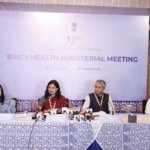
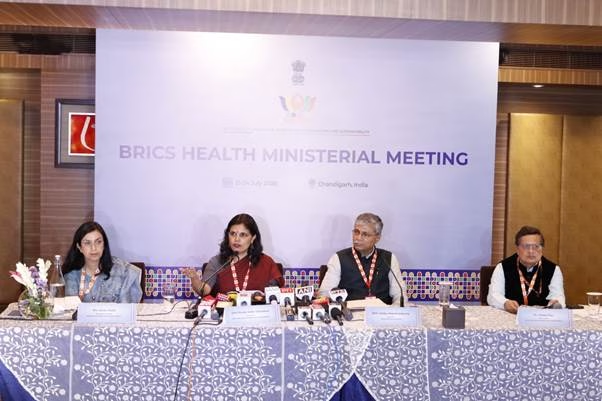
At a press briefing in Chandigarh preceding the inaugural sessions, Union Health Secretary Smt. Punya Salila Srivastava and Ministry of Ayush Secretary Shri Vaidya Rajesh Kotecha outlined the ambitious roadmap established for this year’s meetings. Building on previous summits, India retained established technical tracks while introducing two landmark initiatives: the BRICS Mission for Healthy Lifestyle and the Promotion of Mental Wellness.
In total, nine core priority areas are guiding discussions:
-
BRICS Tuberculosis (TB) Research Network: Accelerating joint clinical trials, vaccine development, and diagnostic tools to eliminate TB.
-
Regulatory Collaboration: Aligning national medical products regulatory authorities to streamline drug approvals and lower pharmaceutical costs.
-
Integrated Early Warning System: Creating shared surveillance protocols for early detection and rapid response to emerging infectious disease threats.
-
Digital Health Architecture: Building standardized, secure systems for digital health records that ensure continuity of care, especially in remote regions.
-
BRICS Mission for Healthy Lifestyle: Promoting population-level interventions against non-communicable diseases (NCDs) by encouraging physical activity and nutrition.
-
Promotion of Mental Wellness: Integrating mental healthcare into primary health services and reducing social stigma.
-
Traditional, Complementary, and Integrative Medicine (TCIM): Expanding evidence-based research and scientific integration of traditional healing practices into mainstream medicine.
-
Addressing Social Determinants of Health: Tackling poverty, sanitation, housing, and environmental risk factors driving chronic illnesses.
-
Network of Public Health Institutes: Strengthening institutional ties for workforce training, epidemiological research, and rapid technical exchange.
“This meeting reflects India’s unwavering commitment to advancing collective, people-centric action across the Global South,” stated Union Health Secretary Punya Salila Srivastava during the media address. “By prioritizing preventive health, digital tools, and resilient supply chains, we are creating a blueprint for Universal Health Coverage.”
From Electronic Health Records to Responsible AI
A major highlight of the three-day programme is the high-level side event scheduled for July 24: “BRICS Dialogue: From Digital Health Records to AI-Enabled Healthcare – Strengthening the Continuum of Care through Interoperable Data Infrastructure and Responsible Artificial Intelligence.”
As AI language models and diagnostic algorithms rapidly enter clinical settings, the dialogue focuses on establishing international technical standards. Health leaders aim to ensure that digital health tools remain interoperable—meaning different medical software systems can securely exchange data without compromising patient privacy or creating technological silos.
“Digital health is no longer just about digitizing paper files; it is about predictive care and equitable access,” said Dr. Aris Thorne, a global health policy researcher not affiliated with the summit organizing committee. “If BRICS member nations can establish unified ethical guidelines and open-source standards for healthcare AI, it could revolutionize diagnostic accuracy and clinical decision-making for billions of people in rural and underserved areas.”
Integrating Traditional Wisdom with Modern Science
Alongside modern digital infrastructure, the Chandigarh summit places strong emphasis on Traditional, Complementary, and Integrative Medicine (TCIM). The Ministry of Ayush showcased live demonstrations of the Common Yoga Protocol, corporate wellness routines (“Y-Break”), and evidence-based herbal research at an interactive exhibition alongside the main sessions.
Delegates are finalizing the Terms of Reference for a formal BRICS Expert Working Group on TCIM. The initiative seeks to establish rigorous clinical trials and regulatory frameworks for traditional remedies, allowing validated therapies to complement standard pharmaceutical treatments safely.
What This Means for Everyday Healthcare
For the general public, multilateral health summits can often feel abstract. However, the agreements negotiated at the Chandigarh meeting carry concrete benefits for daily life:
-
Cheaper, Quality Medicines: Stronger coordination among regulatory agencies reduces redundant testing, speeding up the availability of safe, affordable generic drugs.
-
Faster Pandemic Response: Shared early warning systems mean outbreaks in one region can be identified and contained before reaching global pandemic proportions.
-
Better Remote Care: Standardized digital health frameworks mean patients living in isolated rural zones can securely access specialist consultations via telemedicine.
-
Holistic Wellness Support: A formal shift toward preventive lifestyle medicine and mental health awareness helps shift healthcare from simply treating illness to proactively maintaining long-term wellness.
Public Health Implications and Implementation Challenges
While the scope of the 2026 agenda is expansive, global health experts caution that moving from diplomatic declarations to practical implementation presents real-world hurdles.
| Priority Focus | Intended Impact | Implementation Challenge |
| Digital Health & AI | Unified medical records and automated diagnostic support | Varying cross-border data protection laws and digital infrastructure levels. |
| TB Research Network | Shared funding and clinical trials for new treatments | Managing diverse drug-resistance patterns across different geographic regions. |
| Integrative Medicine | Standardized, evidence-based traditional healthcare options | Harmonizing scientific validation methods between traditional and Western clinical practices. |
Balancing diplomatic alignment among 11 distinct economic and political systems requires sustained financial funding and shared data infrastructure. Furthermore, ensuring that consumer health data used in AI training models remains strictly protected against unauthorized surveillance or commercial exploitation remains an ongoing regulatory concern.
Despite these operational complexities, the Sixteenth BRICS Health Ministers’ Meeting signals a decisive move toward a more balanced, collaborative approach to world health—one where preventive care, digital access, and global cooperation take center stage.
Medical Disclaimer
This article is for informational purposes only and should not be considered medical advice. Always consult with qualified healthcare professionals before making any health-related decisions or changes to your treatment plan. The information presented here is based on current research and expert opinions, which may evolve as new evidence emerges.
References
-
Press Information Bureau (PIB), Government of India. “India to Host the Sixteenth BRICS Health Ministers’ Meeting in Chandigarh from 22–24 July.” Released July 21, 2026. [PRID: 2287325].