 0
0
 0
0
NEW DELHI – In a move set to redefine the landscape of Indian healthcare, the Union Ministry of Ayush has concluded its landmark Chintan Shivir 2026, unveiling a strategic blueprint designed to bridge the gap between traditional wisdom and modern medical science.
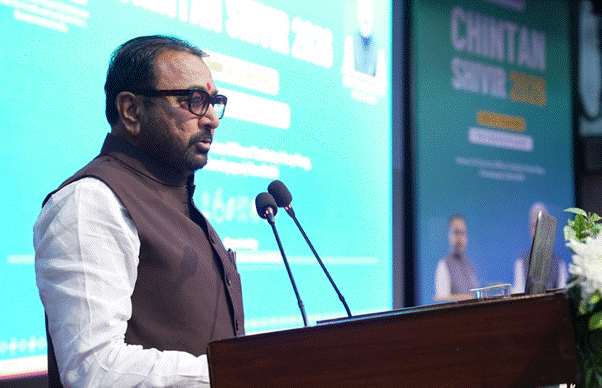
The two-day national brainstorming session, which concluded on April 17, 2026, brought together the country’s top medical minds, policymakers, and government officials. Union Minister Shri Prataprao Jadhav closed the summit with a clear mandate: the Ayush sector (comprising Ayurveda, Yoga, Unani, Siddha, and Homeopathy) must move beyond theoretical discussion and into an “action-oriented roadmap” that prioritizes evidence-based research and digital accessibility.
A Vision for Integrative Medicine
The primary takeaway from the summit is the shift toward Integrative Healthcare. Rather than viewing Ayush as an alternative to “English medicine” (allopathy), the government is pushing for a unified system where both can coexist to treat chronic conditions, particularly Non-Communicable Diseases (NCDs) like diabetes and hypertension.
Dr. Vinod Paul, Member of NITI Aayog and a prominent voice in Indian public health, outlined a vision for Universal Health Coverage. He emphasized that for India to reach its “Viksit Bharat 2047” (Developed India) goals, the healthcare system must transition from a curative-only model to a preventive and holistic approach.
“The seamless integration of Ayush with modern medicine is not just an option; it is a necessity for achieving holistic care,” Dr. Paul noted during the deliberations.
Breaking Down Financial Barriers: The Insurance Breakthrough
For years, a significant hurdle for patients seeking Ayush treatments has been the lack of financial support from insurance providers. The Chintan Shivir addressed this head-on with several major announcements:
-
Expanded Coverage: A Memorandum of Understanding (MoU) was signed between the All India Institute of Ayurveda and the General Insurance Council. This is expected to streamline how Ayush treatments are covered under standard health insurance policies.
-
Standardized Costs: The Ministry released a “benchmark rates” document. This provides a transparent pricing structure for Ayush procedures, reducing the risk of overcharging and making it easier for insurance companies to process claims.
-
Support Systems: A new toll-free helpline (1800-11-0008) was launched specifically to assist the public with Ayush insurance queries.
Evidence-Based Credibility and Digital Growth
Vaidya Rajesh Kotecha, Secretary of the Ministry of Ayush, highlighted that the future of traditional medicine rests on its global credibility. This requires a rigorous commitment to standardization and evidence-based research.
To achieve this, the Ministry is leaning heavily into the Ayush Grid—a digital backbone intended to store clinical data and facilitate research. By integrating with the ABHA (Ayushman Bharat Health Account) ID system, patients’ traditional treatment histories can now be digitally accessible to any doctor in the country, ensuring continuity of care.
Key Digital Initiatives Launched:
| Initiative | Purpose |
| Ayush Grid | A central digital platform for health records and research data. |
| Official WhatsApp Channel | Real-time dissemination of verified health information to the public. |
| iGOT Platform Integration | Using the ‘Mission Karmayogi’ framework to train healthcare workers in modern Ayush practices. |
The “Mainstream” Challenge: Expert Perspectives
While the roadmap is ambitious, independent experts suggest that implementation is the real test. “The move toward evidence-based reporting is vital,” says Dr. Ananya Sharma, a public health consultant not involved in the Shivir. “For Ayush to be truly integrated, we need large-scale, peer-reviewed clinical trials that demonstrate efficacy in the same language as modern pharmacology. The focus on insurance and standardization is a massive step in that direction.”
However, some medical professionals caution against “blanket integration.” The challenge lies in ensuring that practitioners of different systems understand the limitations of each. The summit addressed this by proposing better “inter-ministerial coordination” to ensure that patient safety remains the priority as these systems merge at the grassroots level.
What This Means for the Consumer
For the average citizen, these developments signal a more organized and affordable way to access traditional wellness.
-
Preventive Focus: Expect more Ayush services at Ayushman Arogya Mandirs (Health and Wellness Centers), focusing on mental health and maternal care.
-
Rural Reach: The expansion of telemedicine means a patient in a remote village could potentially consult with an Ayush expert in New Delhi via a digital platform.
-
Financial Relief: As insurance companies adopt the new benchmark rates, out-of-pocket expenses for treatments like Panchakarma or Homeopathic consultations are expected to decrease.
Looking Toward 2047
As the Chintan Shivir 2026 concluded, the message was clear: Ayush is no longer a “side-line” sector. With a focus on entrepreneurship, data-driven communication, and rigorous scientific validation, India is positioning itself as a global leader in holistic health.
As Union Minister Jadhav stated, the goal is a “future-ready Ayush workforce” that can tackle modern lifestyle challenges with ancient precision, ultimately contributing to a healthier, developed India by the centenary of its independence.
Medical Disclaimer: This article is for informational purposes only and should not be considered medical advice. Always consult with qualified healthcare professionals before making any health-related decisions or changes to your treatment plan. The information presented here is based on current research and expert opinions, which may evolve as new evidence emerges.
References
Official Sources:
-
Press Information Bureau (PIB) Delhi. (2026, April 17). Union Minister Shri Prataprao Jadhav Concludes Chintan Shivir 2026. [Posted 7:01 PM].