 0
0
 0
0
RIO DE JANEIRO, BRAZIL — In a packed hall at the 26th International AIDS Conference (AIDS 2026), health advocates, legal scholars, and human rights defenders issued an urgent call to action: halt the immediate ratification of the African Union’s new treaty on gender-based violence until significant legal gaps are addressed.
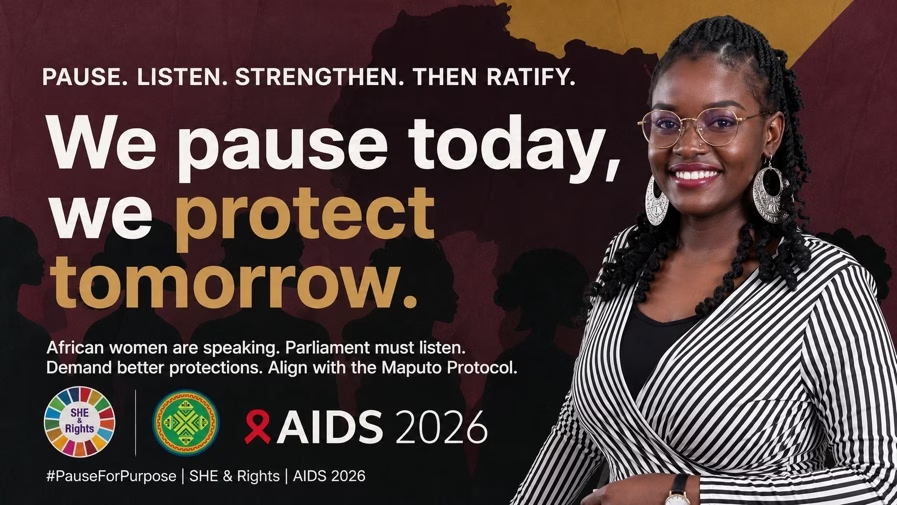
The special session, titled SHE & Rights, spotlighted the growing intersection between human rights rollbacks, gender-based violence (GBV), and the global public health response to HIV/AIDS. Centered on a campaign known as #PauseForPurpose, civil society organizations urged African Union (AU) member states to hold off on ratifying the African Union Convention on Ending Violence Against Women and Girls (AU CEVAWG) in order to strengthen its legal protections.
First introduced during a Pan-African Parliament dialogue on July 25, 2026, the #PauseForPurpose movement emphasizes that it does not oppose a continental treaty. Instead, advocates demand a stronger, legally enforceable instrument that builds upon existing human rights frameworks rather than weakening them.
The Public Health Link: Why Gender-Based Violence Impedes the AIDS Response
Gender-based violence is not only a human rights crisis; it is a primary driver of the HIV/AIDS epidemic among women and young girls globally. According to data from UNAIDS and the World Health Organization (WHO), women who experience physical or sexual intimate partner violence are up to 1.5 times more likely to acquire HIV compared to those who do not.
“There is no contradiction between urgency and due diligence,” explained Mai Aman, Legal Officer for the Initiative for Strategic Litigation in Africa (ISLA), during her keynote address at AIDS 2026. “Violence against women and girls demands urgent action, but urgency cannot justify lowering legal standards.”
In Sub-Saharan Africa, adolescent girls and young women accounted for over 77% of new HIV infections among young people aged 15–24 in recent reporting years, driven largely by structural inequalities, lack of bodily autonomy, child marriage, and domestic abuse. Public health experts at AIDS 2026 stressed that without clear, legally binding mechanisms to hold perpetrators and governments accountable, health programs targeting HIV prevention and survivors of violence will continue to face insurmountable hurdles.
Key Legal Concerns and Structural Gaps
Legal analysts and human rights groups participating in the campaign identified three critical levels of concern regarding the current text of the AU CEVAWG:
1. Lack of Inclusive Consultation
In a survey of approximately 1,500 civil society organizations (CSOs) conducted by campaign organizers, 93% of respondents reported that they were never consulted during the drafting process, while 67% were completely unaware the convention was being drafted prior to its initial adoption. Advocates emphasize that an effective public health and legal treaty cannot be constructed without the meaningful participation of survivors and grassroots advocates.
2. Substantive Legal Deficiencies and Ambiguity
Unlike the landmark 2003 Protocol to the African Charter on Human and Peoples’ Rights on the Rights of Women in Africa (commonly known as the Maputo Protocol), critics argue the new text fails to frame key protections as enforceable rights.
-
Structural Omissions: Essential protections against severe forms of violence—including marital rape, female genital mutilation (FGM), domestic violence, and trafficking—lack explicit state obligations.
-
Ambiguous Terminology: Phrases referencing “African values” and “the family unit” without clear legal definitions risk being weaponized by anti-rights actors to restrict women’s bodily autonomy or justify harmful traditional practices.
3. Weak Accountability and Enforcement Mechanisms
Legal experts caution against the argument that treaty flaws can be remedied post-ratification through non-binding guidance or litigation. Amending international treaties after ratification is procedurally complex and slow, while litigation remains costly and largely inaccessible to vulnerable populations.
       Maputo Protocol (2003)                  Current Draft AU CEVAWG
┌────────────────────────────────────┐   ┌────────────────────────────────────┐
│ • Explicit legal entitlements      │   │ • Framed as aspirational goals     │
│ • Clear state accountability       │ vs│ • Ambiguous cultural terms         │
│ • Comprehensive anti-discrimination│   │ • Limited consultation with CSOs   │
└────────────────────────────────────┘   └────────────────────────────────────┘
Four Concrete Steps for Reform
To ensure the convention achieves its intended goals without diluting existing protections, the #PauseForPurpose coalition presented four concrete recommendations to the Pan-African Parliament and member states:
-
Balanced Parliamentary Representation: Provide equal platforms for civil society, survivors, and legal scholars alongside advocates promoting immediate ratification.
-
Formal Transmission of Civil Society Memorandums: Ensure official distribution of campaign assessments to AU member states, the African Commission on Human and Peoples’ Rights, and the AU Special Envoy on Women, Peace, and Security.
-
Independent Technical Review: Pause additional state ratifications—following initial actions by states like The Gambia—to allow for a transparent, expert-led legal review.
-
Alignment with International Standards: Revise the text to ensure complete harmonization with the Maputo Protocol and established international human rights standards.
Public Health Implications for Communities
For healthcare providers and public health practitioners on the ground, legal frameworks dictate the availability of resources, crisis intervention services, post-exposure prophylaxis (PEP) for HIV, and legal remedies for survivors of violence.
When national laws align with robust international treaties, survivors gain safer access to clinical care, psychological support, and legal protection. Conversely, vague or regressive international agreements can lead to weakened national legislation, compromising survivor care and stalling progress toward ending epidemic violence and infectious disease spread.
The consensus at AIDS 2026 remains clear: a hasty commitment to an incomplete treaty risks undermining decades of progress in women’s health and human rights.
Reference Section
-
Shukla, Shobha. Citizen News Service (CNS). On-site coverage of #PauseForPurpose and the Pan-African Parliament dialogue.
Medical Disclaimer: This article is for informational purposes only and should not be considered medical advice. Always consult with qualified healthcare professionals before making any health-related decisions or changes to your treatment plan. The information presented here is based on current research and expert opinions, which may evolve as new evidence emerges.