 0
0
 0
0
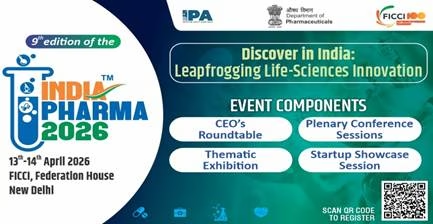
NEW DELHI — On April 13, 2026, the Indian capital becomes the epicenter of global health diplomacy as the 9th Edition of India Pharma officially commences. Organized by the Department of Pharmaceuticals (DoP) and the Federation of Indian Chambers of Commerce & Industry (FICCI), the two-day summit serves as a high-stakes roadmap for an industry currently valued at US$50 billion and surging toward a US$130 billion target by 2030.
Under the theme “Discover in India: Leapfrogging Life-Sciences Innovation,” this year’s conference signals a seismic shift. For decades, India has been the “Pharmacy of the World,” celebrated for providing 20% of the global supply of affordable generic medicines. Now, the nation is pivoting from a volume-led manufacturing model to a value-driven innovation leader, aiming to discover the breakthrough drugs and biologics of the future.
From Generics to Breakthroughs: The Core Strategy
The 2026 conference highlights a critical evolution in India’s pharmaceutical narrative. While generic drugs have saved millions of lives globally by lowering costs, they typically offer lower profit margins.
“The goal is to increase the discovery of biological and chemical drugs within India and conduct their clinical trials here,” stated Arunish Chawla, Secretary of the Department of Pharmaceuticals, during a pre-conference briefing. “Newly discovered drugs offer a monopoly and exclusivity, tapping into a massive global market with much higher value addition.”
Central to this year’s agenda is the CEOs’ Roundtable, a flagship forum where industry titans engage in direct dialogue with government regulators. Key topics include:
-
Regulatory Agility: Reducing the time it takes for a drug to move from discovery to market.
-
Biologics and Advanced Therapies: Capitalizing on the new Biopharma SHAKTI initiative, a $10,000 crore (US$1.2 billion) program designed to position India as a global biopharmaceutical hub.
-
Digital Transformation: Integrating Artificial Intelligence (AI) and machine learning into drug discovery to accelerate clinical trial timelines.
The Biotech Boom: A $300 Billion Vision
Parallel to the pharmaceutical track is the rapid expansion of India’s biotechnology sector. Currently ranked 3rd in the Asia-Pacific region, India’s bioeconomy is valued at approximately US$137 billion. However, under the BioE3 Policy (Biotechnology for Economy, Environment, and Employment), the government has set an ambitious target of US$300 billion by 2030.
This growth is driven by the “Discover in India” mindset, focusing on high-value segments like biosimilars, gene therapies, and sustainable biomanufacturing. By 2026, experts predict that India will define reference standards for emerging markets across Asia, Africa, and Latin America, particularly in the realm of medical devices and imaging technology.
What This Means for Patients and Consumers
For the average consumer, India’s leap into innovation isn’t just about economic statistics; it’s about access and affordability.
-
Lower Costs for Advanced Treatments: As India develops domestic biologics and biosimilars (complex medicines used for cancer and autoimmune diseases), the cost of these life-saving treatments is expected to drop significantly.
-
Clinical Trial Access: By fostering a robust clinical trial ecosystem, Indian patients may gain earlier access to experimental therapies for rare diseases and chronic conditions.
-
Sovereign Health Security: Strengthening the domestic supply chain for Active Pharmaceutical Ingredients (APIs) protects the public from global supply disruptions, ensuring that essential medicines remain available on pharmacy shelves.
“India’s healthcare evolution is no longer about experimentation. It is about discipline, scale, and category leadership,” says Dr. Vikram Singh, a healthcare policy analyst not involved in the conference planning. “The structural shift toward becoming a global CDMO (Contract Development and Manufacturing Organisation) hub means the world’s most advanced medicine will soon be ‘Invented in India’ as much as it is ‘Made in India’.”
Challenges and Counterarguments: The Road Ahead
Despite the optimism, the path to a US$130 billion industry is not without hurdles. Industry observers point to several limitations:
-
R&D Investment: While the shift toward innovation is clear, India’s private sector spending on Research and Development (R&D) still lags behind global giants like the U.S. and Switzerland.
-
Intellectual Property (IP): Strengthening IP frameworks remains a point of contention between domestic firms and international stakeholders, requiring delicate policy balancing to protect innovation without sacrificing drug affordability.
-
Supply Chain Vulnerabilities: Recent global crises have exposed a continued reliance on imported raw materials. Conference sessions on “Unlocking India’s CRDMO Potential” will address how to build a more resilient, self-reliant supply chain.
Public Health Implications
The 9th India Pharma Conference is more than an industry trade show; it is a declaration of intent. Through initiatives like Vaccine Maitri, which supplied nearly 300 million doses to 100 countries, India has already proved its reliability as a global public health partner.
As the 2026 summit unfolds in New Delhi, the focus is now on ensuring that the next generation of medical breakthroughs are “Discovered in India,” bridging the gap between cutting-edge science and global healthcare equity.
Reference Section
Peer-Reviewed & Statistical Sources:
-
Press Information Bureau (PIB): “Backgrounder: India Pharma Conference” (April 10, 2026).
Medical Disclaimer:
This article is for informational purposes only and should not be considered medical advice. Always consult with qualified healthcare professionals before making any health-related decisions or changes to your treatment plan. The information presented here is based on current research and expert opinions, which may evolve as new evidence emerges.