 0
0
 0
0
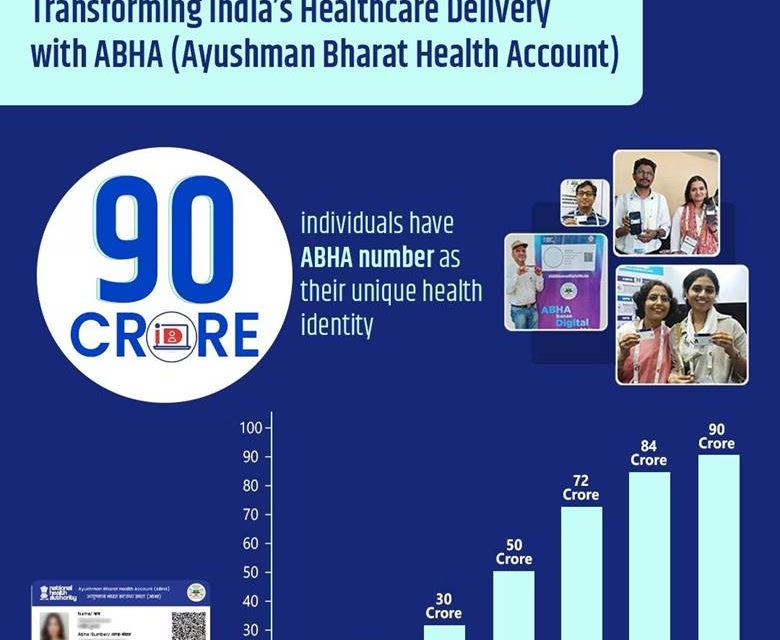
NEW DELHI — In what public health experts are calling a watershed moment for global digital health infrastructure, India’s Ayushman Bharat Digital Mission (ABDM) has officially crossed the landmark milestone of 90 crore (900 million) Ayushman Bharat Health Accounts (ABHAs). Announcing the achievement on May 30, 2026, the National Health Authority (NHA) revealed that the digital health identity ecosystem has grown more than sixfold since its inception in 2021, laying the groundwork for a fully interoperable, paperless healthcare delivery system across the world’s most populous nation.
The ABHA system assigns a unique 14-digit digital health identification number to citizens. This identifier allows individuals to securely link, store, and share their medical history—including prescriptions, diagnostic reports, and vaccination certificates—across participating hospitals, clinics, and insurance providers nationwide. By establishing a unified digital network, the initiative aims to eliminate the fragmentation of medical data, reduce diagnostic redundancies, and ensure continuity of care regardless of a patient’s geographic location.
Exponential Growth and Regional Leadership
The trajectory of ABHA enrollment underscores one of the fastest digital public infrastructure rollouts in history. According to data released by the Press Information Bureau (PIB), cumulative ABHA creation stood at 14.7 crore in late 2021. The figures steadily climbed to 30.4 crore in 2022, 50.6 crore in 2023, 72.2 crore in 2024, and 84.5 crore in 2025, before breaching the 90 crore threshold this month.
[ABHA Account Growth (2021 - 2026 in Crores)]
2021: 14.7
2022: 30.4
2023: 50.6
2024: 72.2
2025: 84.5
2026: 90.0+
A demographic and geographic breakdown of the data reveals strong federal participation:
-
State Leadership: Uttar Pradesh leads the country in absolute numbers, accounting for over 15.3 crore accounts. Rajasthan and Maharashtra follow closely, both crossing the 7.1 crore mark, with Bihar (6.3 crore) and West Bengal (5.9 crore) rounding out the top five.
-
Population Saturation: High saturation levels relative to local populations have been achieved in several regions. Smaller Union Territories like the Andaman and Nicobar Islands, Ladakh, and Lakshadweep have reached full 100% saturation. Among larger states, Andhra Pradesh leads with 98.5% saturation, followed closely by Odisha at 91.9%.
“The creation of over 90 crore ABHAs reflects the growing participation of citizens, states, and ecosystem partners,” said Dr. Sunil Kumar Barnwal, CEO of the National Health Authority, in a public statement. “ABHA is an important step towards empowering citizens with secure, consent-based access to their own health information, reducing dependence on physical records and supporting a more seamless healthcare delivery system.”
Bridging the Gender Divide in Digital Health
Historically, women in developing economies have faced significant barriers to accessing both digital technology and formal healthcare systems. However, the latest ABDM metrics indicate an encouraging trend toward inclusive growth: women constitute 49.75% of all ABHA cardholders—nearly half of the total database.
Public health analysts emphasize that this near-equal split is critical for maternal and child healthcare. When a woman possesses a digital longitudinal health record (a lifetime tracking of medical history), essential services such as prenatal checkups, immunization schedules, and nutritional interventions can be monitored systematically. This reduces the risk of critical medical data being lost when patients move between rural primary health centers and tertiary care municipal hospitals.
Understanding the Technical Architecture
To appreciate what this milestone means for daily health decisions, it helps to understand the underlying framework. The ABDM operates much like a secure digital pipeline. Rather than storing actual medical records on a centralized government server, the system acts as an indexer.
The core ecosystem consists of several interconnected components:
-
Health Facility Registry (HFR) & Healthcare Professionals Registry (HPR): Verified directories of clinics, hospitals, doctors, and nurses, ensuring that patients interact with legitimate entities.
-
Health Information Exchange and Consent Manager (HIE-CM): The security gatekeeper. A hospital cannot view a patient’s past medical records from another clinic unless the patient explicitly grants permission via an SMS or app-based consent prompt.
-
National Health Claims Exchange (NHCX): A digital portal designed to standardize and speed up the processing of health insurance claims, reducing paperwork delays for patients during discharge.
Expert Perspectives: Opportunities and Challenges
While government authorities celebrate the 90 crore milestone, independent global health experts urge a balanced interpretation of the metrics. Industry observers note that while account creation is a massive administrative success, the true measure of public health impact lies in active utilization.
“An account exists, but is it being actively linked to daily medical encounters?” poses Dr. Arvinder Singh, a New Delhi-based health systems researcher who is not affiliated with the NHA. “The landmark is historic, but we must look closely at the utilization gap. Millions of accounts have been generated automatically through integrations with welfare schemes or vaccine registries. The next critical step is ensuring that rural clinics and private practitioners are actively uploading diagnostic data to these accounts.”
Independent technical evaluations also highlight ongoing structural challenges that must be addressed to maximize the system’s utility:
-
The Private Sector Integration Gap: While public hospitals have widely adopted the system, large portions of India’s highly fragmented private healthcare sector—which manages a substantial percentage of outpatient care—remain slow to integrate their proprietary Electronic Health Record (EHR) software with the ABDM network.
-
Digital Literacy Barriers: For a consumer, managing consent through an app requires a baseline level of digital literacy. In rural pockets, patients frequently rely on frontline health workers (such as ASHA workers) to manage their digital profiles, raising practical questions about privacy boundaries and data stewardship.
-
Infrastructure Deficits: Interoperable digital health relies entirely on steady electricity and high-speed internet. In remote primary health centers, connectivity blackouts can stall the digital verification process, forcing a reliance on traditional paper documents.
What This Means for Individual Health Decisions
For the average consumer, the deepening of the ABDM ecosystem marks a gradual shift away from the burden of maintaining physical medical folders. When fully utilized, an ABHA account allows a patient to walk into an emergency room anywhere in the country without needing to remember previous drug dosages, allergies, or past surgical histories.
Physicians can make safer, faster clinical decisions when they have immediate access to a patient’s verified medical history. Furthermore, it prevents the common and expensive issue of patients needing to repeat blood tests or CT scans simply because they misplaced their physical copies.
As India moves closer to universal digital health coverage, the operational focus is expected to shift from scale to deep system integration. For the 90 crore account holders, the eventual success of the platform will depend on how securely, smoothly, and frequently those 14-digit numbers are used at the point of care.
Reference Section
-
Statistical Dataset: National Health Authority (NHA), Ministry of Health and Family Welfare, Government of India. Press Information Bureau (PIB) Delhi. Ayushman Bharat Digital Mission Crosses Landmark Milestone of 90 Crore ABHA Accounts. Published May 30, 2026.
Medical Disclaimer: This article is for informational purposes only and should not be considered medical advice. Always consult with qualified healthcare professionals before making any health-related decisions or changes to your treatment plan. The information presented here is based on current research and expert opinions, which may evolve as new evidence emerges.