 0
0
 0
0
For millions of individuals and couples navigating the emotionally demanding terrain of infertility, the decision of how to proceed with medical intervention often reduces to a choice between two primary treatments: Intrauterine Insemination (IUI) and In Vitro Fertilization (IVF). While both procedures share the ultimate goal of achieving a healthy pregnancy, reproductive endocrinologists emphasize that they represent fundamentally distinct clinical approaches, differing significantly in complexity, financial cost, physical strain, and success rates.
According to data from public health agencies, roughly one in six people worldwide experiences infertility in their lifetime. As diagnostic tools improve and family-building decisions evolve, understanding the nuanced differences between IUI and IVF has become crucial for patients seeking to optimize their treatment plans without incurring unnecessary physical or financial stress.
What the Treatments Involve: Internal vs. External Fertilization
The fundamental distinction between IUI and IVF lies in where fertilization takes place.
-
-
Intrauterine Insemination (IUI): Often termed “artificial insemination,” IUI is a minimally invasive outpatient procedure. Concentrated, washed sperm is deposited directly into the patient’s uterus via a thin catheter around the precise time of ovulation. The goal is to give high-quality sperm a head start by bypassing the cervix and shortening the distance to the fallopian tube, where natural fertilization must still occur.
-
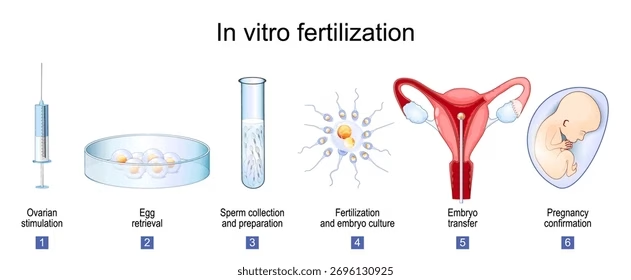
In Vitro Fertilization (IVF): In contrast, IVF is a multi-step assisted reproductive technology (ART) where fertilization occurs entirely outside the human body. Eggs are maturely stimulated using injectable hormone medications, surgically retrieved under mild anesthesia, and combined with sperm in a specialized embryology laboratory. Once fertilized, the resulting embryos are cultured and monitored before one or more are selected for transfer directly into the uterus.
-
IVF requires significant laboratory oversight at each stage—from ovarian stimulation to embryo culture—whereas IUI simply facilitates the journey of sperm to egg inside the reproductive tract.
Why Doctors Recommend IUI as a First-Line Step
Clinicians frequently recommend starting with IUI for patients with specific, mild fertility challenges. It is often the preferred choice when addressing:
-
Mild male factor infertility (such as slightly reduced sperm count or motility)
-
Unexplained infertility in younger patients
-
Cervical factor issues (such as thick cervical mucus blocking sperm)
-
Ovulatory disorders that respond well to mild fertility medications
-
Single women or same-sex couples utilizing donor sperm
“IUI serves as a bridge between conservative lifestyle adjustments or ovulation induction and complex high-tech procedures,” notes Dr. Sarah Jenkins, a reproductive endocrinologist not affiliated with the primary clinical trials. “It offers an entry point that is significantly less physically demanding and costs a fraction of an IVF cycle, making it a very logical first choice when tubal factor disease is ruled out.”
Beyond lower costs, IUI requires fewer clinic visits, involves less intensive medication protocols, and eliminates the surgical risks associated with egg retrievals under anesthesia.
When IVF Becomes the Preferred or Necessary Option
Despite its higher complexity and cost, IVF is often recommended as the initial treatment when specific clinical factors render IUI unlikely to succeed. Key clinical indicators for moving directly to IVF include:
-
Tubal Factor Infertility: Blocked, damaged, or absent fallopian tubes prevent natural fertilization.
-
Severe Male Factor Infertility: Significant deficits in sperm count, movement, or shape require specialized techniques like Intracytoplasmic Sperm Injection (ICSI).
-
Advanced Reproductive Age: Patients over age 38, where egg quantity and quality decline more rapidly, benefit from the higher per-cycle success rates of IVF.
-
Severe Endometriosis: Structural changes or inflammation caused by tissue growth outside the uterus often impair natural fertilization.
-
Preimplantation Genetic Testing (PGT): Patients carrying genetic conditions who need embryo screening before implantation.
A common management strategy across fertility centers is to attempt 3 to 4 cycles of IUI. If pregnancy is not achieved within that window, guidelines suggest transitioning to IVF to prevent unnecessary emotional burden and age-related decline in ovarian reserve.
Comparing Treatment Pathways
| Factor | Intrauterine Insemination (IUI) | In Vitro Fertilization (IVF) |
| Site of Fertilization | Internal (Inside the fallopian tube) | External (Inside an embryology lab) |
| Average Per-Cycle Success | Typically 8% to 20% (varies by age/diagnosis) | Typically 40% to 55%+ for under age 35 |
| Invasiveness | Minimal (Catheter placement in clinic) | Moderate to High (Injectable meds, minor surgery) |
| Treatment Timeline | Approximately 2 weeks per cycle | 4 to 6 weeks per complete cycle |
| Primary Risks | Multiple gestation (if using oral/injectable meds) | Ovarian Hyperstimulation Syndrome (OHSS), multiples |
Success Rates and Public Health Implications
Success rates in reproductive medicine can be complex to interpret. While marketing materials frequently spotlight high cumulative success numbers, experts caution patients to evaluate per-cycle statistics tailored to their age and specific diagnosis.
While IUI generally yields single-digit to low double-digit success rates per cycle, IVF provides much higher success per attempt—particularly for younger individuals. However, evaluating treatments solely on per-cycle success ignores crucial public health factors, including equity, access, and total cost of care.
Because IVF is expensive and often under-covered by insurance policies worldwide, financial burden remains a significant barrier. This disparity often forces couples to undergo multiple low-yield IUI cycles when IVF is clinically indicated, or prevents access to fertility care altogether.
From a public health standpoint, medical guidelines strongly emphasize early diagnostic evaluations. Seeking a complete fertility workup after 12 months of unsuccessful attempts (or 6 months for individuals aged 35 and older) allows patients to select the correct treatment pathway early, reducing emotional distress and unnecessary financial strain.
Key Questions for Patients to Ask Their Specialist
Before deciding on a treatment plan, patients are encouraged to discuss the following with their medical team:
-
Based on our diagnostic evaluation, what is our estimated success rate per cycle for IUI versus IVF?
-
How many cycles of IUI do you recommend before we consider transitioning to IVF?
-
What are the complete out-of-pocket costs, including medications and potential lab procedures?
-
Are there specific risk factors, such as multiple gestation or medication side effects, unique to my treatment plan?
Ultimately, there is no universally “correct” choice between IUI and IVF. The ideal approach balances medical indicators, patient age, personal timeline, financial resources, and emotional readiness.
Medical Disclaimer
This article is for informational purposes only and should not be considered medical advice. Always consult with qualified healthcare professionals before making any health-related decisions or changes to your treatment plan. The information presented here is based on current research and expert opinions, which may evolve as new evidence emerges.
References
- https://www.thehealthsite.com/pregnancy/world-ivf-day-2026-ivf-or-iui-expert-explains-which-fertility-treatment-is-right-for-you-1334458/