 0
0
 0
0
HYDERABAD — India’s ongoing structural pivot toward an integrated, three-tier public healthcare model reached a critical operational milestone on July 9, 2026. Union Minister of Health and Family Welfare, Shri Jagat Prakash Nadda, led a high-level review of the All India Institute of Medical Sciences (AIIMS) Bibinagar, confirming that the mega-facility is approximately 87.4% complete, with an expenditure of ₹902 crore out of its sanctioned budget of ₹1,110.55 crore.
Originally established under Phase-VII of the Pradhan Mantri Swasthya Suraksha Yojana (PMSSY) in 2019, physical construction on the retrofitted site commenced in June 2022. The review reveals an institutional shift that aims to directly address the country’s historic urban-rural medical imbalances.
From Standalone Flagships to an Integrated Network
The physical expansion of the AIIMS network marks an aggressive departure from the 20th-century model of centralized super-specialty care. For decades, the sole AIIMS in New Delhi shouldered an unsustainable national caseload. According to ministry statements, the country has scaled its tertiary medical framework from that single institution to 23 distinct AIIMS campuses across various states, with 18 currently fully operational.
      [ Tertiary Care ] -> 23 AIIMS Campuses (18 Operational)
             ▲
             │
     [ Secondary Care ] -> 820 Medical Colleges & District Hospitals
             ▲
             │
      [ Primary Care ]  -> 1.85 Lakh Ayushman Arogya Mandirs
This expansion forms the apex of what the ministry terms a uniform, integrated health framework. In this model, high-end tertiary institutes are dynamically tied to primary and secondary tiers. At the grassroots level, 1.85 lakh Ayushman Arogya Mandirs (health and wellness centers) provide initial screening and preventive care to nearly 1.5 billion people. Concurrently, secondary capacity has expanded via an increase in medical colleges—growing from 387 in 2014 to 820 in 2026, according to recent National Medical Commission records.
Inside the Operational Metrics of AIIMS Bibinagar
The dynamic scaling of the facility highlights its current capacity across education, specialized clinical care, and regional health tech integration:
-
Daily Clinical Footfall: The outpatient departments (OPDs) span all major medical specialties, handling an average of 1,800 patients daily.
-
Inpatient Capacity: The facility houses 250 active inpatient beds, supported by newly opened emergency medicine departments. Advanced diagnostic tools—including high-field Magnetic Resonance Imaging (MRI), Computed Tomography (CT), and Dual-energy X-ray Absorptiometry (DEXA) densitometry—are fully operational.
-
Medical Cohort: The academic block supports 902 enrolled students. The core curriculum spans undergraduate MBBS cycles, postgraduate programs across 24 MD medical disciplines, five super-specialty DM/MCh avenues, and specialized B.Sc. and M.Sc. nursing tracks.
-
Digital Penetration: Approximately 90% of all incoming patients are formally registered via the Ayushman Bharat Digital Mission (ABDM) pathway. Teleconsultations through the e-Sanjeevani platform now actively extend specialized oversight across all 33 districts of Telangana.
                AIIMS BIBINAGAR CURRENT METRICS (JULY 2026)
  ┌─────────────────────────────────────┬─────────────────────────────────────┐
  │         PATIENT CARE CAPACITY       │         ACADEMIC INFRASTRUCTURE     │
  ├─────────────────────────────────────┼─────────────────────────────────────┤
  │ • 1,800 Daily Outpatient Footfall   │ • 902 Enrolled Medical/Nursing Stud.│
  │ • 250 Active Inpatient Beds         │ • 24 Active MD Specialty Disciplines│
  │ • 90% Patients Logged via ABDM      │ • 5 DM/MCh Super-Specialty Tracks  │
  └─────────────────────────────────────┴─────────────────────────────────────┘
The campus is also carving out a specialized footprint in translational clinical research, securing ₹64 crore across 129 distinct research projects. Prominent among these is a joint development venture with the Defence Research and Development Organisation (DRDO) targeting the manufacture of ‘ADIDOC’—a highly specialized carbon-impregnated lower-limb prosthetic device intended to lower costs for rehabilitative mobility care.
Addressing the Tertiary Staffing Bottleneck
Despite rapid structural builds, experts argue that physical infrastructure is only as robust as the human capital operating within it. During his address, Minister Nadda specifically emphasized the need to optimize clinical staffing ratios. The facility currently operates with 132 designated faculty members and 133 senior residents.
To prevent the administrative bottlenecks that frequently stall medical recruitments, the Health Ministry directed the institute’s Standing Selection Committee to scale up its evaluations to at least four sessions annually. Furthermore, the ministry proposed structured, cyclical faculty exchange protocols across older, established AIIMS campuses alongside the regular induction of highly qualified visiting specialists to mitigate transient departmental deficits.
Community-Led Public Health Integration
A notable element of the Bibinagar blueprint is its direct immersion into regional community health ecosystems. The institution has formally adopted six rural villages, executing 547 mobile medical camps. Combined with dedicated Rural Health Training Centers (RHTCs) and Urban Health Training Centers (UHTCs), these initiatives have provided direct medical care to 66,148 distinct patients.
To reinforce health literacy outside the clinic, the campus leverages a localized community radio network with a 10-kilometer broadcast radius. The platform has transmitted 43 unique evidence-based educational tracks covering essential topics such as maternal health, childhood vaccination schedules, and metabolic disease management.
Structural Adaptations and Project Timelines
The remaining 12.6% of the construction blueprint carries specific engineering complexities. Unlike greenfield projects built entirely from scratch, AIIMS Bibinagar represents a structural adaptation of pre-existing state medical infrastructure originally built in 2008.
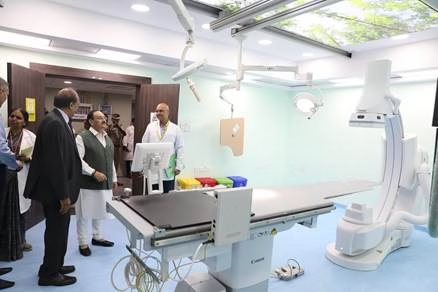
Bringing these older structures up to strict modern tertiary medical standards requires extensive retrofitting, reinforcements, and specialized layout modifications. While structural completions for Blocks C and F, the Academic Core, the AYUSH building, and student housing are fully accounted for, work is currently focused on finishing the high-precision Radiotherapy wing and the main Operation Theatre (OT) surgical complex. The entire facility is projected to be fully completed by December 2026.
The Broader Public Health Perspective
Independent health system analysts emphasize that physical completion is merely step one. The long-term success of the facility depends on its ability to retain top-tier medical talent and maintain equipment lifecycles.
“Expanding physical buildings to 23 campuses is an essential step to decentralize Indian healthcare, but the real test lies in maintaining consistent standards of clinical execution,” notes a senior healthcare policy consultant not involved with the review. “A premier institute requires decades to mature. Balancing high-volume public welfare demands under insurance schemes like Aarogyasri while simultaneously cultivating a world-class clinical research culture remains a complex institutional balancing act.”
As the December 2026 target for full operations approaches, the facility’s integration of digital patient records, regional community clinics, and specialized biomedical research plans will serve as an informative case study for India’s evolving healthcare system.
Reference Section
1. Official Government and Press Sources
-
Press Information Bureau (PIB) Delhi: Ministry of Health and Family Welfare. Union Health Minister Shri JP Nadda Reviews Progress of AIIMS Bibinagar, Hyderabad. Published July 9, 2026.
Medical Disclaimer: This article is for informational purposes only and should not be considered medical advice. Always consult with qualified healthcare professionals before making any health-related decisions or changes to your treatment plan. The information presented here is based on current research and expert opinions, which may evolve as new evidence emerges.