 0
0
 0
0
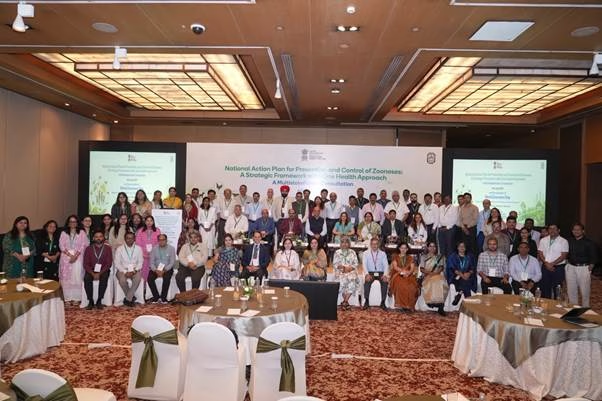
NEW DELHI — In a major bid to shield national health security from future pandemic-level threats, the Union Ministry of Health & Family Welfare convened a National Multistakeholder Consultation on the newly drafted National Action Plan for Prevention and Control of Zoonoses. Staged on World Zoonoses Day, the milestone gathering brought together senior leaders across human medicine, veterinary science, wildlife biology, and environmental sectors to hammer out a unified defense against illnesses that cross from animals to humans. Alongside the strategic blueprint, the government launched an emergency-ready Learning Resource Package covering 10 priority zoonotic diseases, supplemented by interactive e-learning modules designed to drastically improve early identification on the front lines.
A New Frontier for Disease Intelligence
Zoonotic diseases—pathogens that spread naturally between animals and humans—are no longer considered peripheral medical issues. According to the World Health Organization (WHO), roughly 60% of known human infectious diseases and 75% of newly emerging ones, including COVID-19, Mpox, and Ebola, trace their origins back to animal hosts.
With India’s dense human population, massive livestock economy, and expanding urban-wildlife interfaces, the country faces a persistent threat from spillover events. Addressing the convention, Dr. Rakesh Gupta, Additional Secretary to the Ministry of Health & Family Welfare, stressed that these illnesses present severe public health, animal health, and financial challenges.
   Global Pathogen Matrix (WHO Estimates)
┌──────────────────────────────────────────────────────────┐
│ ■ Human Illnesses with Animal Origins: 60%               │
│ ──────────────────────────────────────────────────────── │
│ ■ Emerging Infectious Threats: 75%                       │
└──────────────────────────────────────────────────────────┘
To counter this, Dr. Gupta announced a sweeping commitment to digital innovation and integrated surveillance via the Integrated Health Information Platform (IHIP 2.0). The impending National Action Plan is designed to provide a comprehensive roadmap, enabling states and union territories to draft customized regional action plans that match local ecological and agricultural realities.
Frontline Fortification: The 10 Priority Diseases
A core highlight of the consultation was the unveiling of a specialized technical educational bundle. The National One Health Programme for Prevention and Control of Zoonoses developed this suite to upgrade the diagnostic competencies of medical officers, veterinarians, and field-level public health staff.
The resource package specifically zeroes in on 10 priority zoonotic pathogens that have historically triggered localized outbreaks or present high epidemic risks within the country:
-
Viral Threats: Nipah virus disease, Crimean-Congo Haemorrhagic Fever (CCHF), Zika virus, and Mpox.
-
Bacterial and Parasitic Conditions: Anthrax, Brucellosis, Leptospirosis, and Scrub Typhus.
-
Persistent Public Health Emergencies: Rabies and Kyasanur Forest Disease (KFD, commonly known as monkey fever).
Prof. (Dr.) Ranjan Das, Director of the National Centre for Disease Control (NCDC), noted that expanding sentinel surveillance sites and relying on rapid data sharing are crucial to containing these outbreaks before they escape containment zones.
Understanding the “One Health” Paradigm
For decades, human healthcare and veterinary medicine operated in distinct silos. If a dairy cow fell ill with Brucellosis—a bacterial infection that causes reproductive failure in livestock and chronic, debilitating fevers in humans—the veterinary sector dealt with the animal, while human clinicians treated the patient, rarely sharing data in real time.
The One Health framework deliberately dismantles these boundaries, recognizing that human welfare is permanently linked to animal fitness and ecological stability.
       THE ONE HEALTH PARADIGM

          ┌───────────────┐
          │               │
          │ Human Health  │
          │               │
          └───────┬───────┘
                  │
         ┌────────┴────────┐
         │                 │
┌────────┴──────┐   ┌──────┴────────┐
│               │   │               │
│ Animal Health │   │ Environmental │
│               │   │    Health     │
└───────────────┘   └───────────────┘
“Sustained coordination among ministries is essential to turn the One Health approach from a conceptual framework into an active defense network,” emphasized Dr. Sujata Chaudhary, Additional Director General of Health Services. Delegates at the convention discussed leveraging artificial intelligence and digital disease intelligence to predict how shifts in climate patterns, rainfall, and deforestation might alter animal migrations and accelerate spillover risks.
Perspectives and Policy Balancing Acts
While public health professionals have widely praised the action plan, independent healthcare analysts warn that execution remains a monumental hurdle. Fulfilling the goals of IHIP 2.0 requires seamless communication between rural veterinary dispensaries and remote primary health centers, many of which still experience deficits in digital infrastructure and specialized staff.
“The introduction of standardized training resources is a massive step forward,” says Dr. Arati Vakil, an independent epidemiology consultant who was not involved in drafting the framework.
“However, paper-based policies face severe bottlenecks at the grass-roots level. A veterinary worker in an agricultural belt might spot a spike in livestock miscarriages, but if there isn’t an automated, penalty-free communication channel to alert local medical officers, the system breaks down. We must ensure local workers are incentivized, not penalized, for reporting potential outbreaks early.”
Furthermore, behavioral and socio-cultural practices present distinct containment challenges. For instance, managing Brucellosis requires shifting deeply ingrained consumer behaviors, such as the consumption of unpasteurized raw dairy in rural communities. Similarly, controlling Leptospirosis requires systemic improvements in urban sanitation and rodent control, which extend far beyond conventional medical interventions.
Actionable Tips for the Health-Conscious Citizen
While the government builds out macro-level defenses, public health experts emphasize that everyday individual actions remain the most effective barrier against zoonotic infections:
-
Consume Dairy Responsibly: Always boil milk thoroughly or consume certified pasteurized dairy products to avoid foodborne pathogens like Brucella.
-
Practice Strict Pet Hygiene: Ensure domestic dogs and cats receive timely rabies vaccinations. Seek immediate medical evaluation and post-exposure prophylaxis (PEP) if bitten or scratched by stray or wild mammals.
-
Prevent Vector Exposure: Use insect repellent, clear stagnant water around residences, and wear long sleeves during agricultural work to minimize exposure to vectors carrying Scrub Typhus, Zika, or KFD.
Medical Disclaimer
This article is for informational purposes only and should not be considered medical advice. Always consult with qualified healthcare professionals before making any health-related decisions or changes to your treatment plan. The information presented here is based on current research and expert opinions, which may evolve as new evidence emerges.
Reference Section
Government & Intergovernmental Source Materials
-
Press Information Bureau (PIB) Delhi: “Union Ministry of Health & Family Welfare organized National Multistakeholder Consultation on National Action Plan for Prevention and Control of Zoonoses on the occasion of World Zoonoses Day,” Ministry of Health and Family Welfare, Government of India. Published July 6, 2026. [PRID: 2281860].