 0
0
 0
0
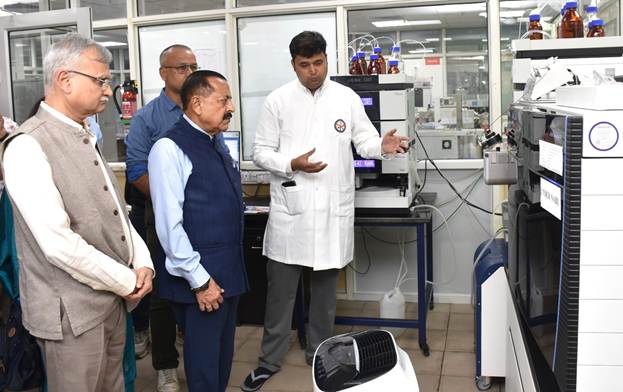
VARANASI — In a move to democratize high-end scientific research and accelerate medical breakthroughs, Union Minister Dr. Jitendra Singh visited the Banaras Hindu University (BHU) on May 10, 2026, to review the Sophisticated Analytical & Technical Help Institute (SATHI). Supported by the Department of Science & Technology (DST), this ₹72-crore facility has emerged as a critical national hub, providing local startups and medical researchers with the kind of advanced instrumentation typically reserved for elite global institutions.
The visit underscores a shift in India’s scientific strategy: moving away from “siloed” research and toward a shared-infrastructure model that empowers small-scale innovators, particularly in the life sciences and pharmaceutical sectors.
A National Hub for Discovery
The SATHI-BHU facility functions as a multidisciplinary nerve center. Dr. Jitendra Singh emphasized that the DST is aggressively expanding these research support systems to ensure that advanced technology is no longer the exclusive domain of a few premier institutes.
“Initiatives such as SATHI are helping build a strong ecosystem for research, innovation, and start-ups,” Dr. Singh stated during his inspection. “By strengthening scientific infrastructure in universities, we are making India globally competitive in emerging technologies and advanced research domains.”
For the healthcare sector, this means faster transition times from a laboratory concept to a tangible medical product. Historically, Indian medical startups often faced a “bottleneck” where the lack of expensive imaging and testing equipment stalled development. SATHI aims to eliminate that barrier.
The “High-Tech” Arsenal: What’s Inside?
To the layperson, the equipment housed within BHU might sound like science fiction, but for a doctor or a drug developer, these tools are the difference between guesswork and precision.
Key facilities inspected by the Minister include:
-
Super-Resolution Confocal Microscopy: Allows researchers to view live cells with unprecedented clarity, essential for understanding how new drugs interact with human tissue at a molecular level.
-
High-Resolution Accurate Mass Spectrometry (HRAMS): Used to identify unknown substances in biological samples, crucial for toxicology and the development of new vaccines.
-
Advanced NMR Spectroscopy: A cornerstone for pharmaceutical development, helping scientists map the structure of complex organic molecules.
-
Clean Room Facilities: Controlled environments that limit pollutants, necessary for the fabrication of medical devices and semiconductors.
Since its inception, the center has served nearly 1,100 users from across academia and industry, processing over 30,000 samples. This volume suggests a high demand for high-tier analytical services that were previously inaccessible to small and medium enterprises (MSMEs).
Implications for Public Health
While SATHI is a “technical” facility, its impact is deeply personal for the general public. Access to these tools supports:
-
Affordable Drug Development: By providing local pharmaceutical companies with the infrastructure to test and validate their products, the cost of R&D decreases—a saving that can eventually be passed down to the patient.
-
Precision Medicine: The ability to perform live-cell imaging and isotope analysis allows for the development of treatments tailored to specific genetic profiles.
-
Food and Environmental Safety: Beyond medicine, the facility analyzes food contaminants and environmental pollutants, directly impacting community health and nutrition.
“Modern medicine is no longer just about the stethoscope; it’s about the molecule,” says Dr. Arindam Ghosh, a biotech consultant not affiliated with the BHU project. “Facilities like SATHI allow Indian researchers to validate their work to international standards, meaning Indian-made medical innovations can be trusted globally.”
A Sustainable Model for the Future
One of the most notable aspects of SATHI-BHU is its operational model. It functions as a Section 8 company—a non-profit structure that allows it to operate with the agility of a private firm while remaining embedded in the university ecosystem. The facility has also achieved NABL accreditation, ensuring that the data generated meets the highest international quality standards.
However, some experts caution that infrastructure is only half the battle. “While the hardware is world-class, the long-term success of SATHI depends on the ‘brainware’—the continued training of technicians who can interpret this complex data,” notes a spokesperson from a prominent health advocacy group. BHU has addressed this by training around 1,000 researchers through 60 short-term programs, but maintaining this momentum is vital.
What This Means for You
For the health-conscious consumer, the growth of SATHI-BHU signals a more robust domestic healthcare industry. It means that the “Made in India” label on a medical device or a specialized medication is backed by the same level of rigorous, high-tech scrutiny found in the United States or Europe.
As India moves toward the vision of Atmanirbhar Bharat (Self-Reliant India), the democratizing of science ensures that the next medical breakthrough could come from a small lab in a regional university, rather than just a multinational giant.
Reference Section
Source Material:
-
Press Information Bureau (PIB): “Union Minister Dr Jitendra Singh takes stock of interdisciplinary facility ‘SATHI’ set up at BHU,” published May 10, 2026. [Ref: 5:31PM by PIB Delhi].
Medical Disclaimer: This article is for informational purposes only and should not be considered medical advice. Always consult with qualified healthcare professionals before making any health-related decisions or changes to your treatment plan. The information presented here is based on current research and expert opinions, which may evolve as new evidence emerges.