 0
0
 0
0
Read Time:4 Minute, 59 Second
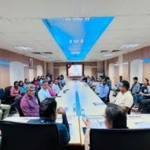
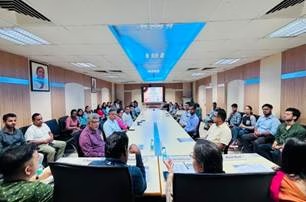
NEW DELHI — In an era where online health rumors and misinterpreted research can directly alter medical outcomes, the CSIR-National Institute of Science Communication and Policy Research (CSIR-NIScPR) concluded a two-day national skill training course titled “Science Communication and Emerging Trends” in New Delhi. Held under Phase III of the CSIR Integrated Skill Initiative, the program brought together 30 selected researchers, media professionals, academic scholars, and industry leaders from across India to advance the practice of evidence-based science and medical reporting. The intensive program addressed an urgent challenge in modern public health: translating complex biomedical research into clear, actionable, and ethical health messages for the public.
Mastering Emerging Tools in Health and Science Communication
The two-day intensive workshop combined theoretical frameworks with practical, hands-on training tailored for the contemporary digital landscape. Participants engaged with multidisciplinary experts to explore how advanced digital tools—ranging from generative artificial intelligence (AI) to specialized data visualization—can be deployed responsibly to improve public health literacy.
Core Focus Areas of the Curriculum:
-
Audience-Centric & Behavioral Communication: Designing messages tailored to community health literacy levels and applying behavioral insights to promote healthy decision-making.
-
Multimedia Content Development: Hands-on instruction in crafting educational infographics, short-form video content (reels), and health podcasts designed to demystify clinical terminology.
-
AI Integration and Data Ethics: Leveraging AI applications for editorial workflows while maintaining factual accuracy, mitigating algorithmic bias, and avoiding automated misinformation.
-
Social Media & Risk Communication: Managing public health communications during outbreaks, epidemics, and medical controversies.
To quantify the workshop’s impact, program coordinators administered pre- and post-training evaluation surveys. Preliminary findings showed a notable increase in participants’ competency regarding digital media tools, critical appraisal of peer-reviewed literature, and ethical frameworks in journalism.
Expert Perspectives on Credibility and Digital Ethics
Inaugurating the event, Dr. Geetha Vani Rayasam, Director of CSIR-NIScPR, stressed that the modern information ecosystem demands both technological speed and unwavering scientific rigor.
“Responsible science communication is no longer just about disseminating information; it is about building public trust,” Dr. Rayasam stated during her opening address. “Digital technologies and artificial intelligence offer unprecedented reach, but they must be anchored in scientific integrity to ensure that health knowledge remains credible, transparent, and impactful.”
Highlighting the societal necessity of the initiative, Mr. Mukesh A. Pund, Head of the Training Division at CSIR-NIScPR, emphasized that translating research out of specialized laboratories is a vital pillar of public wellbeing.
“Bridging the gap between scientific research and society is essential for informed decision-making,” noted Mr. Pund. “By equipping communicators with modern tools, we empower them to translate intricate medical data into clear guidance that directly benefits communities.”
The program featured lectures from leading academicians and science communicators, including Dr. V. V. Binoy (National Institute of Advanced Studies, Bengaluru), Dr. H. S. Sudhira (Director, Gubbi Labs), Dr. Hemansi and Ms. Priyanka (Ashoka University), alongside course coordinator Dr. Paramananda Barman and co-coordinator Dr. Meher Wan. Event coordination was managed by Ms. Meetali Bharti (Nodal Principal Investigator) and Mr. Salim Ansari (Co-PI).
Context: The Public Health Risk of Misinformation
The initiative comes at a critical time for global public health. According to the World Health Organization (WHO), the rapid spread of health misinformation—often referred to as an “infodemic”—can lead to delayed medical treatment, vaccine hesitancy, and the widespread adoption of unverified home remedies or predatory wellness products.
                                  INFORMATIONAL PIPELINE

  [ Academic Research ]  --->  [ Science Communicators ]  --->  [ Informed Public ]
  Peer-reviewed trials         Ethical translation, AI         Evidence-based health
  & medical breakthroughs      verification & clear media      decisions & trust
In India, where mobile internet access reaches hundreds of millions of people across varied literacy levels, short-form digital media frequently reaches audiences faster than official public health guidance. When health reports lack nuance—such as confusing preliminary in vitro studies with human clinical trials—the public can be misled into unsafe health decisions.
By institutionalizing formal training under the CSIR Integrated Skill Initiative, CSIR-NIScPR aims to build a national workforce capable of vetting scientific literature, contextualizing statistical risk, and creating engaging, verified health communications.
Public Health Implications and Daily Application
For patients and health-conscious consumers, the downstream benefits of trained science communicators are significant:
-
Clear Risk Contextualization: Instead of dramatic headlines declaring “miracle cures” or “deadly threats,” trained communicators explain absolute risk versus relative risk, helping readers weigh real medical trade-offs.
-
Identification of False Claims: Consumers equipped with clear infographics and verified health podcasts can better evaluate popular social media wellness trends against rigorous scientific consensus.
-
Empowered Patient-Doctor Dialogues: When complex medical guidelines are translated accurately, patients gain the language needed to ask informed questions during routine consultations.
Limitations and Future Challenges
While the CSIR-NIScPR initiative represents a significant step forward, experts note several ongoing structural challenges:
-
Capacity Constraints: Training 30 participants per workshop provides high-quality, hands-on instruction, but scaling this model across a country with over 1.4 billion people requires sustained decentralization through regional academic centers.
-
The Pace of AI Development: As AI tools evolve to generate ultra-realistic media, science journalists must continuously update their technical verification toolkits to detect automated deepfakes and hallucinated clinical citations.
-
Commercial Sensationalism: Communicators often face commercial pressure from media outlets to publish click-driven headlines, which can conflict with the nuanced, measured nature of scientific reporting.
Addressing these challenges will require ongoing collaboration between research institutions, public health agencies, and mainstream news organizations to incentivize accurate, patient-first health journalism.
Medical Disclaimer
Medical Disclaimer: This article is for informational purposes only and should not be considered medical advice. Always consult with qualified healthcare professionals before making any health-related decisions or changes to your treatment plan. The information presented here is based on current research and expert opinions, which may evolve as new evidence emerges.
References
-
Press Information Bureau (PIB), Government of India. (2026, August 6). CSIR-NIScPR Organised Skill Training Course on “Science Communication and Emerging Trends”. Ministry of Science & Technology, Delhi.


Happy
0 %

Sad
0 %

Excited
0 %

Sleepy
0 %

Angry
0 %

Surprise
0 %