 0
0
 0
0
Read Time:7 Minute, 21 Second
TAIPEI, Taiwan — Simple, low-tech assessments of balance, agility, and lower-body strength may serve as powerful predictors of longevity in older adults, rivaling or even exceeding traditional cardiorespiratory fitness evaluations, according to a landmark nationwide study published in JAMA Network Open.
Researchers tracked more than 13,000 Taiwanese adults aged 65 and older over a seven-year period after evaluating their physical capabilities across seven basic fitness domains. The findings reveal a striking correlation: individuals who scored in the top 20% for measures like single-leg balance, agility, and sitting-to-standing movement experienced up to a 55% reduction in all-cause mortality compared to their lowest-performing peers.
The study adds to a growing body of evidence suggesting that functional fitness—how effectively the neuromuscular system coordinates everyday movements—is a critical, yet often underutilized, marker of overall health and biological aging.
Evaluating the Seven Fitness Domains: Key Findings
The comprehensive study analyzed standardized physical fitness performance data collected from older adults across Taiwan between 2015 and 2016. During the average seven-year follow-up period, approximately 1,600 participants passed away.
To evaluate physical capacity, researchers measured performance across seven distinct domains: cardiorespiratory endurance, muscular strength, static balance, dynamic agility, and upper- and lower-body flexibility. After adjusting for potential confounding variables—including baseline health status, age, sex, and socioeconomic factors—the researchers identified significant mortality reductions across several key categories.
| Fitness Assessment Domain | Physical Test Method | Mortality Risk Reduction (Top vs. Bottom 20%) |
| Cardiorespiratory Fitness | Aerobic step/walk endurance test | 58% Lower Risk |
| Lower-Body Strength | Chair stand test (repeated sit-to-stand) | 55% Lower Risk |
| Static Balance | One-leg stance test (eyes open) | 50% Lower Risk |
| Agility & Dynamic Mobility | 8-foot “Up-and-Go” timed task | 41% Lower Risk |
| Composite Fitness Index | Combined score across all 7 domains | 39% Lower Risk |
When researchers combined all test parameters into a single composite fitness index, individuals in the highest performance tier maintained a 39% lower overall risk of death compared to those in the lowest tier. Notably, flexibility tests—such as the shoulder reach and seated forward reach—showed no statistically significant association with lifespan.
The Neuromuscular Axis: Why Balance and Agility Dictate Lifespan
While aerobic capacity has long been considered the “gold standard” of physical longevity markers, experts point out that balance and agility require a complex, highly integrated biological infrastructure.
Executing a single-leg stand or rapidly navigating an obstacle course relies on real-time coordination between the central nervous system, inner ear vestibular mechanisms, visual feedback, sensory proprioceptors in the joints, and muscular motor units. As biological aging progresses, subtle declines in neurological processing speed or muscle mass (sarcopenia) show up early as balance instabilities or reduced agility.
       [ Central Nervous System & Brain Processing ]
                          │
         ┌────────────────┴────────────────┐
         ▼                                 ▼
[ Sensory Inputs ]               [ Musculoskeletal System ]
• Vestibular (Inner Ear)         • Lower-Body Muscle Power
• Proprioception (Joints)        • Fast-Twitch Fibers
• Visual Spatial Tracking        • Joint Stability & Flexibility
         │                                 │
         └────────────────┬────────────────┘
                          ▼
             [ Functional Agility & Balance ]
                          │
                          ▼
            Reduced Fall Risk & Long-Term Survival
The study highlighted dramatic divergence in outcomes within the dynamic mobility category. On the 8-foot “Up-and-Go” test—which measures the time required to rise from a chair, walk eight feet, turn around, and sit back down—nearly 25% (one in four) of participants in the slowest performance quintile died during the seven-year follow-up. In contrast, only 5% (one in twenty) of the fastest performers passed away.
Furthermore, performance on the single-leg stance test demonstrated a clear step-wise trend: extended balance times correlated with lower mortality risk, supporting prior European and American studies indicating that each additional second of single-leg balance time can reduce relative mortality risk by approximately 10%.
Independent Clinical Commentary
Although not directly involved in the study design, geriatric health specialists emphasize the profound clinical implications of evaluating physical movement in aging populations.
“For decades, preventive medicine focused primarily on blood pressure, lipid panels, and basic cardiovascular health,” explains Dr. Elena Rostova, a clinical geriatrician and researcher in healthy aging who reviewed the findings. “What this data illustrates is that motor performance is essentially a vital sign. If an older adult loses the ability to rise smoothly from a chair or adjust their footing quickly after a slip, it reflects underlying systemic vulnerability long before a major clinical event occurs.”
Dr. Rostova cautions that while balance loss itself is rarely a direct cause of death, its downstream secondary effects are severe. “Poor balance and compromised agility lead directly to traumatic falls, hip fractures, prolonged hospitalizations, and secondary infections. Beyond physical injury, the fear of falling often triggers a sedentary cycle: fear reduces physical activity, which accelerates muscle atrophy, further compromises independence, and ultimately decreases life expectancy.”
Practical Application: Four Daily Movements for Functional Health
For health-conscious adults and caregivers, the study offers encouraging news: the physical traits most strongly linked to longevity are trainable and can be practiced at home without specialized equipment.
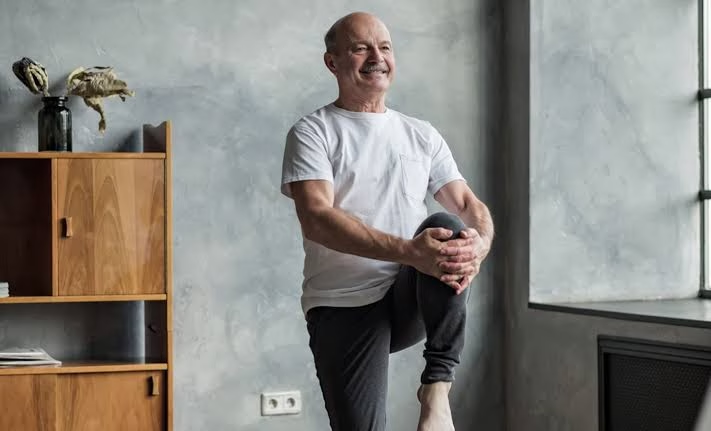
1. Static Balance: Single-Leg Stance
-
How to do it: Stand near a sturdy kitchen counter or wall for safety. Lift one foot off the floor and maintain an upright posture on the opposing leg.
-
Target: Work toward holding the position for 30 seconds per side with eyes open.
-
Progression: As stability improves, lightly reduce finger contact on the support surface.
2. Lower-Body Power: Chair Stands (Sit-to-Stand)
-
How to do it: Sit in a firm chair with feet flat on the floor, shoulder-width apart. Crossing arms over the chest, stand up completely, pause briefly, and control the descent back into the seat.
-
Target: Perform 10 to 15 controlled repetitions in a single set.
-
Why it matters: Builds quadricep and gluteal power necessary for climbing stairs and preventing trips.
3. Agility and Dynamic Movement: Modified Up-and-Go
-
How to do it: Place a chair eight feet away from a designated mark on the floor. Practice standing from the chair, walking briskly around the mark, returning, and sitting down.
-
Target: Focus on smooth, confident turns and maintaining a steady stride without hesitation.
4. Aerobic Capacity: Moderate Physical Activity
-
How to do it: Engage in 150 minutes per week of brisk walking, cycling, or swimming. Cardiorespiratory fitness remained the single strongest individual predictor of survival in the JAMA Network Open trial.
The Power of Consistency: Long workouts are not strictly required to yield physiological adaptation. Recent research from Pennsylvania State University demonstrated that just four minutes a day of focused lower-body resistance and balance training yielded measurable improvements in sit-to-stand speeds and single-leg balance capacity among adults aged 65 and older within a 12-week period.
Study Limitations and Nuance
While the prospective cohort design and large sample size (over 13,000 participants) strengthen the reliability of these findings, researchers and clinicians emphasize several methodological limitations:
-
Observational Nature: The study establishes strong statistical associations, but it cannot definitively prove direct cause-and-effect. Superior performance on balance and agility tests may reflect broader lifestyle advantages, such as lower chronic disease burden, superior lifelong nutrition, or higher socioeconomic status.
-
Geographic Scope: Data collection was restricted to Taiwanese older adults. While the fundamental principles of neuromuscular physiology apply universally, ethnic and cultural variations in daily activity patterns mean additional validation studies across international cohorts remain important.
-
The Role of Flexibility: The absence of a direct statistical link between flexibility tests and mortality risk does not render stretching useless. Range-of-motion exercises remain clinically important for joint health, osteoarthritis management, and preventing acute muscle strain, even if flexibility itself does not serve as a primary predictor of overall lifespan.
Public Health Implications and Policy Impact
As global demographic trends shift toward an aging population, integrating low-cost, rapid physical screening tools into standard medical care could deliver substantial public health benefits.
Standard cardiovascular risk screenings rely on laboratory tests and clinical monitoring equipment. In contrast, the single-leg stand and 8-foot up-and-go tests require zero specialized equipment, can be conducted in under three minutes during a routine doctor visit, and offer immediate actionable data.
Public health experts advocate using these simple screening tools to identify at-risk older adults early, allowing clinicians to prescribe targeted community exercise programs, physical therapy, or fall-prevention interventions before a catastrophic fall occurs. Systemic investment in accessible community exercise initiatives, safe pedestrian infrastructure, and local balance-building classes represents a cost-effective strategy to promote healthy aging, preserve independence, and support longevity worldwide.
Medical Disclaimer: This article is for informational purposes only and should not be considered medical advice. Always consult with qualified healthcare professionals before making any health-related decisions or changes to your treatment plan. The information presented here is based on current research and expert opinions, which may evolve as new evidence emerges.
References


Happy
0 %

Sad
0 %

Excited
0 %

Sleepy
0 %

Angry
0 %

Surprise
0 %