 0
0
 0
0
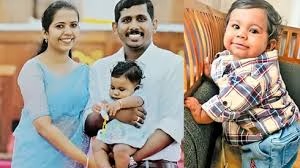
KOCHI, KERALA — In a quiet hospital room in Kochi this February, a ten-month-old girl named Aalin Sherin Abraham achieved what many do not accomplish in a century: she saved the lives of four other children. By becoming the youngest organ donor in the history of Kerala, Aalin has not only provided a “gift of life” to grieving families but has also ignited a national conversation on the critical shortage of pediatric organ donations in India.
The infant was laid to rest with full state honors on February 15, 2026, following a tragic road accident that left her brain-dead but her organs viable for transplant. Her story serves as a poignant intersection of personal tragedy and public health necessity, highlighting the sophisticated coordination of the Kerala State Organ and Tissue Transplant Organisation (K-SOTTO) and the urgent need for increased donor awareness.
From Tragedy to Transformation
The journey began on February 5, 2026, when a head-on collision near Pallam-Borma Junction in Kottayam left Aalin with critical head injuries. Despite exhaustive efforts by medical teams at a private hospital in Kochi, the infant was declared brain-dead on February 12.
In the wake of this devastating news, her parents, Arun Abraham and Sherin Ann John, made the courageous decision to donate her organs. “We lost our baby, who was with us for 20 months—10 in the womb and 10 on earth,” her grandfather, Reji Samuel, remarked during the funeral service. “But we gained four children. Our baby returned after fulfilling the purpose of her birth.”
The logistical feat that followed was a testament to modern medical infrastructure. Through K-SOTTO, Aalin’s kidneys were transported to a 10-year-old girl at SAT Hospital in Thiruvananthapuram; her liver was sent to KIMS Hospital; her heart valves were secured by the Sree Chitra Tirunal Institute; and her corneas were allocated to restore sight to visually impaired recipients.
The Pediatric Gap: A Medical Challenge
While organ donation is complex for adults, it is exponentially more challenging for infants. Pediatric transplantation requires precise “size-matching”—an adult kidney or liver lobe often cannot fit into the abdominal cavity of a small child.
“Children’s bodies are still growing, which presents unique physiological hurdles,” explains Dr. Jyoti Kumari, a pediatric specialist. “They are at a higher risk of both organ rejection and post-operative infections compared to adults.”
Data from a recent meta-analysis published in PubMed highlights the stakes:
-
Kidney Transplants: 1-year patient survival stands at 96%, though it matures to 75% at the 10-year mark.
-
Liver Transplants: Success rates remain high, with 92% 1-year and 88% 5-year survival rates.
-
The Infection Factor: In India, the primary cause of graft loss is infection rather than chronic rejection, which is more common in Western nations. This underscores the need for sterile, high-tier post-operative care.
The Statistical Reality: Why Aalin’s Case Matters
Despite Kerala’s reputation for advanced healthcare, the state—and India as a whole—faces a stark deficit in deceased organ donations.
-
National Ranking: Kerala currently ranks 12th in India for registered donors, with approximately 5,891 registrants, dwarfed by Maharashtra’s 51,506.
-
The Waiting List: As of mid-2025, over 2,767 patients remained on the K-SOTTO waiting list.
-
Donation Rates: India’s deceased donation rate is a mere 0.52 per million population (PMP), significantly lower than global leaders like Spain, which maintains a rate over 40 PMP.
Health Minister Veena George noted that while the loss of a child is an immeasurable tragedy, the Abraham family has transformed their pain into a “beacon of hope” that could encourage more families to consider donation.
Comparison of Deceased Organ Donors (Per Million Population)
| Country | Donation Rate (PMP) |
| Spain | ~46.0 |
| United States | ~36.0 |
| India | 0.52 |
Legal and Ethical Safeguards
Aalin’s donation was made possible by the Transplantation of Human Organs and Tissues Act, 1994 (THOTA). The act provides the legal framework for recognizing “brain-stem death”—the irreversible cessation of all functions of the entire brain, including the brain stem.
Under Indian law, brain death must be certified by a board of four medical experts, including a neurologist or neurosurgeon, twice within a six-hour interval. This rigorous process ensures that organ retrieval only occurs when there is no possibility of recovery, protecting both the donor’s dignity and the integrity of the medical profession.
Addressing the Challenges Ahead
Despite the success of Aalin’s case, public health experts point to significant hurdles that remain. One major concern is the “living donor” bias in India. Currently, approximately 95% of transplants in recent years have come from living donors. This raises ethical concerns regarding the potential commercialization of organs and the health risks to living donors.
Furthermore, there is a geographical disparity in access. Rural populations often lack the specialized “Green Corridors”—emergency traffic routes used to transport organs quickly—available in urban centers like Kochi or Thiruvananthapuram.
Moving Forward: What This Means for You
For the average citizen, Aalin’s story is a call to action. Medical professionals emphasize that a single deceased donor can save or enhance the lives of up to eight people.
How you can contribute:
-
Register: Sign up as an organ donor through K-SOTTO (in Kerala) or the National Organ and Tissue Transplant Organisation (NOTTO).
-
Discuss: The most crucial step is informing your family. In India, even if an individual is a registered donor, final consent often rests with the next of kin.
-
Prevention: Public health experts also remind the public that many transplant needs arise from preventable trauma. Safe driving and helmet use are the first line of defense against the tragedies that lead to these situations.
As Shreya, the 10-year-old recipient of Aalin’s kidney, continues her recovery, her grandfather Chandran summed up the sentiment of a grateful nation: “I met the angel for the last time. She gave a new life to my granddaughter.”
Aalin Sherin Abraham lived for only ten months, but through her parents’ selflessness, she has achieved a form of biological immortality, living on through the four children who now have a second chance at life.
References
-
Times of India. “Kerala bids adieu to infant who gave the gift of life.” February 15, 2026.
Medical Disclaimer: This article is for informational purposes only and should not be considered medical advice. Always consult with qualified healthcare professionals before making any health-related decisions or changes to your treatment plan. The information presented here is based on current research and expert opinions, which may evolve as new evidence emerges.