 0
0
 0
0
Every child has the right to safe, quality health care — from the very beginning. Yet, newborns and young children face higher risks due to their rapid development, evolving health needs and different disease patterns. They rely on adults to speak up and make decisions for them. Children may also face added challenges depending on their socio-economic circumstances, such as not being able to get the care they need. These factors make them more susceptible to harm if care isn’t specifically adapted to their age, size, health condition and context.
A single safety incident can have lifelong consequences for a child’s health and development. That’s why World Patient Safety Day 2025 is dedicated to ensuring safe care for every newborn and child, with a special focus on those from birth to nine years old. This year’s slogan, “Patient safety from the start!”, emphasizes the urgent need to act early and consistently to prevent harm throughout childhood, and yield benefits across the life course.
WHO calls on parents, caregivers, health practitioners, health care leaders, educators and communities, to unite in action to prevent avoidable harm in paediatric care and to build a safer, healthier future for every child, as part of the global effort to achieve Sustainable Development Goal 3.
Campaign objectives
- Raise global awareness of safety risks in paediatric and newborn care in all health care settings, emphasizing the specific needs of children, families and caregivers.
- Mobilize governments, health care organizations, professional bodies and civil society to implement sustainable strategies for safer care for newborns and children, as part of broader patient safety and quality initiatives.
- Empower parents, caregivers and children in patient safety by promoting education, awareness and active participation in care.
- Advocate for strengthening research on patient safety in paediatric and newborn care.
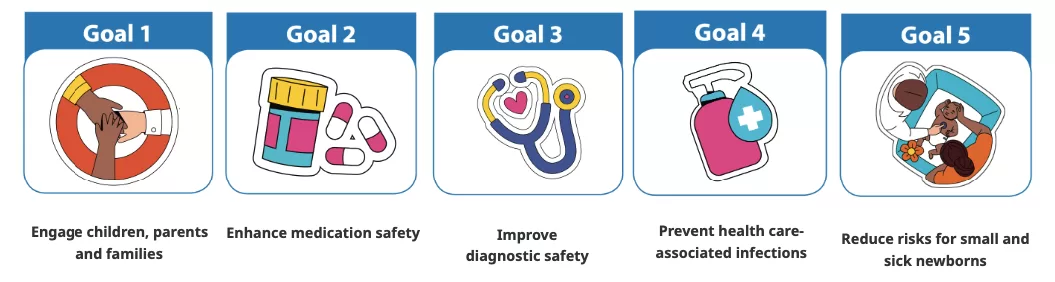
On the occasion of World Patient Safety Day 2025, with the theme “Safe care for every newborn and every child”, WHO is proposing a set of Goals to facilitate action for improvement at the point of care. These goals highlight priority areas where health facilities, organizations, health care leaders, managers and health practitioners can make tangible changes to reduce avoidable harm and improve safety for newborns and children.
Calls to action and key messages
- Patients and caregiversBe your child’s safety champion. Stay informed. Stay involved. Speak up.
- Track and share: keep notes on symptoms, medications and appointments. Share everything with your health care team.
- Keep informed: learn about common medical conditions in children and what to watch out for. Understand hospital safety protocols, such as handwashing and visitor restrictions.
- Have your say: take part in the decisions being taken about your child’s care.
- Ask and confirm: always ask about treatments. Double-check names, allergies and medications before interventions.
- Trust your gut: if something feels off, speak up. You know your child best.
- School-aged children (6+ years)Be a patient safety star, speak up for your safety!
- Speak up: tell an adult if you feel sick, are hurting, or if something feels wrong during your care. Try your best to describe what you’re feeling, like pain or tiredness.
- Stay safe during care: share your name, birthday and allergies with your doctor or nurse. Ask what your medicine is for. If you get a cut or scrape, ask how to keep it clean while it heals.
- Be a germ buster: wash your hands often. Cover your cough or sneeze with your elbow or a tissue. It’s okay to remind others to do that, too.
- You can help: if something doesn’t look or feel right, tell an adult.
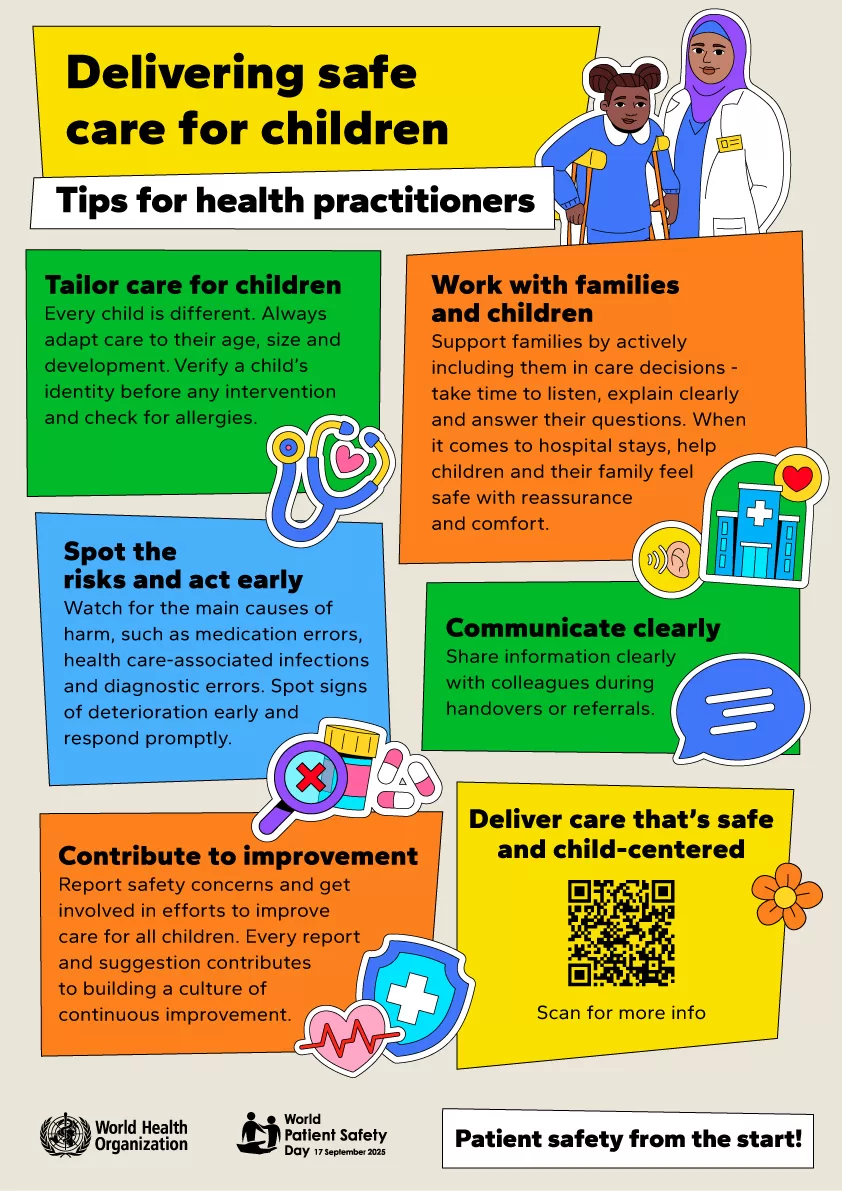
- Health practitionersDeliver care that’s safe and child-centred.
- Tailor care to the child: adjust for age, weight and development. Verify a child’s identity before any intervention and check for allergies.
- Prevent harm: watch for the main causes of harm such as medication errors, health care-associated infections and diagnostic errors.
- Act early: spot signs of deterioration. Respond promptly.
- Partner with parents and children: communicate clearly. Listen actively. Encourage questions and involve them in the decision-making.
- Coordinate and learn: share information clearly across teams. Report incidents to improve care and contribute towards improvement efforts.
- Health care facility managersMake safe care the standard for every child, everywhere.
- Streamline safety: apply WHO quality of care standards. Establish core safety systems such as patient identification, safe medication, infection prevention, and care escalation.
- Support the workforce: ensure staff are trained in safe paediatric care skills. Foster teamwork, open communication and standardized care.
- Make care child-friendly: provide appropriate child-friendly spaces and equipment.
- Use data to improve care: establish a safety culture. Support incident reporting by staff and caregivers. Track safety indicators and act on insights.
- Policy-makers and health care leadersInvest in safe care for children. Save lives and resources.
- Embed paediatric safety within policy: integrate safety into national health policies and strategies.
- Invest in safer care: build workforce capacity and equip facilities with the tools, training and infrastructure needed to keep children safe.
- Lead with data and learning: strengthen data systems. Promote a culture of safety and learning.
- Engage communities: involve civil society, patient advocates, child protection groups and educators in building safer systems and promoting patient safety in schools.
- Teachers, educators and school health staffEmpower children to participate in their health care.
- Empower children: teach them to speak up, ask questions and share symptoms or concerns.
- Create safe spaces: listen with empathy. Reduce fear around health care.
- Promote safety education: partner with health workers. Build children’s hygiene habits, health literacy and awareness of patient safety.
- Practice and celebrate: recognize and praise children when they make safe health decisions, such as regular handwashing and coughing into the elbow.
- Civil society organizations and advocacy groupsRaise awareness. Mobilize communities. Demand safe care for every child.
- Raise awareness: promote health literacy. Share clear, accessible information on patient safety risks and the prevention of harm.
- Promote equity: advocate for safe care in all settings, especially those in low-resourced, marginalized or humanitarian settings, where risks are greatest.
- Amplify voices: represent patients in health dialogues. Co-create safer systems with health workers.