 0
0
 0
0
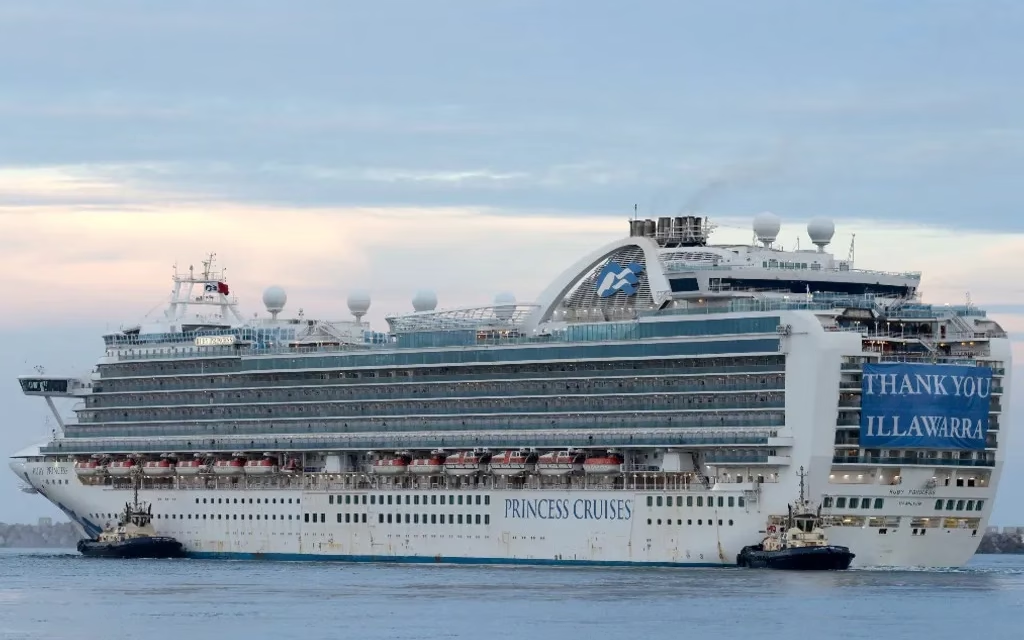
SAN FRANCISCO, CA — A major gastrointestinal outbreak aboard a Princess Cruises vessel has sickened more than 120 people, according to the U.S. Centers for Disease Control and Prevention (CDC), shining a harsh public spotlight back on the unique challenges of controlling highly contagious pathogens in dense, maritime environments.
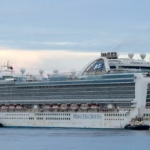
The incident, which occurred aboard the Ruby Princess during a 20-day voyage from San Francisco to Canada and Alaska, concluded on July 2, 2026, when the ship docked back in California to undergo extensive, specialized disinfection protocols. The federal agency confirmed that 102 passengers and 23 crew members fell ill during the sailing, meeting the strict clinical thresholds that trigger mandatory federal reporting and active vessel sanitation interventions.
Under long-standing CDC guidelines managed via the federal Vessel Sanitation Program (VSP), cruise ships operating under U.S. jurisdiction are required to formally report outbreaks when 3 percent or more of the total population on board develops acute gastrointestinal symptoms. This latest maritime cluster marks the second notable outbreak for Princess Cruises this year alone, following a similar event aboard the Caribbean Princess where 145 out of 3,116 passengers (4.7 percent) and 15 out of 1,131 crew members (1.3 percent) reported debilitating stomach illness.
The Biology of Containment: Why the “Winter Vomiting Bug” Thrives at Sea
Norovirus, historically referred to as the “winter vomiting bug,” is an exceptionally resilient, non-enveloped virus that causes acute gastroenteritis—a painful inflammation of the stomach and large intestine linings. Characterized by the sudden onset of severe, projectile vomiting, watery diarrhea, nausea, and abdominal cramping, the incubation period is incredibly brief, typically manifesting within 12 to 48 hours following exposure.
Public health investigators point to the physical and social structures of modern cruise travel as a perfect accelerator for the virus. While cruise ships are not the primary source of norovirus—which is far more prevalent in land-based settings like long-term care facilities, hospitals, and schools—their environments feature dense contact networks. Hundreds or thousands of travelers share dining rooms, theaters, buffet utensils, and handrails over extended periods.
According to a comprehensive 2024 systematic review and meta-analysis published in the peer-reviewed journal Eurosurveillance, which scrutinized 45 distinct cruise-ship outbreaks spanning three decades, the weighted average attack rate is predictably uneven: roughly 7 percent for passengers compared to 2 percent for crew members. The researchers concluded that person-to-person spread is the primary transmission pathway, highlighting that having an ill cabin mate serves as the single strongest risk factor for contracting the virus while at sea.
The Public Health Fallacy: Why Sanitizer Fails Against Norovirus
One of the most dangerous and persistent misconceptions among the traveling public is the reliance on alcohol-based hand sanitizers to ward off stomach bugs.
Unlike enveloped viruses like influenza or SARS-CoV-2, which possess a lipid outer membrane that alcohol easily disrupts, norovirus is a non-enveloped virus. It possesses a sturdy protein shell (capsid) that resists structural breakdown by standard alcohol gels.
“Time and again, we see travelers liberally applying hand gel at buffet entrances thinking they are fully protected,” says Dr. Elena Rostova, an independent infectious disease epidemiologist not involved in the CDC investigation. “The reality is that alcohol-based rubs fail to reliably neutralize the norovirus virion. The virus is structurally built to survive those chemical rinses. Friction, warm water, and surfactant soaps are non-negotiable for physically stripping the pathogen from the skin.”
The CDC’s standard travel medicine guidelines explicitly mandate washing hands vigorously with soap and water for a minimum of 20 seconds, particularly before handling food, eating, or after utilizing public restrooms.
Clinical Implications and Vulnerable Populations
For the vast majority of healthy adults, a norovirus infection is self-limiting, resolving within one to three days without specific antiviral treatments or long-term complications. However, public health officials warn against treating these outbreaks as mere vacation inconveniences.
The rapid fluid loss caused by simultaneous vomiting and diarrhea poses an immediate medical hazard, particularly for three high-risk demographics frequently found on long-haul cruises:
-
Older adults (aged 65 and older)
-
Young children
-
Individuals managing chronic medical conditions or compromised immune systems
Severe dehydration can progress rapidly in these groups, occasionally necessitating intravenous fluid resuscitation in the ship’s medical ward or emergency medical evacuation to a shoreside hospital.
Limitations in Outbreak Data Collection
Epidemiologists caution that the data provided by the CDC’s cruise-ship outbreak tracker inherently reflects certain reporting biases. Because the figures rely exclusively on passengers and crew members who proactively report their symptoms to the ship’s infirmary, the true case count may be underestimated. Conversely, early statistics frequently categorize cases broadly as generic “gastrointestinal illness” (GI) before diagnostic laboratory tests confirm norovirus via stool samples, meaning initial data reflects a symptomatic net rather than a confirmed viral count.
Furthermore, a high case count does not indicate that a vessel is inherently unsanitary or that all passengers contracted the illness from a singular, contaminated food source. Because of the prolonged 20-day duration of the Ruby Princess voyage, distinct chains of person-to-person transmission likely developed sequentially as asymptomatic or mildly symptomatic individuals moved through common areas.
Proactive Strategies for Future Travelers
To mitigate the risk of contracting gastrointestinal illness on upcoming voyages, health authorities advise passengers to assume a proactive stance regarding personal hygiene and spatial awareness.
| Preventive Measure | Correct Action | Why It Matters |
| Hand Hygiene | Wash with soap and water for ≥20 seconds | Physically removes the resilient non-enveloped viral particles. |
| Symptom Management | Report immediately to medical staff & isolate | Prevents secondary transmission chains to cabin mates and neighbors. |
| Dining Habits | Avoid self-service buffets if active cases exist | Minimizes exposure to communal utensils touched by thousands of hands. |
| Surface Awareness | Disinfect cabin touchpoints with bleach-based wipes | Norovirus can survive on dry surfaces for days or weeks if untreated. |
In response to the early 2026 outbreaks, cruise lines under VSP monitoring have stepped up their response protocols. When the 3 percent illness threshold is crossed, ships execute rapid counter-measures: isolating symptomatic individuals to their staterooms for at least 48 hours after symptoms subside, shifting from self-service buffets to crew-served dining, utilizing EPA-approved, bleach-based virucides on high-touch surfaces, and conducting targeted epidemiological monitoring of the ship’s crew.
Ultimately, while routine sanitation measures executed by cruise lines act as a structural shield, the highly contagious nature of norovirus means that individual passenger behavior remains the definitive line of defense against outbreaks at sea.
References
- https://globalnews.ca/news/11951499/norovirus-outbreak-princess-cruise/
Medical Disclaimer: This article is for informational purposes only and should not be considered medical advice. Always consult with qualified healthcare professionals before making any health-related decisions or changes to your treatment plan. The information presented here is based on current research and expert opinions, which may evolve as new evidence emerges.