 0
0
 0
0
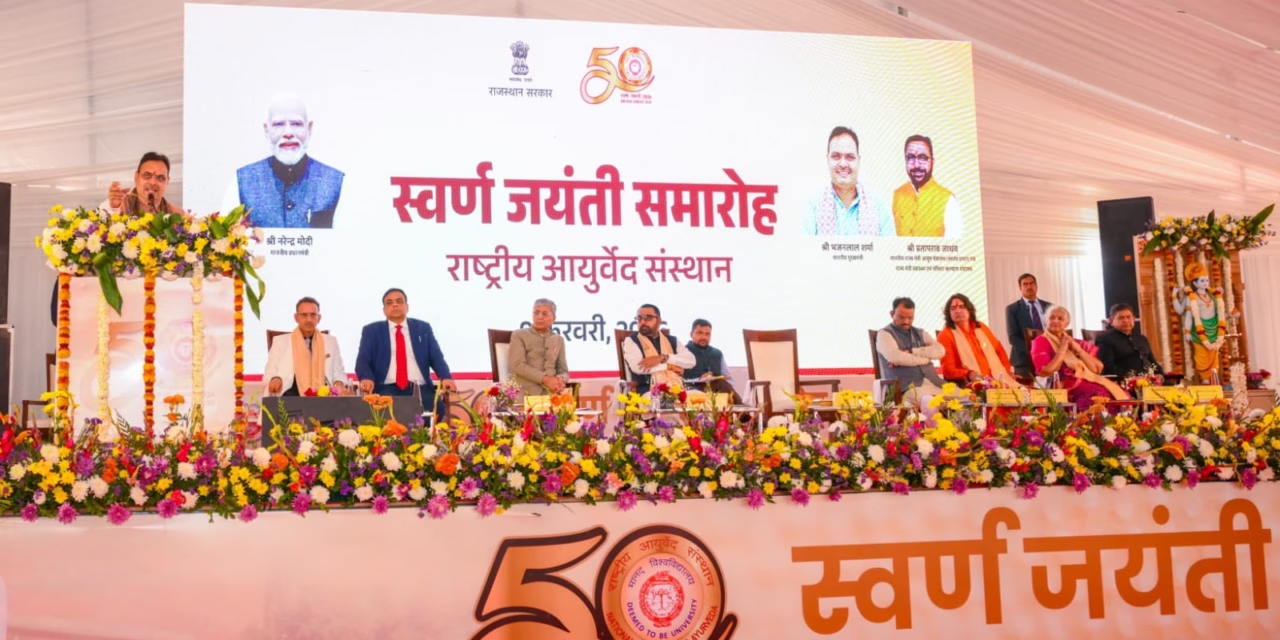
JAIPUR – In a milestone event for global holistic healthcare, the National Institute of Ayurveda (NIA) in Jaipur celebrated its Golden Jubilee today, marking 50 years as a premier hub for Ayurvedic education, research, and clinical care. The anniversary was punctuated by the unveiling of state-of-the-art medical infrastructure designed to bridge the gap between traditional Indian medicine and contemporary scientific rigor.
The celebrations were led by Rajasthan Chief Minister Shri Bhajan Lal Sharma and Union Minister of State for Ayush Shri Prataprao Jadhav. The event served as both a retrospective of NIA’s evolution—from a local college in 1976 to India’s first Ayurveda Deemed-to-be University—and a roadmap for the future of evidence-based traditional medicine.
A New Era of Infrastructure and Digital Outreach
The Golden Jubilee was marked by the inauguration of several key facilities aimed at modernizing patient care and medical training:
-
Sushrut Bhavan: A new Outpatient Department (OPD) block designed to increase patient volume and improve accessibility for the thousands who seek Ayurvedic consultation daily.
-
Advanced Simulation Lab and OT Block: These facilities represent a significant leap in surgical and clinical training, allowing students to practice complex procedures in a controlled environment before moving to human patients.
-
Dhanwantari Upvan: A dedicated medicinal plant garden focused on the conservation of rare flora and the education of researchers on raw drug identification.
-
Digital Outreach: Union Minister Shri Prataprao Jadhav recorded the inaugural episode of the NIA’s first official podcast, signaling a shift toward digital health literacy and public engagement.
“The National Institute of Ayurveda is a living bridge between India’s ancient medical wisdom and modern scientific inquiry,” stated Chief Minister Sharma during his address. He emphasized that Rajasthan is uniquely positioned as a hub for this integration due to its rich “medicinal biodiversity.”
The Push for Evidence-Based Ayurveda
A central theme of the anniversary was the transition of Ayurveda from a traditional practice to a scientifically validated medical system. Union Minister Shri Prataprao Jadhav noted that the government’s objective is to position AYUSH (Ayurveda, Yoga, Naturopathy, Unani, Siddha, and Homeopathy) as “evidence-based, scientifically validated, and globally accepted.”
This move toward standardization is crucial for international acceptance. By utilizing the new Advanced Simulation Laboratory and conducting rigorous research, the NIA aims to provide the clinical data required to satisfy global medical standards.
Expert Perspective: Bridging the Gap
While not directly involved in the NIA’s administration, independent experts see this as a turning point. Dr. Arathi Varma, a public health researcher specializing in integrative medicine, notes that infrastructure like simulation labs is vital.
“The challenge for Ayurveda has often been reproducibility and standardization,” Dr. Varma explains. “When an institution like NIA invests in high-tech surgical blocks and simulation, it tells the global community that Ayurveda is not just a philosophy, but a clinical science that respects modern safety protocols.”
Public Health Implications: What This Means for Patients
For the average health-conscious consumer, the expansion of the NIA offers several practical benefits:
-
Increased Access: The “Sushrut Bhavan” OPD block is expected to reduce wait times and provide more streamlined care for chronic conditions such as arthritis, digestive disorders, and skin ailments.
-
Patient Safety: The new Operation Theatre (OT) block incorporates modern sterile standards and advanced monitoring, ensuring that Ayurvedic surgical interventions (Shalya Tantra) are performed with the highest safety margins.
-
Holistic Wellness: The emphasis on “Heal in India” suggests a push toward medical tourism, where patients can receive integrative care that combines traditional detox therapies (Panchakarma) with modern diagnostic tools.
Understanding the Growth: NIA’s Evolution
| Year | Milestone |
| 1976 | Established as an Ayurveda College under the Government of Rajasthan |
| 2020 | Granted ‘Deemed-to-be University’ status by the Ministry of Education |
| 2026 | Golden Jubilee: Launch of Advanced Simulation Lab and “Sushrut Bhavan” |
Navigating the Challenges: Limitations and Counterarguments
Despite the enthusiasm, the integration of traditional and modern medicine faces hurdles. Critics often point to the “dilution” of traditional principles when they are forced into western scientific frameworks. Furthermore, while the NIA is leading the way in research, many smaller Ayurvedic clinics across India lack the same level of oversight and infrastructure.
Public health officials also warn that “holistic wellness” should complement, not replace, conventional medicine in emergency situations. The NIA’s approach emphasizes integrative care—where Ayurveda works alongside modern medicine—rather than as a standalone substitute for acute conditions.
A Global Vision: “Heal in India”
The Golden Jubilee aligns with India’s broader “Heal in India” vision. Deputy Chief Minister Shri Prem Chand Bairwa reiterated that the state is committed to making NIA a world-class center. With the establishment of three new All India Institutes of Ayurveda (AIIA) and the WHO Global Centre for Traditional Medicine in Jamnagar, the NIA sits at the heart of a rapidly expanding ecosystem.
As NIA Jaipur enters its next half-century, its focus remains clear: transforming ancient texts into modern treatments that can be prescribed with the same confidence as any contemporary pharmaceutical.
Medical Disclaimer: This article is for informational purposes only and should not be considered medical advice. Always consult with qualified healthcare professionals before making any health-related decisions or changes to your treatment plan. The information presented here is based on current research and expert opinions, which may evolve as new evidence emerges.
References
-
Press Information Bureau (PIB). (2026, February 9). NIA Jaipur’s Golden Jubilee highlights 50 years of leadership in Ayurveda. Ministry of Ayush, Government of India.