 0
0
 0
0
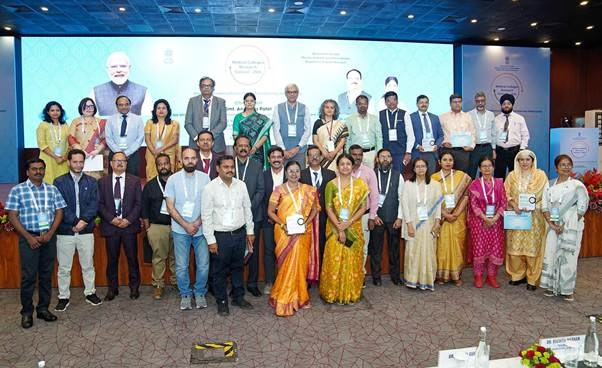
NEW DELHI — In a move set to redefine the landscape of Indian healthcare, Union Minister of State for Health & Family Welfare, Smt. Anupriya Patel, officially inaugurated the Medical Colleges Research Connect 2026 at Sushma Swaraj Bhawan on February 26, 2026. The landmark two-day summit marks a pivotal moment for the nation’s scientific community, backed by a massive ₹4,800 crore allocation to the Department of Health Research (DHR) to modernize infrastructure and foster high-quality biomedical innovation across more than 100 multidisciplinary research units (MRUs) nationwide.
The conference brings together deans, principal investigators, and scientists from over 100 premier medical institutions. The goal is simple but ambitious: to ensure that the next generation of life-saving treatments and diagnostic tools are “Made in India.”
From Classrooms to Laboratories: The ₹4,800 Crore Vision
For decades, many of India’s medical colleges functioned primarily as teaching hospitals, focusing on patient care and undergraduate education. However, the Central Sector Umbrella Scheme is shifting this paradigm. By establishing Multi-Disciplinary Research Units (MRUs), the government is providing the physical and financial “scaffolding” required for clinical faculty to conduct sophisticated genetic, molecular, and epidemiological research.
In her keynote address, Minister Anupriya Patel emphasized that this investment is a cornerstone of the Viksit Bharat (Developed India) initiative.
“We are not just building buildings; we are building an ecosystem,” Minister Patel stated. “By empowering our medical faculty with state-of-the-art infrastructure and a ₹4,800 crore budget, we are ensuring that Indian research meets global standards, directly benefiting the health of our citizens.”
Dr. Abhijat Chandrakant Sheth, Chairman of the National Medical Commission (NMC), joined the Minister as a Guest of Honour, highlighting that research integration is now a critical metric for the excellence of medical institutions.
Strengthening the “Research Connect”
The 2026 summit serves as a collaborative melting pot. Over the two-day event (Feb 26–27), representatives from 100+ MRUs are engaging in:
-
Grant Writing Workshops: Training researchers to secure international and national funding.
-
Technical Symposia: Sharing breakthroughs in areas like genomic sequencing and infectious disease tracking.
-
Resource Sharing: Establishing a network where smaller colleges can leverage the advanced equipment of larger institutes.
Why This Matters for Public Health
For the average citizen, this isn’t just about academic papers. Biomedical research at the local level means:
-
Localized Medicine: Understanding how specific diseases affect different regional populations in India.
-
Faster Diagnostics: Developing low-cost kits for diseases like Tuberculosis, Malaria, and Diabetes.
-
Outbreak Readiness: Strengthening the network of labs that can identify new viral strains before they become pandemics.
Expert Perspectives: Bridging the Gap
While the funding is unprecedented, independent experts suggest that the “culture of research” is just as important as the “capital for research.”
“The allocation of ₹4,800 crore is a gargantuan step forward,” says Dr. Arvinder Singh, a public health consultant not affiliated with the DHR. “However, the challenge lies in protected time. Most medical college faculty are overwhelmed with patient loads. For this initiative to truly succeed, we must ensure these doctors have dedicated hours for the lab, away from the wards.”
Statistical data from the DHR suggests that prior to the MRU rollout, less than 20% of government medical colleges had published high-impact research annually. With this new infrastructure, the government aims to triple that output by 2030.
Navigating Challenges and Limitations
Despite the optimism, the road to becoming a global research hub has hurdles. Critics often point to the “red tape” involved in government procurement of high-end reagents and equipment, which can delay sensitive biological experiments.
Furthermore, the “Research Connect” must address the disparity between urban “Institutes of National Importance” (like AIIMS) and smaller state-run colleges in rural districts. The 2026 conference aims to bridge this gap by pairing “mentor” institutions with “mentee” units to ensure uniform quality across the board.
| Feature | Impact of the ₹4,800 Cr Allocation |
| Infrastructure | Upgrading 100+ labs with molecular diagnostic tools. |
| Human Capital | Specialized training for 1,000+ clinical researchers. |
| Public Health | Shift from “Imported Science” to “Indigenous Solutions.” |
What This Means for You
As a consumer of healthcare, this shift signifies a future where your doctor isn’t just following a textbook written in the West, but is actively contributing to clinical trials that include Indian genetic markers.
If you are a student or a healthcare professional, the message is clear: the era of the “Clinician-Scientist” has arrived in India. The DHR’s commitment ensures that the financial barriers to entry for medical research are lower than ever before.
References
-
Government Source: Press Information Bureau (PIB). (2026, Feb 26). Union Minister Smt. Anupriya Patel Inaugurates DHR’s Medical Colleges Research Connect 2026. Release ID: 2026/DHR/01.
Medical Disclaimer: This article is for informational purposes only and should not be considered medical advice. Always consult with qualified healthcare professionals before making any health-related decisions or changes to your treatment plan. The information presented here is based on current research and expert opinions, which may evolve as new evidence emerges.