 0
0
 0
0
Published: March 10, 2026
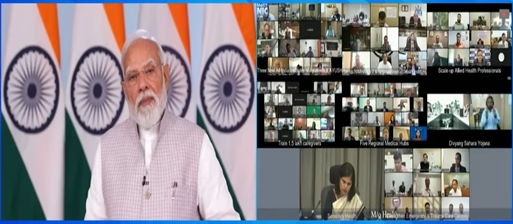
NEW DELHI – Prime Minister Narendra Modi and Union Health Minister J.P. Nadda outlined a transformative vision for India’s healthcare landscape during a post-budget webinar titled “Sabka Saath Sabka Vikas – Fulfilling Aspirations of People” yesterday. Addressing a diverse group of policymakers, medical experts, and stakeholders, the Prime Minister emphasized a shift toward preventive and holistic wellness, the rapid expansion of medical education infrastructure, and a strategic push to train over 250,000 specialized healthcare workers to meet both domestic and burgeoning global demands.
A Shift Toward Holistic and Preventive Care
The cornerstone of the 2026-27 health initiatives is a departure from reactive “sick-care” toward a proactive “wellness” model. Prime Minister Modi highlighted that India is increasingly focusing on early diagnosis and accessible treatment, bolstered by the expanding network of Ayushman Arogya Mandirs.
“India today is working on a vast vision for preventive and holistic health,” the Prime Minister stated, noting that traditional practices like Yoga and Ayurveda are no longer just cultural heritage but are driving a global shift toward integrated health.
This integration is backed by significant infrastructure growth. The government confirmed that hundreds of new medical colleges have opened across various districts in recent years, aiming to correct the historical imbalance in doctor-to-patient ratios in rural India.
Addressing the “Care Gap”: 250,000 New Professionals
One of the most significant takeaways from the webinar was the announcement of a massive skilling initiative. Union Health Minister J.P. Nadda detailed plans to develop a workforce of 100,000 skilled allied healthcare professionals. These individuals—including technicians, therapists, and radiographers—are seen as the backbone of modern diagnostics and rehabilitation.
Furthermore, responding to the “care economy” spurred by an aging global population, the Prime Minister called for the training of 150,000 dedicated caregivers.
-
Demographic Shift: By 2030, the population of senior citizens in India is expected to rise significantly, increasing the demand for geriatric care.
-
Global Export: Many Western nations are facing acute shortages of caregivers, positioning India as a potential global hub for trained healthcare support staff.
“New skill-based employment opportunities are emerging for millions of youth,” Modi remarked, urging experts to create training models that satisfy international standards.
Strengthening Mental Health and Emergency Response
In a move lauded by mental health advocates, Minister Nadda announced the expansion of the National Institute of Mental Health and Neurosciences (NIMHANS) with a second campus in North India. This is intended to decentralize advanced psychiatric care, which has historically been concentrated in the South.
Additionally, the Central Institute of Psychiatry (CIP) in Ranchi and the Lokopriya Gopinath Bordoloi Regional Institute of Mental Health in Tezpur will be upgraded to “Regional Apex Institutions.”
“Modern healthcare requires a team-based approach,” Nadda explained. “Better infrastructure and integrated emergency response systems at the district level are key to ensuring timely life-saving care.”
Telemedicine and the Digital Frontier
While the “Ayushman Bharat Digital Mission” has already made strides, the Prime Minister acknowledged that barriers to entry remain for the average citizen. He urged for “simpler digital health platforms” and increased awareness of telemedicine.
Telemedicine is viewed as a critical equalizer for “The Last Mile”—reaching citizens in high-altitude or remote forest regions where physical specialist visits are difficult. However, experts at the webinar noted that digital literacy and high-speed internet stability remain the primary hurdles for universal adoption.
Expert Perspectives and Challenges
Public health experts have reacted to the announcements with cautious optimism. Dr. Vinod Paul, Member (Health) at NITI Aayog, summarized the strategic roadmap, emphasizing that the success of these initiatives depends on the “effective implementation” at the state level.
Independent analysts point out potential challenges:
-
Quality Control in Education: With the rapid opening of medical colleges, maintaining high pedagogical standards and adequate faculty-to-student ratios is paramount.
-
Retention: Training 250,000 professionals is a feat, but retaining them within the public health system—rather than losing them to the private sector or overseas migration—requires competitive wage structures and improved working conditions.
-
Rural Integration: While infrastructure is being built, ensuring that specialized professionals are willing to serve in “Tier 3” cities remains a persistent hurdle.
What This Means for the Citizen
For the average Indian family, the 2026-27 budget focus suggests:
-
Lower Diagnostic Costs: An increase in allied health professionals typically leads to better access to pathology and radiology services.
-
Shorter Travel Times: More district-level medical colleges and trauma centers mean fewer “referral chains” to distant metro cities.
-
Support for the Elderly: The push for trained caregivers may provide more affordable options for families managing chronic illnesses at home.
Medical Disclaimer
This article is for informational purposes only and should not be considered medical advice. Always consult with qualified healthcare professionals before making any health-related decisions or changes to your treatment plan. The information presented here is based on current research and expert opinions, which may evolve as new evidence emerges.
References
Official Sources:
-
Press Information Bureau (PIB) Delhi: “Prime Minister Shri Narendra Modi Addresses Post-Budget Webinar on Health Sector Initiatives,” Posted 09 March 2026.