 0
0
 0
0
Published: May 17, 2026 | Ahmedabad
AHMEDABAD — In an aggressive move to intercept mosquito-borne outbreaks before the seasonal rains arrive, the Gujarat Health Department has launched one of its most extensive pre-monsoon dengue prevention campaigns to date. Health officials confirmed that workers have tested over 2.56 lakh fever samples and deployed more than 23,000 specialized teams to inspect over two crore households. This massive mobilization comes in the immediate wake of National Dengue Day, observed across the country on Saturday, May 16, 2026, as India braces for the annual monsoon season when vector-borne diseases historically surge.
Key Findings: Unprecedented Scale of Prevention Drive
The state’s latest health offensive marks a significant escalation in proactive epidemiological surveillance. During an intensive ten-day drive conducted between April 27 and May 6, 2026, more than 23,000 field teams executed systematic house-to-house surveys. Technicians and vector control workers visited over two crore locations, including private residences, commercial offices, and industrial settlements.
The primary metrics from this statewide sweep highlight the scale of the operation:
-
Larvae Destruction: Active mosquito larvae populations were detected and systematically destroyed in more than 1 lakh homes.
-
Source Reduction: Approximately 27 lakh potential breeding sites—ranging from discarded containers to uncovered storage tanks—were permanently eliminated.
-
Mass Screening: Field workers collected 2.56 lakh blood samples from symptomatic fever patients to ensure early diagnostic screening.
This high-volume approach builds directly upon the state’s 2024 intervention strategies. In 2024, Gujarat processed 2.21 lakh serum samples, uncovering 7,820 dengue-positive cases. Notably, increased testing expanding across the state led to a drop in the overall seropositivity rate to 3.5% in 2024, down from 4.7% recorded in 2023. This downward trend underscores the epidemiological value of identifying and isolating clusters early.
Understanding Dengue: What Readers Need to Know
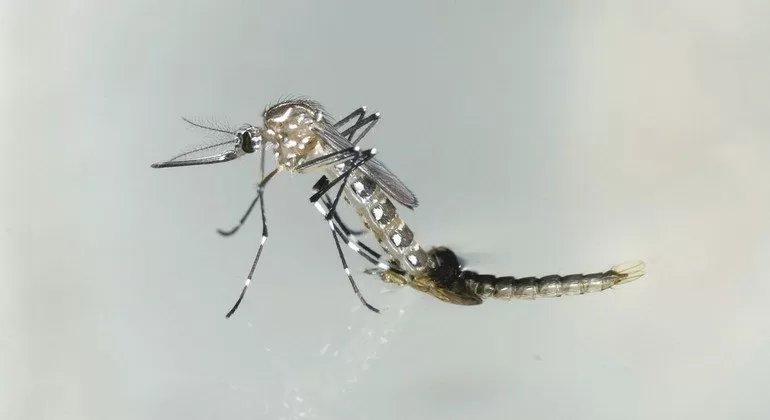
Dengue fever is a systemic viral infection transmitted to humans through the bite of an infected Aedes aegypti or Aedes albopictus mosquito. Unlike the mosquitoes responsible for malaria, which typically bite during nighttime hours, the Aedes mosquito is primarily a daytime biter, peaking in activity during the early morning and late afternoon.
The virus manifests as an acute flu-like illness. Standard symptoms include a sudden high fever accompanied by severe headache, retro-orbital pain (pain behind the eyes), debilitating muscle and joint aches—often earning it the moniker “breakbone fever”—nausea, vomiting, and transient skin rashes.
Critical Warning Signs
While many patients recover within a week, a subset of individuals can progress to Severe Dengue (previously known as Dengue Hemorrhagic Fever), a life-threatening medical emergency. The World Health Organization (WHO) and the Centers for Disease Control and Prevention (CDC) advise immediate hospitalization if a patient exhibits any of the following warning signs:
Severe abdominal pain or persistent abdominal tenderness
Persistent vomiting (at least 3 episodes within a 24-hour window)
Mucosal bleeding (bleeding from the nose, gums, or mouth)
Hematemesis or melena (blood in vomit or stool)
Extreme lethargy, fatigue, or acute restlessness
“Because the Aedes mosquito rests indoors and bites during daylight hours, many individuals do not realize they are actively at risk in their own living rooms or offices until they develop clinical symptoms,” notes Dr. Rajesh Kumar, an infectious disease specialist at Apollo Hospitals Delhi, who is not involved in the Gujarat campaign. “Early clinical evaluation is the single most critical factor in preventing severe complications.”
Expert Commentary: Why Early Action Matters
National Dengue Day was established by the Ministry of Health and Family Welfare in 2010 to serve as an annual pre-monsoon alert, prompting state machineries and communities to decimate vector populations before seasonal breeding peaks. The 2026 national theme, “Unite. Act. Eliminate.”, centers squarely on grassroots community accountability.
“Dengue can no longer be viewed strictly as a short-term, post-monsoon hazard. Urbanization and changing climate patterns have turned it into a year-round public health threat in several parts of India,” explains Dr. Meera Sharma, a professor of public health at AIIMS New Delhi, providing independent expert commentary. “The strategy deployed in Gujarat—shifting the focus from reactive treatment to mass pre-monsoon larval source reduction—is precisely the proactive template required nationwide.”
According to historical data from the Ministry of Health, India’s case fatality rate (CFR) for dengue has successfully been maintained below 1% since 2008, settling at 0.13% in 2024. Clinical data demonstrates that while there is no specific antiviral cure for dengue, timely diagnostic identification followed by supportive medical care—primarily precise intravenous fluid management—can reduce the mortality rate among severe dengue patients to less than 0.5%.
National Context: The Macro Burden
The shifting footprint of dengue across India remains a major focus for public health tracking, as evidenced by fluctuating national case counts:
National Dengue Trends (2021–2026)
| Year | Documented Cases | Recorded Deaths |
| 2021 | 193,245 | 346 |
| 2022 | 233,251 | 303 |
| 2023 | 289,235 | 485 |
| 2024 | 233,519 | 297 |
| 2025 | 121,824 | 131 |
| 2026* | 6,927 | 10 |
*Provisional data compiled as of February 2026.
Provisional data for the opening months of 2026 reveals that Tamil Nadu currently leads the country with 2,873 cases, followed by Maharashtra (786), Kerala (670), Karnataka (560), and Andhra Pradesh (448). Epidemiological projections published in the Journal of Family Medicine and Primary Care caution that if monsoon transmission patterns accelerate, nationwide cases could potentially exceed the 3 lakh mark by the end of the year.
Gujarat’s Track Record: Analyzing the Numbers
A closer look at Gujarat’s historical data reveals a nuanced epidemiological picture. The state recorded a marginal increase in absolute cases in 2024, reaching 7,820 cases compared to 7,222 in 2023. However, this rise coincided with a substantial expansion in diagnostic tracking: the state processed 2.21 lakh serum samples in 2024 against just 1.49 lakh in 2023. This expanded testing paradigm successfully drove down the seropositivity rate from 4.7% to 3.5%, indicating that wider diagnostic nets are catching milder, previously unrecorded cases.
To streamline this process, the state distributed 1.7 lakh rapid NS1 antigen test kits to rural and urban health centers. Furthermore, positive serum samples are systematically routed to BJ Medical College and the Gujarat Biotechnology Research Centre (GBRC) in Gandhinagar for genomic sequencing to map circulating dengue virus serotypes (DEN-1, DEN-2, DEN-3, and DEN-4), which is critical for predicting potential outbreaks of severe dengue.
What This Means for Your Health: Practical Prevention
Public health officials emphasize that institutional interventions are only as effective as the domestic sanitation practices supporting them. The health department advocates for a strict “Check, Clean, Cover” protocol.
Environmental Engineering at Home
-
Eliminate Standing Water: Empty, scrub, and dry flower pots, birdbaths, air cooler trays, and domestic pet bowls at least once a week to disrupt the mosquito breeding cycle.
-
Secure Storage: Seal all domestic water storage tanks, barrels, and jerrycans with airtight lids or fine mesh covers to prevent female mosquitoes from depositing eggs.
-
Structural Barriers: Install well-fitted mosquito wire screens on all windows and doors to establish a physical barrier against indoor entry.
Personal Protective Measures
-
Defensive Wardrobes: Wear loose, light-colored, long-sleeved clothing and long trousers, particularly during early morning and late afternoon hours.
-
Chemical Repellents: Apply insect repellents containing EPA-approved active ingredients such as DEET, Picaridin, or Oil of Lemon Eucalyptus to exposed skin surfaces.
-
Daytime Netting: Utilize insecticide-treated mosquito nets over beds, especially for infants, the elderly, or night-shift workers who sleep during the daytime.
Limitations and Challenges: The Vector Battleground
Despite the scale of Gujarat’s pre-monsoon drive, vector biology experts point out persistent systemic bottlenecks.
“Relying heavily on outdoor chemical fogging or fumigation provides a false sense of security,” cautions Dr. Amit Patel, a vector control specialist affiliated with the National Centre for Vector Borne Diseases Control (NCVBDC). “Because Aedes aegypti is highly domesticated and rests deep inside dark indoor closets, under furniture, and behind curtains, space spraying outdoors does very little to mitigate indoor transmission. The true, sustainable remedy is rigorous larval source management combined with sustained household behavioral modifications.”
Global clinical trials, such as the Camino Verde evidence-based trials conducted in Latin America, have demonstrated that community-led mobilization can dramatically reduce vector density and dengue incidence. However, translating these findings into India’s highly dense, complex urban ecosystems remains a challenge. Public health analysts note that the ongoing proliferation of non-biodegradable plastic waste, discarded vehicle tires, and erratic municipal water supplies—which forces residents to store water in open containers—creates a continuous supply of artificial micro-breeding sites that structural campaigns struggle to completely eliminate.
The Road Ahead
With Union Health Minister Shri Jagat Prakash Nadda recently directing central agencies to review regional vulnerabilities, federal support has increased, including the allocation of thousands of advanced diagnostic kits to high-burden states.
“The massive screening setup in Gujarat highlights what structural public health tracking can achieve when executed before the monsoon peak,” states Dr. Sharma. “However, vector control cannot be treated as a brief, one-time campaign. It requires an uninterrupted, multi-month commitment from both municipal engineering teams and individual citizens.”
As the country faces a potentially challenging vector season, the outcome will ultimately depend on whether public health infrastructure can effectively bridge the gap between government intervention and individual household responsibility.
Medical Disclaimer
Medical Disclaimer: This article is for informational purposes only and should not be considered medical advice. Always consult with qualified healthcare professionals before making any health-related decisions or changes to your treatment plan. The information presented here is based on current research and expert opinions, which may evolve as new evidence emerges.
References
-
NDTV Health. (2026, May 16). National Dengue Day: Gujarat Tests Over 2.56 Lakh Fever Samples During Prevention Campaign.