 0
0
 0
0
Read Time:4 Minute, 32 Second
NEW DELHI — In an unprecedented effort to bridge the gap between classroom science and real-world public health, India’s premier medical research body, the Department of Health Research-Indian Council of Medical Research (DHR-ICMR), has officially launched the second edition of its nationwide school outreach initiative: S.H.I.N.E. 2026 (Science, Health and Innovation for NextGen Explorers).
Taking place across August 11–12, 2026, the two-day event opens the doors of 83 state-of-the-art ICMR institutes, Model Rural Health Research Units (MRHRUs), and affiliated field centers to an estimated 30,000 students from Grades 9 through 12. Inspired by Prime Minister Narendra Modi’s vision encouraging youth to “spend one day as a scientist,” S.H.I.N.E. 2026 aims to transform abstract textbook concepts into tangible public health solutions while cultivating the nation’s next generation of medical researchers.
Inspiring the Next Generation of Public Health Leaders
For decades, exposure to cutting-edge biomedical research in India was largely confined to university postgraduates and medical professionals. S.H.I.N.E. 2026 fundamentally shifts this dynamic by engaging high school students at a crucial junction in their career planning.
By inviting students from both government and private institutions across urban and rural sectors, ICMR is fostering an inclusive pipeline for future scientific talent.
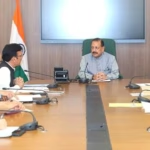
“S.H.I.N.E. invites students to apply scientific thinking to real-world public health challenges,” said Dr. Rajiv Bahl, Secretary of the Department of Health Research and Director General of ICMR. “We welcome all participating students and encourage them to make the most of this opportunity to interact directly with scientists, explore research laboratories, and experience the world of health innovation firsthand.”
The initiative forms a core building block of India’s Viksit Bharat 2047 vision, which prioritizes self-reliance in science, medicine, and healthcare technology.
Beyond the Classroom: What Happens Inside the Labs
During the two-day program, students will step away from rote learning and dive into experiential science. The immersive schedule includes:
-
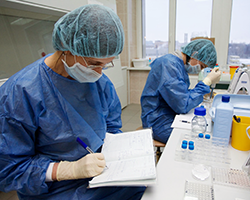
Guided Laboratory Visits: Access to specialized facilities studying epidemiology, vector-borne diseases, virology, nutrition, and non-communicable diseases.
-
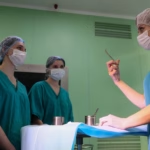
Live Scientific Demonstrations: Real-time observations of diagnostic procedures, microbial cultures, and modern biomedical instruments.
-
Interactive Poster Walks & Video Exhibits: Visual breakdowns of complex medical breakthroughs, from indigenous vaccine developments to digital health tracking.
-
Scientist Mentorship Sessions: Direct Q&A roundtables with leading researchers discussing career pathways, research ethics, and daily life in biomedical research.
       ┌────────────────────────────────────────────────────────┐
       │                 S.H.I.N.E. 2026 AT A GLANCE            │
       ├──────────────────────────┬─────────────────────────────┤
       │ Metric                   │ Coverage                    │
       ├──────────────────────────┼─────────────────────────────┤
       │ Host Facilities          │ 83 Locations Nationwide     │
       │ Student Participation    │ ~30,000 Students            │
       │ Target Grades            │ Grades 9 to 12 (Ages 14–18) │
       │ Institution Types        │ ICMR Institutes & MRHRUs    │
       │ Regional Scope           │ Metro, Tier-2, & Rural      │
       └──────────────────────────┴─────────────────────────────┘
Bridging the Rural-Urban Healthcare Gap
A critical element of S.H.I.N.E. 2026 is its deployment across DHR-Model Rural Health Research Units (MRHRUs). Rural healthcare challenges—ranging from vector control to maternal nutrition—often require localized research approaches.
Independent education and healthcare advocates have noted that introducing rural students to research happening in their own backyards provides immense educational equity.
“When students from rural districts see scientists solving health problems specific to their immediate environment, science stops being an abstract subject in a textbook,” observes Dr. Anita Sharma, a New Delhi-based community health education analyst not affiliated with the program. “It becomes a practical tool for community empowerment. This early exposure can inspire talent from underrepresented regions to enter biomedical research, which is essential for balanced healthcare delivery.”
Practical Impact and Public Health Policy
From a public health perspective, cultivating early health literacy yields benefits long before these students enter the workforce. High school students equipped with a clear understanding of scientific methodology, disease transmission, and evidence-based medicine act as “health ambassadors” within their families and local communities.
Research published in health communication literature indicates that adolescent health literacy directly correlates with improved health behaviors in households—including vaccine uptake, hygiene practices, and preventive screening awareness.
However, experts also note that one-off immersive days, while powerful spark points, must be backed by sustained engagement. Educational policy specialists emphasize that for S.H.I.N.E. to achieve long-term public health dividends, it should be paired with ongoing mentorship networks, science club integrations in schools, and summer internship pathways for senior students.
Looking Ahead: Building Sustainable Scientific Temper
As the second edition of S.H.I.N.E. doubles down on its geographic reach, ICMR reaffirms its commitment to nurturing a robust scientific temper across the country. By demystifying the laboratory environment, the program reassures young minds that medical innovation is not an elite, distant pursuit—it is an accessible, vital public service that starts with asking the right questions.
References
-
Press Information Bureau (PIB) Delhi. (2026, August 10). Department of Health Research- Indian Council of Medical Research (DHR-ICMR) to Host S.H.I.N.E. Nationwide, Inviting School Students to Spend a Day as Scientist. Ministry of Health and Family Welfare, Government of India.
Medical Disclaimer: This article is for informational purposes only and should not be considered medical advice. Always consult with qualified healthcare professionals before making any health-related decisions or changes to your treatment plan. The information presented here is based on current research and expert opinions, which may evolve as new evidence emerges.


Happy
0 %

Sad
0 %

Excited
0 %

Sleepy
0 %

Angry
0 %

Surprise
0 %