 0
0
 0
0
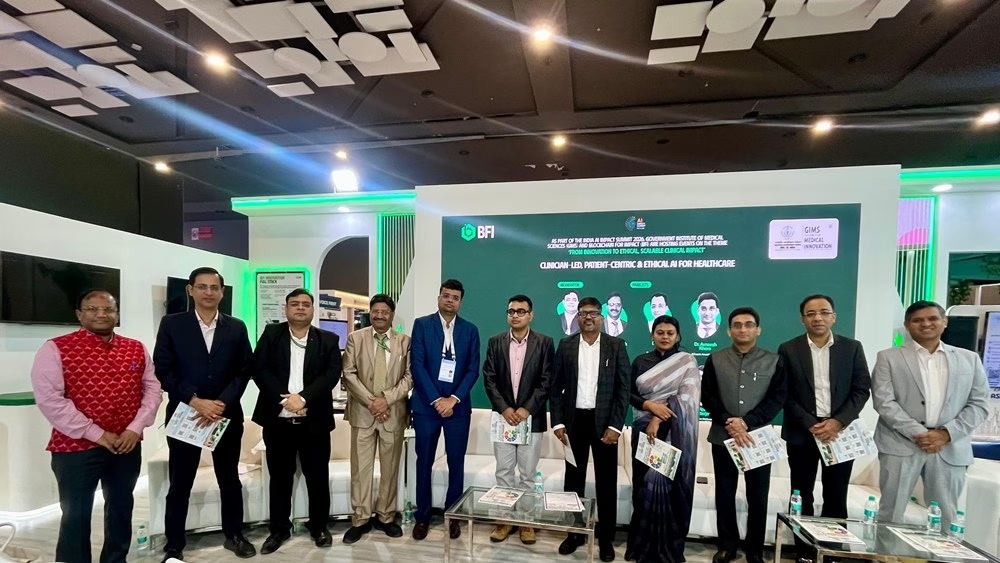
NEW DELHI – In a move that signals a paradigm shift for India’s public healthcare infrastructure, the Government Institute of Medical Sciences (GIMS), Greater Noida, unveiled the state’s first government-led medical incubator at the India–AI Impact Summit 2026. Held at Bharat Mandapam, the international debut positions Uttar Pradesh as a burgeoning hub for ethical, hospital-integrated artificial intelligence (AI), moving public institutions from the role of passive technology adopters to active engines of innovation.
The summit, occurring during the designated Year of Innovation for India and France, drew global attention to a unique “Section 8” incubation framework—a non-profit model embedded directly within a high-volume public hospital. This proximity allows developers to test AI tools in real-world clinical environments, ensuring that “Software as a Medical Device” (SaMD) is grounded in patient safety rather than just algorithmic speed.
A Model for the “Year of Innovation”
The presence of high-level French delegates, including Ms. Souad Tenfiche-Ancelle, CEO of LINK Co & Co and Co-President of La French Tech India, and Mr. Gautier Cloix, CEO of H Company, underscored the global resonance of the GIMS model. Their participation aligns with the diplomatic momentum established by Prime Minister Narendra Modi, who declared 2026 a year of bilateral innovation between the two nations.
“Public hospitals must not remain passive users of technology,” stated Brigadier (Dr.) Rakesh Kumar Gupta, Director of GIMS, during the summit. “They must actively shape innovation that is ethical, clinically validated, and aligned with patient welfare.”
The significance of this model lies in its ability to address a common “innovation gap” where high-tech startups develop medical tools that lack clinical relevance or fail to meet the rigorous safety standards required in a hospital setting.
Three Pillars of Ethical AI: The Summit Discussions
GIMS hosted three in-depth panels that outlined the future of public healthcare delivery through the lens of artificial intelligence.
1. The “Doctor-in-the-Loop” Mandate
Panelists argued that for AI to be safe and scalable, it must maintain a “doctor-in-the-loop” structure. This means algorithms are used to augment, not replace, clinical judgment. Discussion centered on ethical data governance—the practice of protecting patient privacy while allowing AI to learn from anonymized medical records—and alignment with global regulatory frameworks.
2. Preserving the Patient-Provider Relationship
The second panel addressed the human element of technology. Experts emphasized that AI should serve as a decision-support tool. By automating administrative tasks or preliminary screenings, AI can actually free up doctors to spend more face-to-face time with patients, potentially reducing burnout and improving the quality of care.
3. The AI Startup Clinic: Navigating the Regulatory Maze
The highlight of the event was the introduction of India’s first AI Startup Clinic within a government hospital. This clinic provides a structured pathway for developers to navigate:
-
CDSCO (Central Drugs Standard Control Organisation) regulatory compliance.
-
Real-world clinical validation using diverse patient data.
-
Market readiness assessments for public health deployment.
Implications for Public Health and Daily Care
For the average citizen, the GIMS incubator model promises more than just high-tech prestige; it signals a future of more accurate and accessible healthcare. When AI tools are developed within a public hospital like GIMS, they are tested against the diverse and complex cases typical of India’s public healthcare system.
“We have built a structured, regulatory-ready incubation ecosystem within a functioning government hospital,” said Dr. Rahul Singh, CEO of the Centre for Medical Innovation (CMI) at GIMS. “Recognition at a global forum like this reinforces that India can set international benchmarks in healthcare AI grounded in safety, governance, and real patient impact.”
For patients, this could mean:
-
Early Detection: AI algorithms that can spot early signs of diseases like tuberculosis or diabetic retinopathy in imaging scans faster than a manual review.
-
Resource Optimization: AI that predicts patient surges, ensuring that beds and staff are allocated efficiently.
-
Reduced Costs: Domestically developed AI tools, validated in public hospitals, are likely to be more affordable than imported proprietary software.
Navigating the Challenges: The Balanced Perspective
While the enthusiasm at Bharat Mandapam was palpable, experts caution that the road to AI integration is not without hurdles. Public trust remains a primary concern. A 2024 study published in The Lancet Digital Health highlighted that patient acceptance of AI is largely dependent on transparency regarding how data is used and who remains accountable for medical errors.
Furthermore, the “digital divide” remains a challenge. For AI to truly impact public health in states like Uttar Pradesh, the infrastructure—including high-speed internet and hardware in rural clinics—must catch up with the software being developed in urban incubators.
Critics also point out that while a government-led incubator is a massive step forward, long-term sustainability will require consistent funding and a continuous pipeline of trained “medical-technologists”—professionals who understand both clinical medicine and data science.
Conclusion: A New Chapter for Uttar Pradesh
The GIMS debut at the India–AI Impact Summit 2026 marks a turning point. It suggests that the future of medical technology in India will not just be “imported” or “bought,” but “built” and “validated” within the very institutions that serve the public.
By integrating clinical leadership with ethical AI, Uttar Pradesh is positioning itself as a leader in a global conversation about how technology can serve humanity without sacrificing safety or privacy. As the Year of Innovation unfolds, the world will be watching to see how this Greater Noida model scales to other regions.
Reference Section
UP’s First Government Medical Incubator Goes Global at India–AI Impact Summit 2026
Medical Disclaimer: This article is for informational purposes only and should not be considered medical advice. Always consult with qualified healthcare professionals before making any health-related decisions or changes to your treatment plan. The information presented here is based on current research and expert opinions, which may evolve as new evidence emerges.