 0
0
 0
0
World Cities Day 2025
People-centred smart cities
World Cities Day, designated by the United Nations General Assembly resolution 68/239, is celebrated annually on 31 October. It serves as an opportunity to promote the international community’s interest in global urbanization, advance cooperation among countries in addressing urban challenges and contribute to sustainable urban development around the world.
This year’s World Cities Day (WCD) focuses on promoting smart city initiatives that put people at the centre. The concept of a people-centred smart city goes beyond technological advancements and digital innovation. It emphasizes evidence-driven decision-making, integrated urban systems, and participatory governance to make urban areas more inclusive and sustainable.
The World Health Organization (WHO) joins UN partners and global stakeholders in commemorating WCD 2025 by highlighting the critical role of urban health in putting people’s health at the centre of smart transition in cities around the world.
To mark the occasion, WHO is launching a set of new resources that provide strategic frameworks, practical guidance, and capacity-building opportunities to help integrate health across urban policy domains, promoting more comprehensive and coordinated approaches to strengthen health responses to emerging megatrends and evolving policy environments.
Taking a strategic approach to urban health: a guide for decision-makers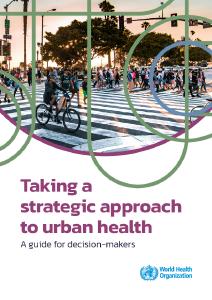
Overview
Governments face complex health challenges shaped by the evolving interactions of people and institutions with urban environments; these are compounded as cities expand and urban populations grow. This WHO guide provides a structured framework for addressing such challenges strategically, avoiding the limitations and undesired consequences of fragmented, short-term initiatives.
The comprehensive report reviews what urban health entails, why it matters, and how to make progress through integrated, long-term action. It outlines the case for prioritizing urban health from epidemiologic, economic, equity, and sustainability perspectives, and shows how decisions in diverse sectors—from climate adaptation to digital transformation—affect well-being in cities. The guide centers on the idea that urban health is a shared responsibility and a strategic societal goal that requires coordination across government and with communities, civil society, and the private sector.
It proposes practical approaches to recognizing complexity, leveraging political and policy entry points, and strengthening means of implementation through governance, financing, capacity-building, data systems, evidence-based decision-support, innovation, partnerships, and participation. The guide also provides recommendations for developing comprehensive urban health strategies adaptable to local contexts.
Drawing on contributions from experts and case examples from cities worldwide, the guide positions urban health as essential to sustainable development, equity, and resilience. It offers decision-makers a roadmap to replace siloed actions with coherent strategies that enable all urban residents to thrive now and in the future.