0
0
 0
0
World Blood Donor Day 2025
Give blood, give hope: together we save lives
On 14 June, the world celebrates World Blood Donor Day, a global tribute to the millions of voluntary, unpaid blood donors who give others a second chance at life. Their generosity saves lives, strengthens communities and embodies the spirit of solidarity. It’s a day to say thank you, but also to spotlight the ongoing, urgent need for safe, regular blood donations.
This year, we honor hope, the kind you give with every drop of blood. Because millions of patients around the world rely on blood transfusions every year, hope flows through every donation.
The objectives of the campaign:
- raise public awareness about the critical need for blood and plasma donations and the impact they have on patients’ lives;
- encourage both new and existing donors to give blood regularly, helping to ensure a stable and sufficient blood supply;
- highlight the positive impact of blood donors on the health and well-being of others and promote the values of solidarity, compassion, and community through blood donation; and
- mobilize support from governments and development partners to invest in and sustain national blood programs to achieve universal access to safe blood transfusion worldwide.
Key messages
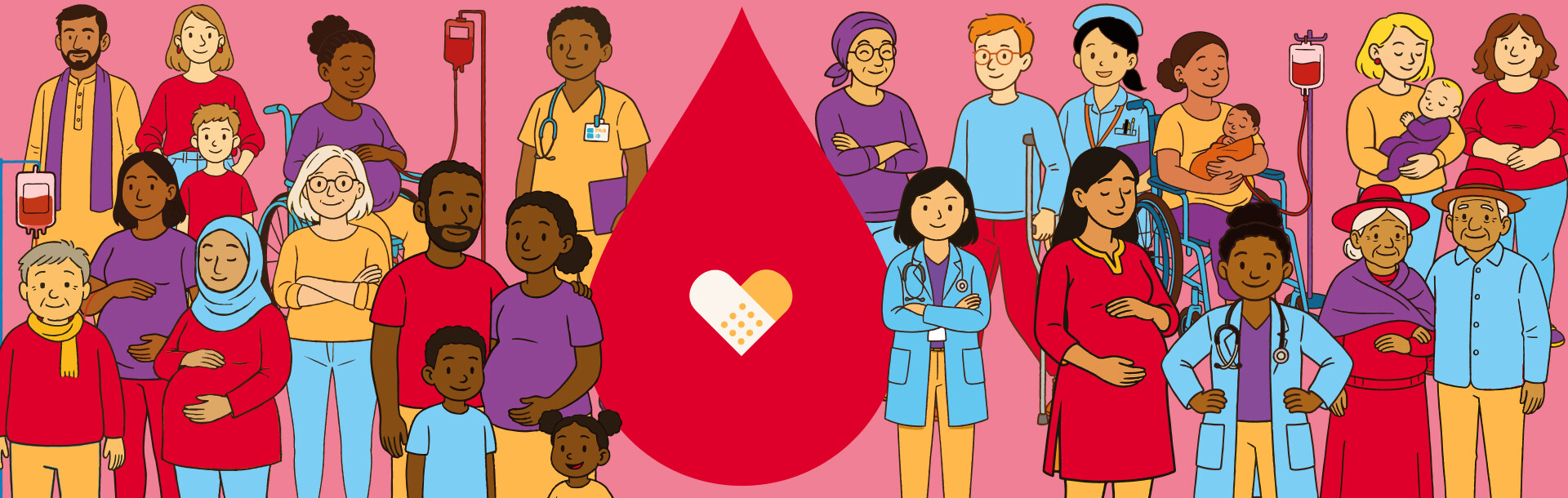
- Safe blood saves lives. A single donation can help save up to three lives.
- Every blood donation is a gift of hope. It can mean the difference between life and death for patients in need of transfusions.
- Blood donation is a collective effort and a powerful act of solidarity. By coming together as a community of donors, we ensure a steady and safe blood supply for all who need it.
- Anyone, anywhere, who needs a transfusion should have timely access to safe blood. Yet in many cases, particularly in emergencies or where donation systems are still developing, the demand often outpaces the supply.
- Everyone who can donate blood should consider making regular voluntary, unpaid donations, so that all countries have adequate and reliable blood supplies.
- Access to safe blood and blood product is essential for universal health coverage and a key component of effective health systems.
- Governments and partners must invest in strong national blood programs to ensure universal access to safe blood transfusions.
- Thank you to all blood donors for your invaluable contributions in bringing hope and saving lives.
Key messages also align with the year-long World Health Day campaign focused on maternal and newborn health: Give blood, give hope. Support maternal and child health for healthy beginnings, hopeful futures!
- 14 million women hemorrhage during childbirth every year. Timely access to safe blood transfusion is crucial for appropriate response and saving lives.
- Severe bleeding during and after childbirth is a top cause of maternal death, particularly in developing countries.
- Millions of babies and young children are also at risk: severe anemia, often resulting from malnutrition and malaria, claim many young lives.
- Timely access to safe blood transfusions can prevent maternal and child deaths.
- A blood donation can save a mother. A baby. A future.
What you can do
Everyone
- Be a voluntary blood donor and an inspiration to others.
- Commit to being a regular donor and give blood throughout the year.
- Encourage your friends and family to become regular blood donors.
- Volunteer with the blood service to reach out to members of your community, provide care to donors, and help manage blood donation sessions/drives.
- Find out your blood type and register as a blood donor.
- Participate in World Blood Donor Day with your social networks.
Ministries of Health
- Organize and participate in (virtual) activities to celebrate World Blood Donor Day, promoting voluntary unpaid blood donation to the public, across government and to other sectors.
- Acknowledge the crucial role of well-organized, committed voluntary, non-remunerated blood donors in ensuring a safe and sufficient blood supply during normal and emergency times.
- Provide resources and infrastructure to facilitate voluntary blood donation.
- Support the development of nationally coordinated blood transfusion services that provide equitable access to safe and quality assured blood transfusions for the whole population.
- Put quality assurance systems in place for blood and blood products.
- Speak to media about the importance of blood donation and the successes and challenges of your country in meeting national needs for blood.
National blood transfusion services
- Disseminate information about the importance of giving blood.
- Distribute campaign materials that you can download from the World Blood Donor Day campaign website.
- Organize a virtual World Blood Donor Day celebration. This could include: inviting prominent politicians, celebrities and sporting heroes to make videos or communicate on the importance of giving blood;
- Producing and disseminating promotional materials through your web site and social channels; setting up virtual visits of blood centres and inviting the public to learn about blood donation and transfusion; and promoting blood donation success stories and heroic blood donors to your media.
- Improve the infrastructure for blood donation and blood donor care.
- Focus attention on donor health and care and provide quality service to blood donors.
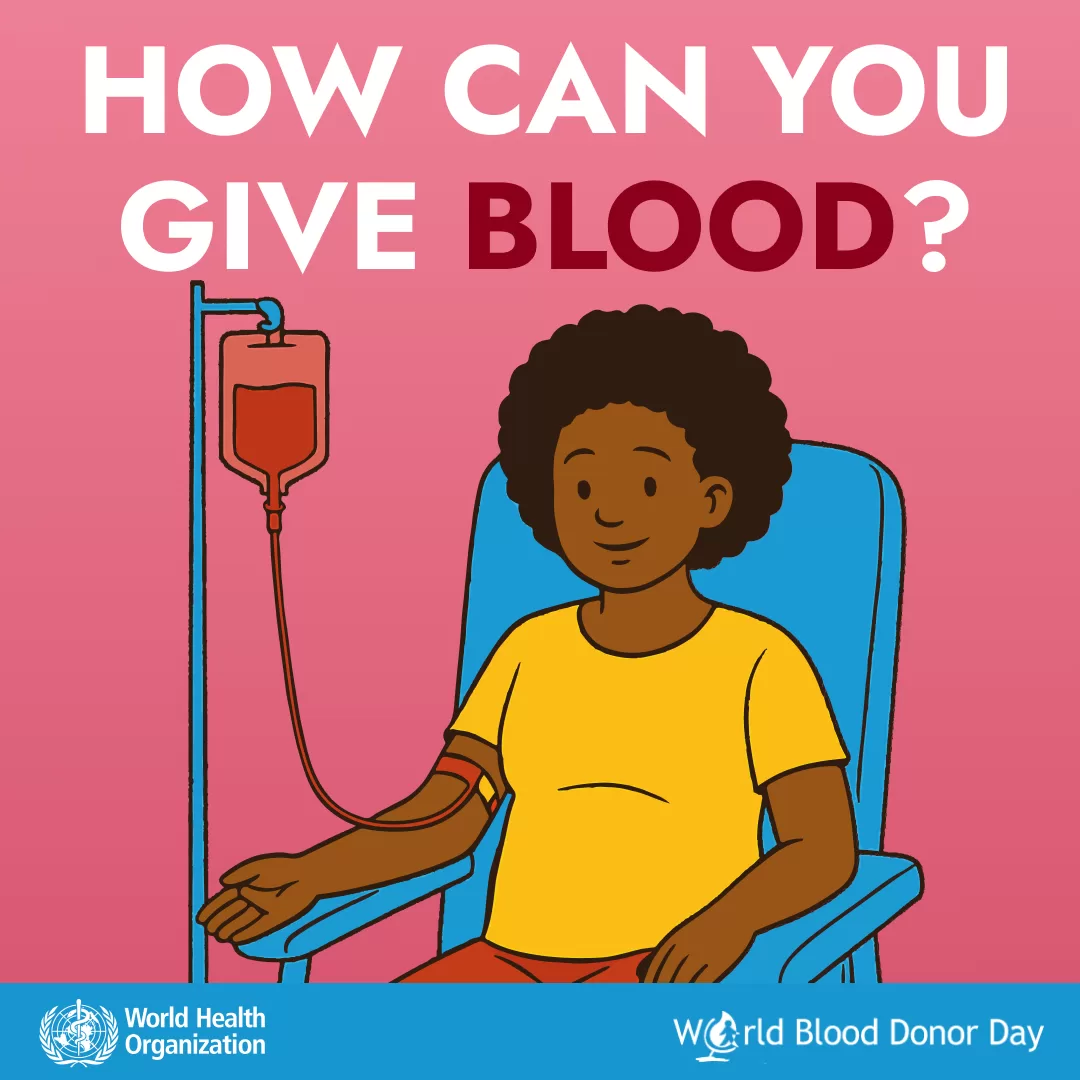
Who can give blood
Most people can give blood if they are in good health. There are some basic requirements one need to fulfill in order to become a blood donor. Below are some basic eligibility guidelines:
Age
You are aged between 18 and 65.
- In some countries national legislation permits 16–17 year-olds to donate provided that they fulfil the physical and hematological criteria required and that appropriate consent is obtained.
- In some countries, regular donors over the age of 65 may be accepted at the discretion of the responsible physician. The upper age limit in some countries are 60.
Weight
You weigh at least 50 kg.
- In some countries, donors of whole blood donations should weigh at least 45 kg to donate 350 ml ± 10%.
Health
You must be in good health at the time you donate.
You cannot donate if you have a cold, flu, sore throat, cold sore, stomach bug or any other infection.
If you have recently had a tattoo or body piercing you cannot donate for 6 months from the date of the procedure. If the body piercing was performed by a registered health professional and any inflammation has settled completely, you can donate blood after 12 hours.
If you have visited the dentist for a minor procedure you must wait 24 hours before donating; for major work wait a month.
You must not donate blood If you do not meet the minimum haemoglobin level for blood donation:
- A test will be administered at the donation site. In many countries, a haemoglobin level of not less than 12.0 g/dl for females and not less than 13.0 g/dl for males as the threshold.
Travel
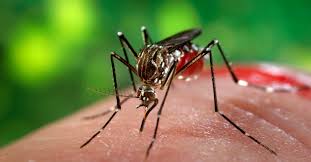
Travel to areas where mosquito-borne infections are endemic, e.g. malaria, dengue and Zika virus infections, may result in a temporary deferral.
Many countries also implemented the policy to defer blood donors with a history of travel or residence for defined cumulative exposure periods in specified countries or areas, as a measure to reduce the risk of transmitting variant Creutzfeldt-Jakob Disease (vCJD) by blood transfusion.
Behaviours
You must not give blood:
- If you engaged in “at risk” sexual activity in the past 12 months
- Individuals with behaviours below will be deferred permanently:
- Have ever had a positive test for HIV (AIDS virus)
- Have ever injected recreational drugs.
In the national blood donor selection guidelines, there are more behavior eligibility criteria. Criteria could be different in different countries.
Pregnancy and breastfeeding
Following pregnancy, the deferral period should last as many months as the duration of the pregnancy.
It is not advisable to donate blood while breast-feeding. Following childbirth, the deferral period is at least 9 months (as for pregnancy) and until 3 months after your baby is significantly weaned (i.e. getting most of his/her nutrition from solids or bottle feeding).
More information on eligibility to donate
National eligibility guidelines must be followed when people donate blood in the blood service in specific countries. To find out whether any health conditions, medications, professions or travel history to could affect your ability to give blood, please search for detailed information in the national/local blood services.