 0
0
 0
0
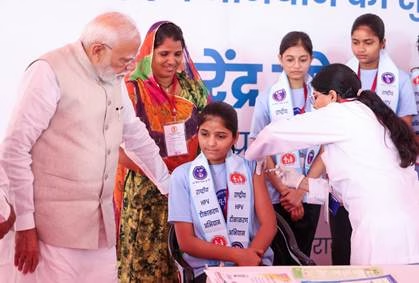
AJMER, RAJASTHAN — In a move hailed as a “landmark step” for global public health, Prime Minister Narendra Modi officially launched India’s nationwide Human Papillomavirus (HPV) vaccination campaign on February 28, 2026. Speaking from Ajmer, the Prime Minister announced that the government will target 1.15 crore adolescent girls aged 14 each year, providing the vaccine free of charge to combat a disease that remains one of the leading killers of women in India.
The initiative, integrated into the government’s “Swastha Nari” (Healthy Woman) vision, seeks to bridge health equity gaps by making the life-saving shots available at primary healthcare centers, including Ayushman Arogya Mandirs, across all states and union territories.
The Strategy: A Single Dose to Save Millions
The campaign follows the latest recommendations from the World Health Organization (WHO) and India’s National Technical Advisory Group on Immunization (NTAGI), which support a single-dose schedule for this age group. This streamlined approach simplifies logistics and reduces the burden on the healthcare system while maintaining high levels of efficacy.
The rollout will utilize both the quadrivalent Gardasil vaccine and India’s first indigenous HPV vaccine, Cervavac. Both vaccines are designed to protect against HPV types 16 and 18—which cause approximately 70% of cervical cancers—as well as types 6 and 11, which are responsible for 90% of genital warts.
“India’s introduction of HPV vaccination at a national scale will have a far-reaching impact,” stated Dr. Catharina Boehme, WHO South-East Asia Officer-in-Charge. “It accelerates progress not only for the country but for the entire region and the world.”
The program begins with a three-month intensive phase focusing on daily vaccinations with mandatory parental consent. Prime Minister Modi emphasized the government’s commitment, stating, “We are leaving no stone unturned to ensure the daughters of the country are healthy and prosperous.”
A Heavy Burden: Why Now?
The urgency of this campaign is underscored by sobering statistics. In India, cervical cancer claims nearly 80,000 lives annually. In 2022 alone, 127,000 new cases were reported, accounting for one-fifth of the global burden.
Cervical cancer is caused by persistent infection with high-risk strains of HPV, a common virus transmitted through skin-to-skin contact, usually during sexual activity. Despite being highly preventable, the disease disproportionately affects women in low-resource settings.
-
Late Detection: Currently, 60–70% of cases in India are detected at advanced stages when treatment is less effective.
-
Low Screening: National screening coverage stands at a mere 1.9%.
-
Regional Disparity: The Northeast region of India faces the highest disease burden, with disability-adjusted life years (DALYs) exceeding 290 per 100,000 women.
Scientific Evidence and Safety
The decision to launch a national drive is backed by over 15 years of global real-world data. Peer-reviewed studies, including a comprehensive Cochrane review of 60 trials involving over 150,000 participants, have confirmed that HPV vaccines reduce the risk of cervical cancer by 80–90% when administered before age 16.
Medical experts are working to reassure the public about the vaccine’s safety profile. “These vaccines are remarkably safe,” says Dr. R. S. Bhatia, Assistant Professor of Oncology at AIIMS-New Delhi, who was not involved in the government rollout. “Rigorous evidence confirms high protection against cancer-causing strains. Side effects are typically mild—such as soreness at the injection site—and are consistent with other common childhood vaccines.”
Dr. Bhatia describes the campaign as “the beginning of the end for cervical cancer in India,” noting that the vaccine provides a critical layer of protection that lasts for at least a decade, and likely much longer.
The Global “90-70-90” Goal
India’s campaign aligns with the WHO’s global strategy to eliminate cervical cancer by 2030. The targets, known as the 90-70-90 goals, include:
-
90% of girls fully vaccinated with the HPV vaccine by age 15.
-
70% of women screened with a high-performance test by ages 35 and 45.
-
90% of women identified with cervical disease receiving treatment.
Achieving these targets globally could avert an estimated 62 million deaths over the next century. India’s scale is particularly significant; as the most populous nation, its success is a prerequisite for global elimination.
Navigating Challenges: Stigma and Supply
Despite the scientific backing, the campaign faces hurdles. India’s history with HPV vaccination includes a 2008–2010 trial that was suspended following media scrutiny over unrelated deaths, which fueled long-standing vaccine hesitancy and stigma regarding sexual health.
Current barriers include:
-
Low Awareness: Most rural populations remain unaware of the link between HPV and cancer.
-
Logistics: Reaching “out-of-school” girls who may not be captured by school-based drives.
-
Screening Gaps: While the vaccine prevents future cases, millions of adult women remain at risk and require improved HPV-DNA testing.
Public health officials emphasize that the vaccine does not protect against all types of cervical cancer, meaning that regular screening remains essential even for those who are vaccinated.
What This Means for You
For parents of adolescent girls, the message from health authorities is clear: the vaccine is most effective when given before exposure to the virus. By providing the vaccine at age 14, the government aims to create a “shield” of immunity before most individuals enter their reproductive years.
Healthcare professionals are encouraged to integrate vaccination discussions into routine pediatric and adolescent check-ups. For the general public, the campaign represents a shift toward preventive oncology—treating cancer not just in the hospital, but in the community through immunization.
As the program expands, the focus will remain on transparent communication to counter misinformation. “Success hinges on community trust,” says Dr. Bhatia. “When we protect our daughters today, we are preventing a tragedy 20 years from now.”
Medical Disclaimer
This article is for informational purposes only and should not be considered medical advice. Always consult with qualified healthcare professionals before making any health-related decisions or changes to your treatment plan. The information presented here is based on current research and expert opinions, which may evolve as new evidence emerges.
References
-
Economic Times Health (2026). WHO South-East Asia Region congratulates India on national launch of HPV vaccination campaign.