 0
0
 0
0
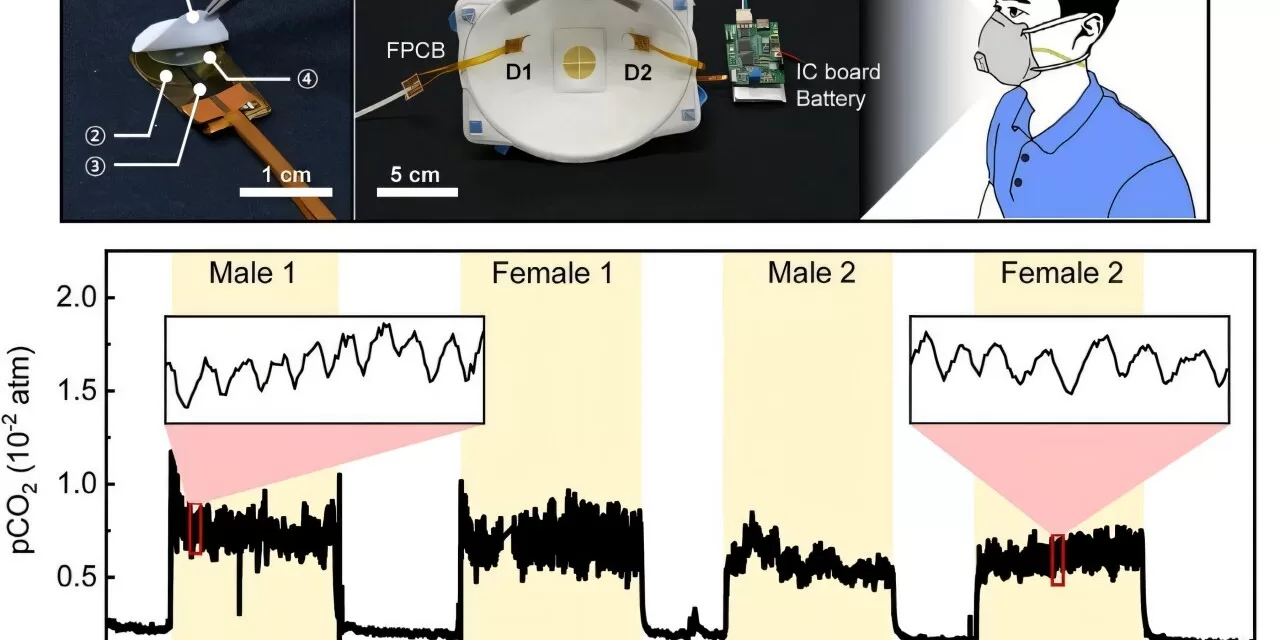
A groundbreaking wearable carbon dioxide (CO2) sensor developed by researchers at the Korea Advanced Institute of Science and Technology (KAIST) is poised to revolutionize respiratory health monitoring. The sensor, designed to be attached to the inside of a mask, enables real-time measurement of CO2 concentration in exhaled breath, facilitating the early diagnosis of respiratory and circulatory system diseases, including sleep apnea.
Innovative Technology for Continuous Monitoring
Led by Professor Seunghyup Yoo from KAIST’s Department of Electrical and Electronic Engineering, the research team has successfully created a low-power, high-speed CO2 sensor capable of stable, real-time breathing monitoring. Unlike traditional non-invasive CO2 sensors, which are often large and power-intensive, this optochemical CO2 sensor is lightweight, compact, and energy-efficient.
Optochemical sensors utilize fluorescent molecules to detect CO2 concentration by monitoring changes in fluorescence intensity. However, conventional versions face limitations due to photodegradation, leading to errors over time. The KAIST team addressed this issue by developing an optical design that suppresses errors caused by photodegradation, thereby extending the sensor’s usability.
Efficiency and Practical Applications
The newly developed sensor, which integrates an LED and an organic photodiode, boasts high light collection efficiency and ultra-low power consumption of just 171 μW—significantly lower than existing models consuming several milliwatts. This breakthrough extends its continuous operational duration to nine hours, compared to the 20-minute lifespan of previous technologies. Additionally, the device remains reusable by replacing the CO2 detection fluorescent film.
With a weight of only 0.12 grams and a thickness of 0.7 mm, the sensor is both flexible and highly sensitive, distinguishing between inhalation and exhalation in real time. These features make it particularly promising for medical applications, including the early diagnosis of hypercapnia, chronic obstructive pulmonary disease (COPD), and sleep apnea.
Potential for Widespread Use
Professor Yoo highlighted the sensor’s potential applications beyond disease diagnosis, stating, “The developed sensor has excellent characteristics such as low power consumption, high stability, and flexibility, making it suitable for various wearable devices. It can also be used to mitigate the adverse effects of prolonged mask-wearing, especially in environments with high dust levels or seasonal changes.”
The research findings, published in the journal Device, offer a promising step forward in wearable healthcare technology. The study, authored by MinJae Kim et al., provides critical insights into improving sensor stability and accuracy for long-term use.
Disclaimer
This article is based on research findings and is intended for informational purposes only. It does not constitute medical advice, diagnosis, or treatment. Individuals experiencing respiratory issues should consult a healthcare professional for proper evaluation and care.