 0
0
 0
0
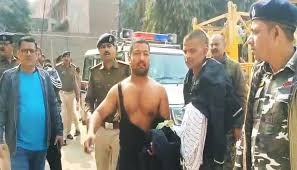
PATNA — Healthcare services at one of Bihar’s largest state-run hospitals, Patna Medical College and Hospital (PMCH), have come to a grinding halt as junior doctors initiated an indefinite strike on Wednesday. The mass walkout follows a violent assault on a female junior doctor and her colleagues by the relatives of a deceased patient, marking the second such attack on medical staff at the facility in less than a week. The incident has once again brought the precarious safety conditions of healthcare professionals in India to the forefront, triggering a standoff that leaves thousands of patients in limbo.
The Flashpoint: “We Cannot Work Under Threat”
The unrest began on the morning of December 3, 2025, following the death of a 70-year-old patient admitted with a severe brain hemorrhage and hypertension. According to hospital reports, the patient was in critical condition upon arrival, and the prognosis had been communicated to the family.
However, following the patient’s passing, a confrontation ensued. Relatives of the deceased allegedly accused the medical team of negligence. The situation escalated rapidly when a female attendant verbally abused a female intern. When a resident doctor intervened, the aggression turned physical.
“A patient with a brain hemorrhage, over 60 years old, was brought to us. It was explained to the family that the chances of survival were very low,” said Dr. Ritika, a junior doctor at PMCH. “Unfortunately, the patient passed away. After this, the female attendant of the patient verbally abused our female intern… the family also verbally abused the resident doctor.”
Witnesses report that the medical staff was subjected to physical assault, with some accounts alleging that relatives used sticks and helmets during the altercation. The deceased’s family has countered these claims, alleging that doctors were the ones who became aggressive when asked to re-check the patient—a claim the Junior Doctors’ Association (JDA) vehemently denies, citing the medical impossibility of reviving a deceased patient with such severe pathology.
A Pattern of Violence
This incident was not an isolated event but rather the breaking point for a medical workforce already on edge. Just days prior, a doctor on duty in the neurosurgery operation theatre was reportedly punched in the head by an individual demanding an immediate blood sample investigation.
The JDA at PMCH responded swiftly, announcing a total suspension of all services, including Emergency, Outpatient Departments (OPD), Inpatient Services (IPD), and elective surgeries.
“The strike is being undertaken with immediate effect and shall continue until meaningful, verifiable actions are taken to ensure the safety of doctors on duty,” the JDA stated in a press release. “We deeply regret the hardship caused to the public; however, it is impossible to deliver patient care under continuous threat, intimidation, and violence.”
The Silent Epidemic: Data Reveals a Crisis
The violence at PMCH mirrors a disturbing national trend. According to the Indian Medical Association (IMA), nearly 75% of doctors in India have faced some form of violence during their careers. A significant portion of these attacks occurs in the grim interface of emergency care, where grief and systemic inefficiencies often boil over into rage directed at frontline workers.
A 2024 survey by the IMA revealed that over one-third of doctors feel unsafe during their night shifts, with female professionals reporting significantly higher levels of vulnerability. Despite the existence of state-level legislation, such as the Bihar Medical Service Institution and Person Protection Act, 2011, enforcement remains a critical gap. The Act theoretically provides for imprisonment and fines for offenders, yet convictions are rare, and “institutional FIRs”—where the hospital administration files the police complaint on behalf of the doctor—are often delayed or neglected.
Expert Perspectives: The Need for Central Protection
Healthcare policy experts argue that piecemeal state laws are insufficient to curb what has become a national crisis.
Dr. R.V. Asokan, a senior leader within the medical community, has previously highlighted the “dark reality” of the profession, noting that violence is often a symptom of infrastructural collapse. “Families arrive in emergency rooms, frightened, desperate, and overwhelmed,” notes Dr. Asokan. “When they face overcrowded wards, non-functional equipment, or staffing shortages, the doctor becomes the visible target for their frustration with the entire system.”
Recently, Parliamentarians like Rajya Sabha MP Fauzia Khan have echoed the medical community’s demand for a Central Protection Act, arguing that a uniform national law with non-bailable warrants is necessary to act as a genuine deterrent.
Public Health Implications
The immediate fallout of the strike is being felt by the patients, many of whom travel from rural Bihar to Patna for specialized care. “There is swelling in my hand, and I am feeling very uncomfortable,” said a patient waiting outside the OPD, who had traveled specifically for treatment. “I found out today that there is a strike going on here, and no doctors are available.”
While the ethical dilemma of striking remains a subject of debate, the medical community maintains that patient safety is intrinsically linked to doctor safety. “A terrified doctor cannot make sound clinical decisions,” explains Dr. Ritika. “If we are constantly looking over our shoulder, fearing for our lives, the quality of care for every patient suffers.”
The Path Forward
The PMCH junior doctors have outlined specific demands for ending the deadlock:
-
Institutional FIRs: Mandatory filing of police complaints by the hospital administration for every incident of violence.
-
Enhanced Security: Deployment of armed security personnel at sensitive points like the ICU and Emergency wards.
-
Legal Enforcement: Strict application of the Bihar Medical Service Institution and Person Protection Act.
As the strike continues, the pressure mounts on the state health department to intervene. For now, the corridors of PMCH remain tense, a battleground where the fight for health has tragically turned into a fight for survival for the healers themselves.
Medical Disclaimer:
This article is for informational purposes only and should not be considered medical advice. Always consult with qualified healthcare professionals before making any health-related decisions or changes to your treatment plan. The information presented here is based on current research and expert opinions, which may evolve as new evidence emerges.
References
-
Primary Incident Report:
-
Saha, A. (2025, December 4). Violence at PMCH: Female junior doctor, colleagues attacked, doctors go on strike. Medical Dialogues. https://medicaldialogues.in/news/health/doctors/violence-at-pmch-female-junior-doctor-colleagues-attacked-doctors-go-on-strike-160009
-