 0
0
 0
0
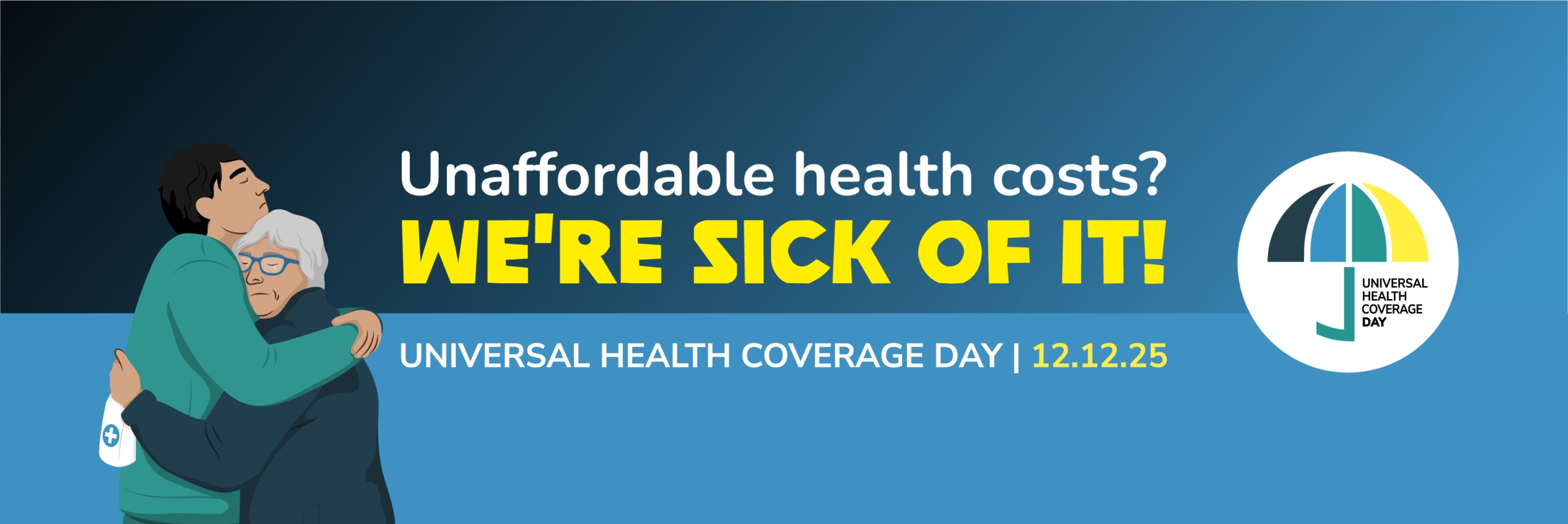
Universal Health Coverage Day 2025 shines a spotlight on the devastating human impact of unaffordable health costs.
Despite numerous high-level political commitments to achieve Universal Health Coverage (UHC) by 2030, more than half of the world’s population still lacks access to essential health services. One in four people face financial hardship when paying for health care out of their own pockets-often at the expense of basic needs such as food, education or housing.
Health for all is a prerequisite for achieving the sustainable development goals (SDGs). Healthier populations foster communities that are more resilient, productive, peaceful and prosperous. When people delay or forgo health care due to costs, they risk worsening health outcomes and longer-term health and financial burden. Conversely, when governments prioritize to ensure people have access to affordable health care, they lay the groundwork for sustainable progress across all sectors.
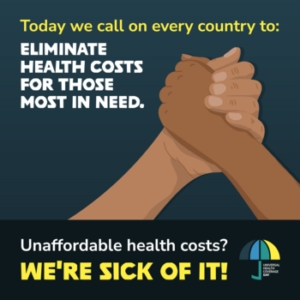
On UHC Day, WHO calls for urgent action to implement financial protection measures and eliminate out-of-pocket health costs for those most in need–including people with low incomes or chronic conditions.
Key facts
- At the current pace, the world is not on track to achieve universal health coverage (UHC), despite earlier gains in expanding health service access and reducing financial hardship since 2000. Progress has slowed since 2015.
- The UHC service coverage index increased from 54 to 71 between 2000 and 2023. However, for the period of 2015-2023, progress dropped to one-third of the annualized rate compared to pre-2015 gains.
- The proportion of the population not covered by essential health services decreased by about 20% between 2000 and 2023, indicating that in 2023, about 4.6 billion people were not fully covered.
- In 2022, 2.1 billion people faced financial hardship, including 1.6 billion people living in poverty or pushed deeper into it due to out-of-pocket health expenses. This equates to 26% of the population, a drop from 34% in 2000.
- All WHO regions saw progress in service coverage, while half (Africa, South-East Asia, and the Western Pacific) also reduced financial hardship since 2015.
Overview
Universal health coverage (UHC) means that all people have access to the full range of quality health services they need, when and where they need them, without financial hardship. It covers the full continuum of essential health services, from health promotion to prevention, treatment, rehabilitation and palliative care across the life course.
Achieving UHC is one of the targets the nations of the world set when they adopted the 2030 Sustainable Development Goals (SDGs) in 2015. At the United Nations General Assembly High Level Meeting on UHC in 2019, countries reaffirmed that health is a precondition for and an outcome and indicator of the social, economic and environmental dimensions of sustainable development. In 2025, the United Nations Statistical Commission approved proposals for revisions of the SDG UHC indicators, as part of a comprehensive review of all SDG indicators. The revised global UHC monitoring framework uses the following two indicators: SDG indicator 3.8.1: UHC service coverage index and SDG indicator 3.8.2 : proportion of the population facing financial hardship in health.
Progress towards UHC
Globally the strongest gains were made in both UHC indicators between 2000 to 2015. The annualized rate of improvement in the service coverage index was 1.5%, but after 2015 that slowed to 0.5%. Financial hardship was also reducing more quickly – about 0.37 percentage points, versus about 0.28 in the period that followed. At the current trajectory, the world will not achieve UHC by 2030; the global service coverage index is projected to be 74 out of 100, and 24% of the population will continue to face financial hardship.
Global progress in service coverage index has been driven primarily by infectious disease control, accounting for 52% of the increase in the service coverage index since 2000. In contrast, reproductive, maternal, newborn, and child health services stagnated in recent years at 72 index points; while care for noncommunicable diseases has lagged, reaching 61 index points in 2023. Disparities in service coverage between countries have narrowed, and the number of countries categorized as having low or very low coverage fell from 55 to just 8 from 2000 between 2023.
Between 2000 and 2022, impoverishing out-of-pocket (OOP) health spending declined mainly because fewer people were further impoverished by health payments (falling from 26.6% to 18.6%), while the share pushed into poverty remained largely unchanged at 1.9–2.8%. However, poverty reduction occurred faster than reductions in impoverishing OOP spending, resulting in a growing concentration of people pushed into or further into poverty by health costs among those already poor.
Inequalities continue to be a fundamental challenge for UHC. Even where there is national progress on UHC, the aggregate data mask inequalities within countries and continue to limit equitable access to care, particularly along economic, educational, and geographic lines.
Across a subset of European countries in 2019, the unmet need for health care showed clear within-country inequalities. Median levels were higher among the poorest 20% than the richest 30% (32% vs 22%), among people with severe disability compared with no disability (42% vs 21%), and among rural compared with urban residents (27% vs 23%).
In 2022, 3 out of 4 people among the poorest segment of the populations faced financial hardship from health costs, compared with fewer than 1 in 25 among the richest.
Financial hardship from health spending also varies by age, household composition, and place of residence – rural populations experience a median hardship rate 14% higher than urban populations, and people in multigenerational households, especially those with adults over 60, face greater financial strain.
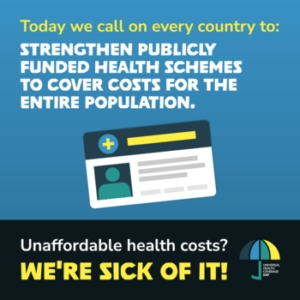
The trends and gaps described point to the need for stronger policies that reduce out-of-pocket spending – especially for the poor and for those on medicines, that expand essential NCD and primary health-care services, that strengthen publicly-funded prepaid coverage, and that adopt multisectoral approaches to address broader determinants of health.
Detailed data is provided in the WHO Global Health Observatory Data Repository for UHC
WHO publishes global reports on UHC every two years.
What can you do?
Step 1: Spread the word!
This year’s campaign slogan is “Unaffordable health costs? We’re sick of it!”
For hundreds of millions of people, access to health care remains unaffordable, especially for those who are already struggling to meet other basic needs such as food, education or housing. This is unacceptable, and we won’t stand for it! In 2024 we held governments to account for their global commitments to universal health coverage (UHC). Now we’re reminding government decision-makers that behind every statistic is a valuable human life. The 2025 UHC Day campaign will push for immediate, tangible action to uphold the right to health.
How? Let’s start by challenging the status quo. It is not normal for people to miss out on or delay health care because of the cost. Or to be pushed into or further into poverty when paying for health care out of their own pockets. Unaffordable health costs are making our communities poorer and sicker. They’re worsening inequalities and holding us back on all the Sustainable Development Goals. Starting today, share the images and messages below to spread awareness of this injustice and set the foundation for our campaign calls to action.
Step 2: Tell your story.
More than half the world’s population still lacks access to essential health services. And a quarter of them face financial hardship when paying for health care out of their own pockets, often at the expense of food, education or housing. These numbers can be hard to grasp, but we must not forget that there are real people behind them. This UHC Day, let’s share the stories behind the data to remind leaders that these aren’t just statistics, but human lives we’re talking about.
How? If you’ve ever had to choose between paying for medicines or a visit to the doctor and other necessities, such as food, housing and education, share your story in a short video. Publish it on social media platforms and use the hashtags #HealthCostsHurt and #UHCDay so that we and other advocates can amplify it!
When we come together to share our stories, we bring social participation to life. By telling your story, you can help decision-makers understand and respond to the real challenges and needs of your community.
Step 3: Call for change.
Unaffordable health costs often force families to choose between paying for medicines or a visit to the doctor and other necessities, such as food, housing and education. On the other hand, investing in UHC based on primary health care enhances health and well-being while fostering equity and social cohesion. In other words, when leaders prioritize people’s health as a foundation for national development, they lay the groundwork for sustainable progress across all sectors. This UHC Day, let’s remind leaders of what needs to be done to turn commitments into action and make health for all a reality for everyone, everywhere.
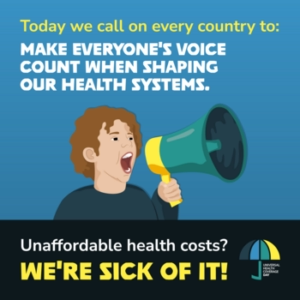
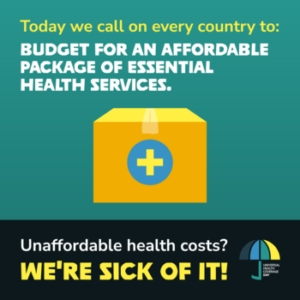
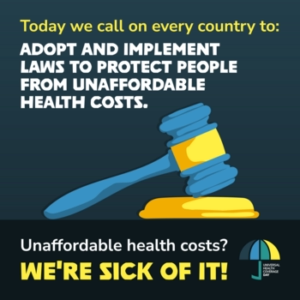
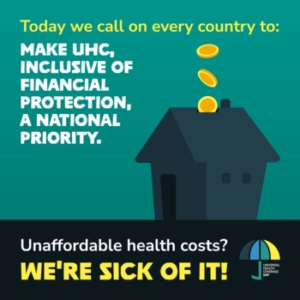
How? Share the below calls to action to remind your decision-makers that health concerns all of us, and that it is the responsibility of governments to adopt laws and budgets that guarantee the right to health for everyone, everywhere. You can also contact your decision-makers directly by sending them a letter, calling them, issuing a statement, or preparing a media release. Together we can show our leaders that the best decisions for health start by placing the voices and needs of populations at the center.
Step 4: Join forces.
Our calls to action outline what leaders can do in general to make UHC a reality, but every context is different, and the global UHC Day campaign should reflect that. When we join forces and take the time to meet and discuss with others, we can better understand local realities and the changes that will have the greatest impact on our communities, especially the most vulnerable.
Consider attending or organizing an event to connect members of your community, experts, leaders, health and care workers and other advocates. These gatherings create space for peer-to-peer learning, amplify diverse perspectives, and foster collaboration across sectors. By combining knowledge with real stories, we can inspire new ideas, build momentum towards UHC Day, and strengthen accountability.
How? Sign up for UHC Day updates on Substack, and read last year’s “Get ready for UHC Day 2024!” series for a step-by-step guide to UHC advocacy and how to organize an event. When ready, add your event to the global heatmap.
Step 5: Share the movement.
We are stronger together! As UHC advocates, we understand that progress toward UHC is progress toward inclusive, peaceful and resilient societies and a foundation for meeting all of the Sustainable Development Goals. So, no matter our unique priorities, let’s show leaders that we are a unified movement and that we stand together behind the urgent need for change.
How? Use the 2025 UHC Day branding in your upcoming meetings and events and across your social media platforms. From profile pics and banners to virtual meeting backgrounds and presentation templates, we’re spoiled for choice!