 0
0
 0
0
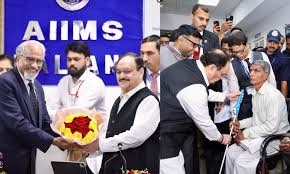
On January 9, 2026, Union Health Minister Jagat Prakash Nadda inaugurated cutting-edge medical facilities worth Rs 40 crore at AIIMS Kalyani in Nadia district, West Bengal, marking a significant step toward enhancing tertiary healthcare in eastern India. The event, part of Nadda’s two-day tour of the state, included the launch of the Department of Radiation Oncology, fully functional Trauma and Emergency Services, and a Pneumatic Tube System to streamline hospital operations. These developments aim to address rising cancer cases and emergency care gaps in the region, serving over 2,000 outpatients daily at the 960-bed super-specialty institute.
Key Facilities Unveiled
The star attractions include state-of-the-art radiotherapy infrastructure featuring a Linear Accelerator (LINAC), High Dose Rate (HDR) Brachytherapy unit, and CT-Simulator, enabling precise cancer treatments like image-guided radiotherapy and volumetric modulated arc therapy. LINAC delivers high-energy X-rays to target tumors while sparing healthy tissue, often reducing treatment sessions to 15-30 minutes on an outpatient basis, which is crucial for patient convenience in resource-limited settings. The Pneumatic Tube System facilitates rapid transport of blood samples, lab reports, and medications across the 179.82-acre campus, cutting turnaround times and supporting NABH/NABL accreditation standards, particularly beneficial for hospitals with over 150 beds like AIIMS Kalyani.
The Trauma and Emergency Services now offer round-the-clock care with dedicated ICU beds, addressing high-volume emergencies in rural and semi-urban West Bengal. Nadda reviewed patient loads and chaired a meeting on the institute’s roadmap, praising its role in Prime Minister Narendra Modi’s vision for accessible healthcare.
Background on AIIMS Kalyani
Established in 2015 under the Pradhan Mantri Swasthya Suraksha Yojana on National Highway 34, about 50 km from Kolkata, AIIMS Kalyani spans 179.82 acres and features 43 departments, including 17 super-specialties like cardiology, neurosurgery, and medical oncology. Phase-I includes a 960-bed hospital emphasizing AYUSH integration, with OPD services starting in 2019 and IPD inaugurated by PM Modi in 2024 with 360 beds and 18 ICUs initially. By 2023-24, OPD footfall exceeded 4 lakh, reflecting surging demand amid West Bengal’s healthcare challenges.
The institute trains 500 MBBS students, 200 nurses, and postgraduate candidates, fostering capacity building in oncology and beyond.
Public Health Context in West Bengal
West Bengal grapples with high cancer burdens, with national projections estimating 1.46 million new cases in India in 2022, lung cancer leading in males and breast in females; local trends show rising breast and oral cavity cancers alongside declining cervical cases. Rural areas suffer from staffing shortages, absent diagnostic services at PHCs, and over-reliance on insurance, pushing patients toward quacks or overburdened urban centers. AIIMS Kalyani’s expansions target these gaps, potentially reducing travel for Nadia and neighboring districts’ 2 million-plus population.
Nadda’s visit followed inspections at Chittaranjan National Cancer Institute (CNCI), the first government cancer hospital with full NABH certification, underscoring integrated cancer strategy.economictimes.
Expert Perspectives
Dr. Jayesh Salunke, Hospital COO with experience in Indian healthcare automation, notes pneumatic tube systems excel in high-volume setups like AIIMS Kalyani, improving lab TAT, NABH compliance, and patient satisfaction—ideal for trauma and multispecialty care, though requiring maintenance investment. Radiation oncology experts highlight LINAC and brachytherapy’s precision for tumors in lungs, breast, or cervix, combining effectively with chemotherapy to boost outcomes and enable early detection screening.
“These facilities will transform cancer care accessibility in eastern India, allowing shorter, precise treatments that minimize side effects,” says a radiation oncologist from a similar AIIMS setup, emphasizing integration with surgical and medical oncology. Another expert stresses trauma services’ lifesaving potential amid rural doctor shortages.
Implications for Public Health
For health-conscious consumers, these upgrades mean faster diagnoses and treatments closer to home, potentially improving survival rates for breast, oral, and lung cancers prevalent locally. Healthcare professionals gain advanced tools for research and training, aligning with national goals under Ayushman Bharat, though state-central tensions over schemes like Swasthya Sathi persist. Daily health decisions benefit via early screening camps, reducing late-stage presentations detected in 67% of regional cases.
Limitations and Challenges
While promising, full utilization depends on staffing PHCs and countering rural-urban divides; pneumatic systems suit non-bulky items only and need power reliability. No specific 2025-26 patient data yet limits impact assessment, and integration with state schemes remains pending. Balanced expansion requires sustained funding to avoid underutilization seen in smaller setups.aiimskalyani.prd.
Medical Disclaimer: This article is for informational purposes only and should not be considered medical advice. Always consult with qualified healthcare professionals before making any health-related decisions or changes to your treatment plan. The information presented here is based on current research and expert opinions, which may evolve as new evidence emerges.
References
-
Medical Dialogues. (2026, Jan 10). Union Health Minister inaugurates advanced facilities at AIIMS Kalyani. https://medicaldialogues.in/news/health/hospital-diagnostics/union-health-minister-inaugurates-advanced-facilities-at-aiims-kalyani-162393medicaldialogues