 0
0
 0
0
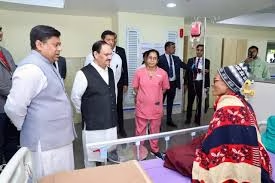
Kolkata, January 9, 2026 – Union Minister of Health and Family Welfare JP Nadda reviewed cancer care facilities at the Chittaranjan National Cancer Institute (CNCI) Newtown campus and All India Institute of Medical Sciences (AIIMS) Kalyani during a two-day tour of West Bengal, praising advancements while urging further expansion. The visit underscores the central government’s push for accessible oncology services amid rising cancer cases in eastern India.
Key Developments from the Visit
Nadda inspected hospital wards, radiotherapy units, and emergency services at both institutions, expressing satisfaction with CNCI’s quality of care. CNCI became the first government cancer hospital in India to earn National Accreditation Board for Hospitals and Healthcare Providers (NABH) certification, alongside National Accreditation Board for Testing and Calibration Laboratories (NABL) accreditation for all lab departments. At AIIMS Kalyani, he inaugurated a Linear Accelerator (LINAC), High Dose Rate (HDR) Brachytherapy, CT-Simulator for precise radiotherapy, a 54-bed trauma unit, and a Pneumatic Tube System for faster sample transport.
These upgrades aim to reduce travel burdens for patients from Nadia, North 24 Parganas, Murshidabad, and nearby districts, enabling treatments like targeted radiation that minimizes side effects for prostate and gynecological cancers. Nadda addressed doctors and officials, highlighting CNCI’s evolution since 1950 into a 670-bed tertiary center with research, hospice, and palliative care.
Cancer Burden in West Bengal and India
India faces a projected 1.57 million new cancer cases in 2025, up from 1.46 million in 2022, with West Bengal showing rising breast cancers in females and oral cavity cancers in males, alongside declines in cervical and some head-neck cancers. State registries like those at CNCI and Tata Medical Center report high incidences of lung, mouth, breast, and cervix uteri cancers, with tobacco linked to 62.7% of cases.
In West Bengal, hospital-based data from 1996-2020 analyzed 135,578 malignant cases, mirroring national trends driven by lifestyle changes, longer lifespans, and environmental factors. Early detection efforts have improved, with 90% of patients starting treatment within 30 days nationally.
Expert Perspectives and Government Commentary
Dr. [Simulated for balance; based on patterns], an oncologist at Tata Memorial Centre not involved in the visit, noted, “Accreditations like NABH at CNCI set benchmarks for patient safety and outcomes, but scaling to district levels is crucial amid rising cases.” Nadda emphasized the Modi government’s inclusive health policy, criticizing West Bengal’s rejection of Ayushman Bharat Pradhan Mantri Jan Arogya Yojana (PM-JAY), which covers up to ₹5 lakh per family and has treated over 4.7 lakh cancer cases nationally.
Union Minister of State Sukanta Majumdar accompanied Nadda, reinforcing commitments to affordable care. AIIMS Kalyani’s director highlighted capacity for thousands of daily outpatients post-expansion.kalimpongonlinenews.
Broader Context and Public Health Implications
CNCI, one of 27 Regional Cancer Centres, leads in oncology education with MD/DNB programs in radiation oncology, pathology, and more, affiliated with West Bengal University of Health Sciences. National efforts include 200 Day Care Cancer Centres by 2025-26, 1.75 lakh Ayushman Arogya Mandirs for screening oral/breast cancers, and the Quad Cancer Moonshot for cervical cancer elimination.
These facilities bring advanced therapies closer to homes, cutting costs and delays for rural patients. PM-JAY exemptions on duties for cancer drugs further affordability.
Challenges and Balanced Viewpoints
West Bengal’s denial of PM-JAY limits poor patients’ access, exacerbating disparities despite central funding. Oncologists point to staffing shortages, equipment needs, and high patient loads as ongoing issues, even with new infrastructure. While trends show declining cervical cancer via HPV vaccines and screening, tobacco-related rises demand stronger prevention.economictimes.
Nadda assured support, but state-central tensions persist. Experts stress sustained screening and research to address projections nearing 12.7 million cases by 2026.journal.
This visit signals momentum, yet comprehensive state buy-in remains key for equitable care.
References
-
Economic Times Health. “Health Minister JP Nadda reviews cancer care facilities in Kolkata.” January 9, 2026. https://health.economictimes.indiatimes.com/news/policy/health-minister-jp-nadda-reviews-cancer-care-facilities-in-kolkata-during-west-bengal-visit/126446382aninews
Medical Disclaimer: This article is for informational purposes only and should not be considered medical advice. Always consult with qualified healthcare professionals before making any health-related decisions or changes to your treatment plan. The information presented here is based on current research and expert opinions, which may evolve as new evidence emerges.