 0
0
 0
0
March 6, 2026
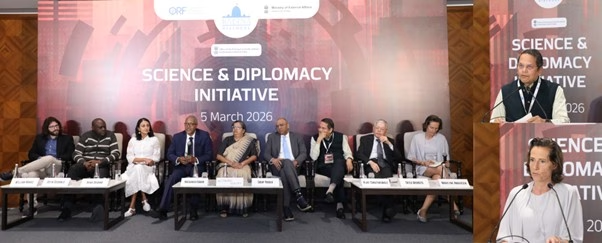
NEW DELHI — In an era where a virus in one hemisphere can become a global pandemic in days, and where artificial intelligence (AI) is rewriting the blueprint of drug discovery, the traditional boundaries of medicine are dissolving. On March 5, 2026, at the Bharat Mandapam in New Delhi, the inaugural Raisina Science Diplomacy Initiative (SDI) convened a powerful assembly of 80 global scientists, diplomats, and policymakers to address a critical question: How do we govern the “disruptive technologies” that will define the next century of human health?
Launched by the Office of the Principal Scientific Adviser to the Government of India in partnership with the Observer Research Foundation (ORF), the summit marks a pivotal shift in how the world views scientific cooperation. No longer confined to laboratories, science is now at the center of national security, economic competitiveness, and, most importantly, the equitable distribution of life-saving medical breakthroughs.
Strategic Autonomy: Balancing Borders and Breakthroughs
The first major theme of the initiative, “Science Diplomacy in the Era of Strategic Autonomy,” carries profound implications for the average patient. Strategic autonomy refers to a nation’s ability to provide for its own essential needs—such as vaccines, semiconductors, and medical active pharmaceutical ingredients (APIs)—without being solely dependent on volatile global supply chains.
Prof. Ajay Kumar Sood, Principal Scientific Adviser to the Government of India, emphasized that science diplomacy must adapt to a landscape where national interests and global cooperation often collide. For the public, this “strategic autonomy” isn’t just a political buzzword; it is what ensures that when a local health crisis hits, the necessary medications are on pharmacy shelves.
“Scientific cooperation remains a vital bridge even amid geopolitical shifts,” noted Sir Peter Gluckman, President of the International Science Council, during the roundtable. The challenge, experts say, is maintaining “trusted networks.” If countries stop sharing genomic data or clinical trial results due to political friction, the development of cures for rare diseases and emerging pathogens could grind to a halt.
The Double-Edged Sword of Disruptive Technologies
The second core focus of the SDI—Disruptive Technologies—targets the rapid rise of AI, gene editing (CRISPR), and biotechnology. While these technologies promise to “disrupt” medicine in positive ways, such as personalized cancer vaccines, they also present unprecedented governance challenges.
Prof. Marilyne Andersen, Director General of the Geneva Science and Diplomacy Anticipator (GESDA), led discussions on creating “anticipatory policy.” This involves predicting the ethical and societal impacts of a technology before it becomes widespread.
Key Disruptive Technologies in Health:
-
Generative AI in Diagnostics: Algorithms that can detect early-stage cancers with higher accuracy than human radiologists.
-
Biotechnology & Synthetic Biology: The ability to “write” DNA, which could lead to bespoke treatments but also raises significant biosecurity concerns.
-
Neurotechnology: Brain-computer interfaces that could restore mobility to paralyzed patients, but raise questions about mental privacy.
The SDI participants stressed that for these technologies to be effective, they must be governed by “inclusive norm-setting.” In simpler terms: the benefits of a $2 million gene therapy shouldn’t only be available to the wealthiest nations.
Why “Science Diplomacy” Matters to Your Health
To the health-conscious consumer, “science diplomacy” might sound like a distant diplomatic exercise. However, it directly impacts the “Three As” of healthcare: Availability, Accessibility, and Affordability.
“The Raisina SDI is a platform for evolving a contemporary framework for science diplomacy,” said Dr. Samir Saran, President of ORF. This framework is essential for establishing international standards. For example, if every country has different safety standards for AI in healthcare, a life-saving diagnostic tool developed in India might not be legally usable in Europe or the U.S., delaying care for millions.
Dr. Steen Søndergaard, NATO Chief Scientist, shared insights on “technology foresight,” highlighting how global systems—including healthcare infrastructure—must be resilient against both natural and man-made disruptions.
The Limitations of Diplomacy
Despite the optimism in New Delhi, critics and skeptics often point to the “innovation gap.” While the SDI aims for “globally equitable” standard-setting, the reality of the COVID-19 pandemic showed how quickly “strategic autonomy” can turn into “vaccine nationalism.”
Furthermore, integrating the private sector—a goal highlighted by Prof. Sood for future editions of the SDI—presents a challenge. Private pharmaceutical and tech giants hold the patents to most disruptive technologies. Balancing their profit motives with the SDI’s goal of “equitable diffusion of technological advancements” will be a delicate, and perhaps uphill, battle.
Looking Ahead: The Role of the Private Sector
As the Raisina SDI transitions into an annual event, the focus will shift toward two major questions posed by Prof. Sood:
-
Private Sector Integration: How can companies like Google Health or Pfizer be brought into the diplomatic fold to ensure their innovations serve the public good?
-
Multilateralism: How can existing bodies like the World Health Organization (WHO) be adapted to handle technologies that move faster than current laws can keep up with?
For the reader, the message from Bharat Mandapam is clear: The future of your health is being decided not just in a doctor’s office, but at the intersection of science and international policy. As science diplomacy matures, it offers the best hope for a world where the next medical miracle is shared by all, rather than hoarded by a few.
Medical Disclaimer:
This article is for informational purposes only and should not be considered medical advice. Always consult with qualified healthcare professionals before making any health-related decisions or changes to your treatment plan. The information presented here is based on current research and expert opinions, which may evolve as new evidence emerges.
References:
Primary Source:
-
Press Information Bureau (PIB), Government of India. “Inaugural Edition of Raisina Science Diplomacy Initiative (SDI) focuses on Strategic Autonomy and Disruptive Technologies.” Published 05 March 2026.