 0
0
 0
0
February 23, 2026
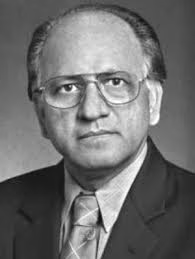
The world of medicine is mourning the loss of a quiet giant whose simple bedside observation became a global shield for patient safety. Dr. Seshagiri Rao Mallampati, the Indian-born anesthesiologist who developed the ubiquitous “Mallampati Score,” passed away on February 9, 2026, in the United States. He was 85.
From the largest surgical theaters in Boston to rural clinics in his native Andhra Pradesh, Dr. Mallampati’s name is spoken daily by thousands of clinicians. His innovation—a quick visual assessment of a patient’s open mouth—has saved an incalculable number of lives by identifying “difficult airways” before a patient is ever placed under general anesthesia.
A Near-Miss That Changed Medicine
Innovation often begins with a close call. For Dr. Mallampati, that moment arrived in 1975 during a routine Caesarean section. Despite the patient appearing to have a normal neck and jaw, her tongue was large enough to completely obscure the airway once she was sedated.
Though both mother and baby were ultimately unharmed, the experience haunted Mallampati. At the time, there was no reliable way to predict which patients would be difficult to intubate—the process of inserting a breathing tube into the windpipe. He realized that if doctors could “see” the difficulty coming, they could prepare specialized equipment or techniques to prevent oxygen deprivation.
The Birth of the “Gold Standard”
Born in 1941 in the Guntur District of Andhra Pradesh, India, Mallampati moved to the U.S. in the early 1970s, eventually joining the staff at Brigham and Women’s Hospital in Boston. In 1985, he published a landmark study in the Canadian Anaesthetists’ Society Journal involving 210 patients.
His proposal was elegantly simple: have the patient sit upright, open their mouth wide, and stick out their tongue without saying “ah.” By looking at how much of the soft palate and uvula (the “dangling” tissue at the back of the throat) were visible, he categorized patients into three classes. A fourth class was later added to refine the system:
-
Class I: Full visibility of the tonsillar pillars, soft palate, and uvula. (Easy intubation)
-
Class II: Visible soft palate and uvula, but pillars are masked.
-
Class III: Only the soft palate and base of the uvula are visible. (Increased difficulty)
-
Class IV: Only the hard palate is visible; the soft palate is entirely hidden. (High risk)
“Dr. Mallampati’s score transformed airway assessment from guesswork to science,” says Dr. Arindam Kar, a prominent critical care specialist, in a recent tribute. “It embodied his modesty—a tool that required no expensive machinery, only keen clinical observation.”
Impact Beyond the Operating Room
While originally designed for anesthesia, the Mallampati Score has found a second home in sleep medicine. Research indicates that patients with higher scores (Classes III and IV) have significantly higher risks of Obstructive Sleep Apnea (OSA).
In adults, each one-point increase in the Mallampati Score doubles the odds of having OSA. In children, the correlation is even more dramatic, with some studies showing a sixfold increase in risk for those with crowded airways. By identifying these patients early, physicians can fast-track them for sleep studies and life-saving CPAP therapy.
Statistical Context:
-
Predictive Power: A meta-analysis of 42 studies involving over 34,500 patients confirmed the score’s value, showing an 86.7% sensitivity in some cohorts for predicting difficult intubation.
-
Safety Margin: In India, where surgical volumes are rising rapidly, the score provides a critical safety buffer in resource-limited settings where advanced video laryngoscopes may not be immediately available.
Limitations and the “Multi-Factor” Approach
Despite its brilliance, the medical community acknowledges that the Mallampati Score is not a crystal ball. Recent studies, including a 2023 analysis by Dr. Rotem Naftalovich, have noted that a patient’s breathing phase can change their score; roughly 42% of patients show a “worse” (higher) score during inspiration.
“While not perfect alone, it’s a cornerstone when combined with other metrics like the distance between the chin and the neck (thyromental distance) and the patient’s BMI,” notes a 2021 clinical review. Modern guidelines now suggest using the Mallampati Score as part of a “bundle” of assessments to ensure the highest level of accuracy.
What This Means for You
If you or a loved one are scheduled for surgery, the legacy of Dr. Mallampati is likely part of your pre-operative care.
-
Be Proactive: During your pre-anesthesia interview, the doctor will ask you to open your mouth. This is the Mallampati test in action.
-
Communication: If you have been told in the past that you have a “difficult airway” or a high Mallampati score, always inform your surgical team. It allows them to have specialized tools, such as video-assisted cameras, ready before you go to sleep.
A Lasting Legacy
Dr. Mallampati retired in 2017, but his influence remains “eternal,” as the Jaipur Society of Anaesthesiologists recently noted. He represents a generation of Indian physicians who moved abroad and fundamentally reshaped global healthcare standards.
His life’s work serves as a reminder that in an era of high-tech AI and robotics, sometimes the most profound medical advancements come from simply asking a patient to “open wide.”
Medical Disclaimer: This article is for informational purposes only and should not be considered medical advice. Always consult with qualified healthcare professionals before making any health-related decisions or changes to your treatment plan. The information presented here is based on current research and expert opinions, which may evolve as new evidence emerges.
References
-
Medical Dialogues. Dr Seshagiri Rao Mallampati, Pioneer of Mallampati Score, Passes Away at 85. February 22, 2026.