 0
0
 0
0
March 10, 2026
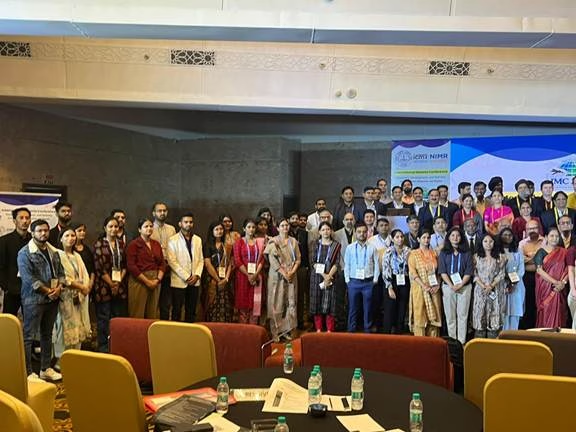
NEW DELHI — As the sun set over the capital city yesterday, the International Malaria Conference (IMC) 2026 concluded with a resolute message: the tools to end malaria are within reach, but only if the global community bridges the gap between laboratory discovery and frontline delivery.
From March 7 to 9, the ICMR–National Institute of Malaria Research (ICMR–NIMR) hosted a high-level assembly of scientists, policymakers, and public health experts. The three-day summit, themed “Discovery, Development and Delivery: Driving Malaria Elimination and Beyond,” served as a critical pulse check for the World Health Organization’s (WHO) goal of reducing malaria incidence by 90% by 2030.
A Triple-Threat Strategy: Discovery, Development, and Delivery
The conference structure mirrored the lifecycle of medical innovation, focusing on three pillars essential for eradicating a disease that still claims hundreds of thousands of lives annually, primarily children under five and pregnant women in sub-Saharan Africa and Southeast Asia.
1. Discovery: Outsmarting the Parasite
The “Discovery” sessions delved into the increasingly complex biology of the Plasmodium parasite. Researchers presented findings on how the parasite hides in the liver and spleen, contributing to “asymptomatic reservoirs”—people who carry the disease without feeling ill, yet continue to spread it via mosquito bites.
“We are in an arms race,” noted Dr. Anup Anvikar, Director of ICMR-NIMR, during his welcome address. “Sustained scientific innovation is our only way to stay ahead of emerging drug and insecticide resistance.”
2. Development: The Next Generation of Tools
The “Development” pillar highlighted a shift toward high-tech surveillance. Discussions centered on gene-drive technology and highly sensitive rapid diagnostic tests (RDTs) capable of detecting low-density infections that current tests miss.
A significant portion of the conference was dedicated to the “next generation” of researchers. Young scientists presented “turbo talks” on digital mapping tools that use satellite imagery to predict malaria outbreaks before they happen, allowing health officials to deploy resources preemptively.
3. Delivery: Turning Science into Survival
The final day addressed the “delivery” gap—the challenge of ensuring that life-saving interventions reach the most remote “last mile” communities. Experts debated the rollout of the R21/Matrix-M vaccine and the necessity of community-led initiatives.
India’s Strategic Role
India, which accounts for a significant portion of the malaria burden in South Asia, has become a focal point for elimination strategies. Dr. Tanu Jain, Director of the National Centre for Vector Borne Diseases Control (NCVBDC), emphasized that India’s path to elimination relies on “strengthening surveillance systems and improving early diagnosis.”
India’s success in reducing cases over the last decade provides a blueprint for other high-burden countries. However, officials warned that “residual transmission”—where malaria persists despite high coverage of bed nets and spraying—remains a formidable hurdle.
Expert Perspective: The Reality of Resistance
While the mood of the conference was optimistic, independent experts cautioned that biology is a moving target.
“We are seeing a worrying trend of PfHRP2/3 gene deletions in parasites across Africa and parts of Asia,” says Dr. Elena Rodriguez, a genomic epidemiologist not affiliated with the conference organizers. “This essentially makes the parasite ‘invisible’ to our most common rapid diagnostic tests. If we can’t see it, we can’t treat it. The IMC’s focus on new diagnostic development is not just a luxury; it’s a necessity for survival.”
What This Means for You
For the general public, the takeaways from IMC 2026 are practical and urgent:
-
Travel Vigilance: As global travel returns to pre-pandemic levels, malaria remains a risk for travelers. The conference underscored the importance of chemoprophylaxis (preventive medication) and personal protection.
-
Climate Change: Rising global temperatures are expanding the habitats of Anopheles mosquitoes. Areas previously considered “malaria-free” may face new risks, necessitating increased public awareness.
-
Vaccine Hope: The expanded use of malaria vaccines is a historic milestone, but experts remind the public that vaccines are a “layer of protection,” not a replacement for bed nets and indoor spraying.
The Road to 2030: Challenges and Constraints
Despite the scientific leaps, two major shadows loomed over the deliberations: funding and climate change.
According to the WHO World Malaria Report 2025, the funding gap for malaria response has widened to nearly $4 billion. Furthermore, extreme weather events—like the floods seen recently in Pakistan and parts of Africa—can undo years of elimination progress in a single season by creating massive mosquito breeding grounds.
“Elimination is a political choice as much as a scientific one,” said one delegate during the valedictory session. “The science is ready. The question is whether the global political will can keep pace.”
Key Statistics at a Glance
| Metric | Current Global Status (Approx.) | 2030 Target |
| Annual Cases | ~249 Million | < 25 Million |
| Annual Deaths | ~608,000 | < 60,000 |
| Vaccine Efficacy | ~75% (R21/Matrix-M) | > 90% (Next Gen Goal) |
| Funding Gap | ~$3.7 – $4 Billion | $0 |
References
-
Governmental Source: Press Information Bureau (PIB), Government of India. (March 9, 2026). International Malaria Conference 2026 Emphasises Global Collaboration.
Medical Disclaimer: This article is for informational purposes only and should not be considered medical advice. Always consult with qualified healthcare professionals before making any health-related decisions or changes to your treatment plan. The information presented here is based on current research and expert opinions, which may evolve as new evidence emerges.