 0
0
 0
0
ISLAMABAD — In a massive public health undertaking that underscores both the scale of Pakistan’s ambition and the stubbornness of its challenges, the nation’s latest nationwide polio campaign successfully reached over 44 million children. However, beneath the headline-grabbing 98% coverage rate lies a sobering reality: nearly one million children were missed, leaving a critical window of opportunity open for a virus that remains endemic in only two countries on Earth.
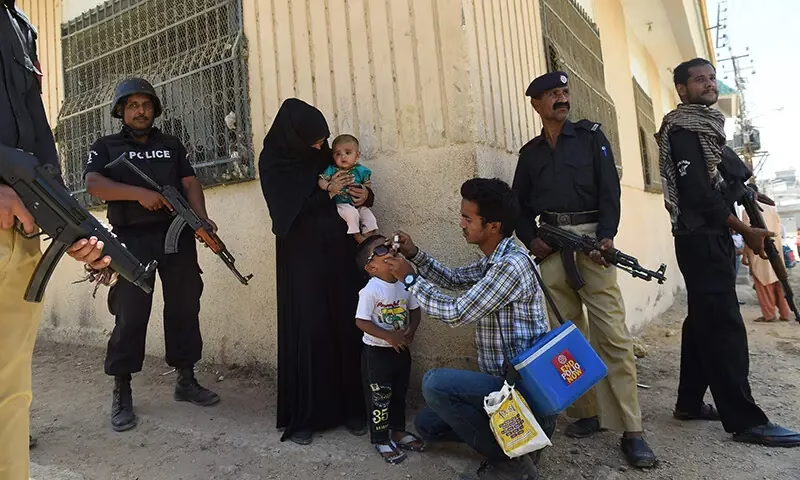
According to recent data from the campaign, approximately 53,000 families refused the vaccine, while roughly 670,000 children were marked as “not available” when vaccinators knocked. For health experts, these numbers represent more than just a statistical margin of error; they represent the “last mile” of a decades-long marathon to erase poliomyelitis from the human experience.
The Danger of the 2% Gap
In the world of infectious disease, 98% is usually considered an “A” grade. But with polio—a highly contagious virus that can cause irreversible paralysis in hours—98% is not enough.
“The poliovirus is an expert at finding the unprotected,” says Dr. Arshad Rafiq, a public health consultant not affiliated with the recent campaign. “As long as you have pockets of a million unvaccinated children, the virus has a reservoir to survive, mutate, and eventually resurface in areas we thought were safe.”
The campaign data, first reported by Dawn, reveals a troubling trend in urban centers. Karachi, Pakistan’s largest city, accounted for 31,000 of the total refusals—nearly 58% of the national total. This concentration suggests that the hurdle is no longer just geographic isolation, but a complex cocktail of urban misinformation, poor local governance, and a lack of political focus in high-density neighborhoods.
“Not at Home” or “Not Reached”?
A significant point of contention among health specialists is the “not available at home” designation for 670,000 children. Independent observers argue this categorization is often used to mask operational failures.
“Children don’t simply vanish,” notes a senior official from a global health NGO who requested anonymity. “If they aren’t at home, they are at school, in the market, or with relatives. A truly robust campaign meets the children where they are, rather than expecting them to be sitting behind a front door.”
Experts are calling for a shift in strategy:
-
Transit Point Vaccination: Increasing teams at bus stations, markets, and parks.
-
Multiple Revisits: Ensuring teams return to missed households at different times of the day.
-
Neighborhood Accountability: Shifting from top-down statistics to localized, community-led monitoring.
The Barriers: Misinformation and Security
The 53,000 refusals highlight the persistent shadow of vaccine hesitancy. In many regions, polio drops have been the victim of long-standing conspiracy theories and “vaccine fatigue,” where parents question why the government is so persistent about polio while other basic needs like clean water and electricity remain unmet.
Furthermore, the shadow of violence continues to haunt the “Polio Workers”—the frontline heroes who are predominantly women. Security lapses in volatile regions have led to tragic attacks on vaccination teams in the past.
“The state has a fundamental responsibility to ensure that no child misses a life-saving vaccine because a health worker felt unsafe,” says Dr. Rafiq. “When a vaccinator is intimidated, the virus wins.”
Looking Forward: A Zero-Tolerance Policy
While Pakistan has seen a decrease in reported paralytic cases and several environmental (sewage) samples have recently tested negative, the Global Polio Eradication Initiative (GPEI) maintains that “low-level circulation” is the most dangerous phase. It creates a false sense of security that can lead to a resurgence.
Public health advocates argue that the campaign must move toward a zero-tolerance model. This involves:
-
Engaging Community Leaders: Utilizing imams and local elders to debunk myths.
-
Stricter Enforcement: Implementing existing vaccination laws while ensuring due process.
-
Integrated Health Services: Delivering polio vaccines alongside other essential services (nutrition, clean water) to build community trust.
The stakes could not be higher. If polio is not eradicated in its final strongholds of Pakistan and Afghanistan, experts warn that the world could see a resurgence of up to 200,000 new cases every year within a decade.
References & Sources
Polio campaign falls short in Pakistan as nearly 1 mn children remain unvaccinated
Medical Disclaimer: This article is for informational purposes only and should not be considered medical advice. Always consult with qualified healthcare professionals before making any health-related decisions or changes to your treatment plan. The information presented here is based on current research and expert opinions, which may evolve as new evidence emerges.