 0
0
 0
0
Published: March 8, 2026
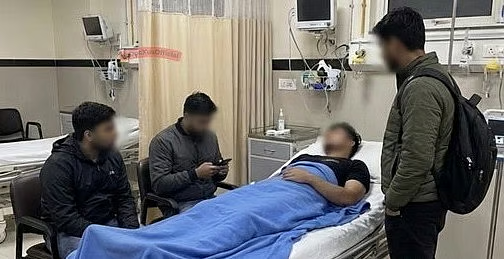
A 24-year-old man was rushed to a metropolitan emergency room on the night of March 6, 2026, with a heart rate of 212 beats per minute (bpm)—a level typically seen only during extreme physical exertion or cardiac distress. While the patient had been sharing alcohol, cigarettes, and a single cannabis joint with friends, he was the only one to collapse.
The culprit, according to a viral report from the treating physician, was not just the recreational substances, but a single over-the-counter (OTC) dose of fluconazole taken 24 hours earlier. This case, which has since ignited a firestorm of discussion on social media, highlights a dangerous and often overlooked “pharmacokinetic collision” between common antifungal medications and cannabis.
The Emergency Room Crisis
When the patient arrived at the ER, he was restless, gasping for air, and gripping the bed rails. Monitors confirmed a diagnosis of narrow complex tachycardia, a condition where the heart’s upper chambers send rapid-fire electrical signals, causing the heart to beat more than double its normal resting rate (60–100 bpm).
“He was in a state of high distress,” noted Dr. Xus (known online as @docxusofficial), the emergency physician who first shared the case. “With a heart rate that high, the heart doesn’t have enough time to fill with blood between beats, which can lead to fainting, chest pain, or even cardiac arrest.”
To stabilize him, the medical team employed the Valsalva maneuver. This technique requires the patient to blow into a syringe or “bear down” as if straining during a bowel movement while reclining. This action stimulates the vagus nerve, which acts as a natural “brake” for the heart. Fortunately, the maneuver was successful, reverting the patient’s rhythm to a normal sinus rhythm within seconds and avoiding the need for more invasive electric shocks or intravenous heart-slowing drugs.
Unraveling the Night’s Events
As the patient stabilized, a medical mystery remained: why did he suffer such a severe reaction when his friends, who consumed the exact same substances, remained unaffected?
The group had shared a standard amount of alcohol and one joint containing THC ($\Delta^9\text{-tetrahydrocannabinol}$), the primary psychoactive component in cannabis. While THC is known to naturally increase heart rate by 20% to 50% by stimulating the sympathetic nervous system, it rarely pushes a healthy young person to 212 bpm.
The “ah-ha” moment came during the medical history review. The patient revealed he had taken fluconazole 150 mg the day before to treat a minor fungal infection. In many regions, including India, this single-dose antifungal is widely available without a prescription.
The Science of the “Clogged Drain”
To understand why this interaction was so volatile, one must look at how the liver processes chemicals. Fluconazole is a potent inhibitor of specific enzymes—primarily CYP2C9 and CYP3A4. These enzymes act like a drainage system for the body, breaking down and clearing THC from the bloodstream.
When the patient took fluconazole, he essentially “clogged the drain.” When the THC entered his system the following night, his liver could not process it at the normal rate.
“Fluconazole slowed his liver’s THC processing to a crawl,” Dr. Xus explained in his viral post. “This caused the THC levels to spike far beyond what his body could handle, amplifying the cardiovascular side effects to a dangerous degree.”
Research supports this. Studies have shown that fluconazole can increase THC concentrations in the blood by approximately 22%, but more importantly, it can increase the levels of its primary metabolite (11-OH-THC) by up to 2.5-fold. This metabolite is even more potent than THC itself, leading to an exaggerated “fight or flight” response in the heart.
Expert Perspectives on Hidden Risks
While this specific case gained traction due to its viral nature, cardiologists warn that it is part of a growing trend.
“These interactions are significantly underappreciated by both the public and some clinicians,” says Dr. Elena Rossi, a cardiologist who follows trends in substance-related ER visits. “As cannabis becomes more socially accepted and legalized, people forget it is a complex drug that interacts with their medicine cabinet. CYP inhibitors like fluconazole can turn moderate, ‘casual’ use into a medical emergency, especially in young people who may already have high sympathetic tone.”
Pharmacologists note that the risk isn’t limited to fluconazole. Other common medications, including certain antidepressants, blood pressure meds, and even grapefruit juice, can interfere with the same metabolic pathways.
| Substance | Enzyme Affected | Impact on THC |
| Fluconazole | CYP2C9 / CYP3A4 | Significant increase in THC/Metabolite levels |
| Ketoconazole | CYP3A4 | Can double THC exposure |
| Alcohol | General Metabolism | Can compound dehydration and tachycardia |
Broader Public Health Implications
This incident arrives at a time when cannabis use is rising globally, with over 200 million users worldwide. Simultaneously, the use of OTC antifungals for conditions like athlete’s foot or yeast infections is ubiquitous.
In many countries, fluconazole is viewed as a “one-and-done” pill with few consequences. However, the drug has a long half-life of roughly 30 hours, meaning it stays in the system long after the pill is swallowed. Public health experts suggest that labels on OTC medications may need to be more explicit about lifestyle interactions, including cannabis.
For the average consumer, the takeaway is clear: transparency with healthcare providers is essential. “Patients need to disclose everything—even OTC pills and casual substance use,” says Dr. Rossi. “The liver doesn’t care if a drug is legal or social; it just sees the chemistry.”
Limitations and a Balanced View
It is important to note that not every person who mixes these substances will end up in the ER. Factors such as genetic variations (some people are naturally “slow metabolizers” of drugs), the potency of the cannabis, and the presence of alcohol or nicotine all play a role.
Furthermore, while the ER doctor’s account is compelling, it is an anecdotal case report. Without blood-level confirmation of THC at the time of the event, other factors—like a panic attack or an underlying undiagnosed heart rhythm issue—cannot be 100% ruled out. However, the pharmacological mechanism for a fluconazole-THC interaction is well-documented in medical literature.
For now, the medical community’s advice is one of caution: If you are taking an antifungal, it is best to skip the cannabis until the medication has completely cleared your system.
Medical Disclaimer: This article is for informational purposes only and should not be considered medical advice. Always consult with qualified healthcare professionals before making any health-related decisions or changes to your treatment plan. The information presented here is based on current research and expert opinions, which may evolve as new evidence emerges.
References
-
Free Press Journal. (2026, March 7). ER Doctor Shares Viral Case of 24-Year-Old’s Tachycardia.