 0
0
 0
0
February 22, 2026
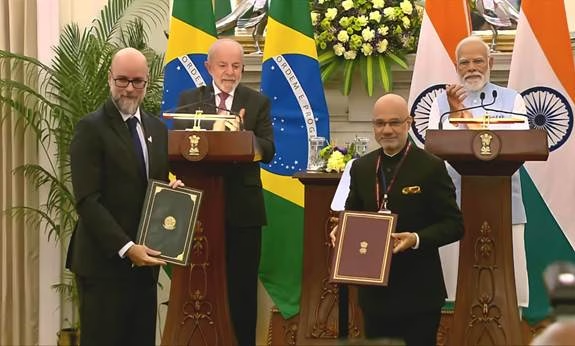
HYDERABAD HOUSE, NEW DELHI — In a move set to reshape the pharmaceutical landscape of the Global South, India and Brazil officially entered into a comprehensive Memorandum of Understanding (MoU) on Saturday to harmonize the regulation of medicines, biological products, and medical devices. The agreement, exchanged between India’s Central Drugs Standard Control Organisation (CDSCO) and the Brazilian Health Regulatory Agency (ANVISA), aims to streamline safety standards and bolster the supply chain for affordable healthcare across both nations.
The exchange took place in the presence of Indian Prime Minister Narendra Modi and Brazilian President Luiz Inácio Lula da Silva, signaling a high-level diplomatic commitment to health security. Under the new framework, the two nations will share critical regulatory data, coordinate oversight of manufacturing facilities, and work toward “regulatory convergence”—a process that could significantly reduce the time it takes for life-saving drugs to move between the two markets.
Bridging the Regulatory Gap
For decades, India has been known as the “pharmacy of the world,” producing roughly 20% of the world’s generic medicines by volume. Brazil, meanwhile, maintains one of the most sophisticated public health systems in Latin America (the Sistema Único de Saúde or SUS) and a rigorous regulatory framework under ANVISA.
Until now, manufacturers in both countries often faced redundant inspections and varying technical requirements that delayed product launches. This MoU establishes a “structured framework” for cooperation in several key areas:
-
Active Pharmaceutical Ingredients (APIs): The raw materials used to manufacture drugs.
-
Biological Products: Including vaccines and gene therapies.
-
Medical Devices: Ranging from diagnostic kits to high-tech imaging equipment.
“This is not just about trade; it’s about trust,” says Dr. Aris Vrettos, a global health policy analyst (unaffiliated with the agreement). “When two of the world’s largest emerging economies align their safety standards, they create a ‘regulatory corridor’ that ensures patients receive high-quality medicine without the added costs of bureaucratic delay.”
Why This Matters for the Public
For the average citizen in Mumbai or São Paulo, the implications are practical and potentially life-saving. By aligning standards, the two countries can more effectively address medicine shortages—a growing global crisis. If a particular antibiotic is in short supply in Brazil but available in India, the synchronized regulatory oversight makes it easier for ANVISA to trust and fast-track Indian batches, and vice versa.
Furthermore, the focus on affordable healthcare is central. Both nations are leaders in the production of generics, which typically cost 80% to 85% less than brand-name equivalents. By reducing the administrative burden on manufacturers, the cost of production remains low, a benefit that is often passed down to the consumer at the pharmacy counter.
Key Benefits at a Glance:
-
Faster Access: Reduced timelines for the approval of new generic drugs.
-
Enhanced Safety: Real-time sharing of information regarding adverse drug reactions or “red flag” manufacturing facilities.
-
Resilient Supply Chains: Less reliance on Western intermediaries for critical medical components.
Expert Perspectives: A Shift in Global Dynamics
While the agreement is a win for bilateral relations, experts note it also serves a broader geopolitical purpose. By strengthening ties between CDSCO and ANVISA, India and Brazil are asserting their independence from Western-centric regulatory bodies like the FDA (USA) or EMA (Europe).
“We are seeing a maturation of the Global South’s medical infrastructure,” says Sarah Thompson, a senior researcher in international health systems. “India and Brazil are no longer just ‘recipients’ of standards; they are now the ‘standard-setters’ for emerging markets.”
However, some industry watchdogs urge caution. “Regulatory convergence is a double-edged sword,” notes Thompson. “While it increases efficiency, it requires absolute transparency. Both CDSCO and ANVISA must ensure that ‘streamlining’ does not lead to ‘cutting corners’ on clinical trial data or manufacturing hygiene.”
Potential Challenges and Limitations
Despite the optimism, the road to full cooperation has hurdles. Differences in national laws regarding intellectual property and patent protection could still cause friction. Additionally, the MoU is a “framework,” meaning the specific technical details—such as which laboratory tests will be mutually recognized—are still being negotiated.
There is also the challenge of implementation. Coordinating two massive bureaucracies requires significant digital infrastructure and a workforce trained in the nuances of each other’s legal systems. Critics argue that without a dedicated fund to support this capacity building, the MoU could remain a “paper-only” victory.
Looking Ahead: The Future of Medicine
The India-Brazil pact is expected to serve as a blueprint for other nations. As clinical trials become increasingly global, the ability for regulators to speak the same language is paramount.
For the health-conscious consumer, this agreement should provide a sense of security. It means that the “Made in India” or “Designed in Brazil” label on your prescription bottle is backed by a collaborative, international safety net.
As Prime Minister Modi noted during the exchange, the partnership underscores a shared vision: that “health is not a luxury, but a fundamental right.” With this MoU, two of the world’s giants have taken a significant step toward making that right a reality for over 1.6 billion people combined.
Statistical Context
-
Trade Volume: India’s pharmaceutical exports to Brazil reached over $1.5 billion in recent years, with a steady 10% annual growth.
-
Market Scale: India and Brazil together represent nearly 20% of the world’s population, making this one of the largest regulatory alignments in history.
Reference Section
-
Press Information Bureau (PIB) Delhi. (2026, Feb 21). India and Brazil Exchange MoU to Strengthen Cooperation in Pharmaceutical and Medical Products Regulation.
Medical Disclaimer: This article is for informational purposes only and should not be considered medical advice. Always consult with qualified healthcare professionals before making any health-related decisions or changes to your treatment plan. The information presented here is based on current research and expert opinions, which may evolve as new evidence emerges.