 0
0
 0
0
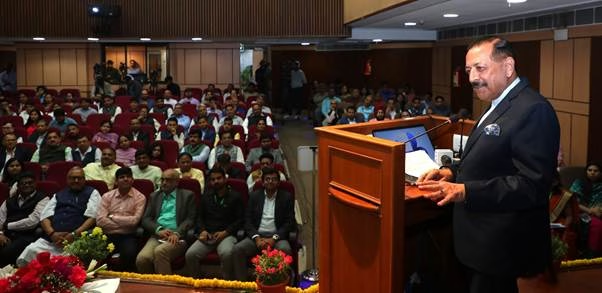
NEW DELHI — In a landmark celebration of National Science Day 2026, the Government of India has pivoted its scientific compass toward a more inclusive and health-centric future. Speaking at the Indian National Science Academy (INSA) auditorium on February 27, Dr. Jitendra Singh, Union Minister for Science and Technology, declared that women are no longer just participants in the laboratory—they are the “catalysts” essential for India’s transition into a developed nation, or Viksit Bharat.
The event was marked by the launch of several high-impact initiatives, ranging from cutting-edge biotechnology outreach to clean energy clusters and advanced nanotechnology for heritage conservation. For the healthcare sector and health-conscious citizens, the message was clear: the next decade of Indian science will prioritize “solutions for the people.”
Women in Science: Beyond Representation
The focal theme of the 2026 celebration, “Women in Science: Catalyzing Viksit Bharat,” highlights a shifting demographic in Indian research. According to Dr. Singh, the transformation of India’s scientific landscape requires a “multiplier effect” that can only be achieved by empowering young girls through structured exposure to research institutions.
“India’s scientific advancement must be measured not only by global rankings but by its capacity to deliver solutions for its people,” Dr. Singh stated. This sentiment is backed by recent trends showing a steady increase in women leading biotechnology and medical research projects across the country.
To support this pipeline, the Minister announced the “Engage with Science” Programme. This initiative provides one-week residential immersions for students in Classes 8 and 9 at 16 autonomous Department of Science and Technology (DST) institutions. Crucially, the program covers seven thematic areas, including Medical Technology and Biological Sciences, designed to spark early interest in life-saving innovations.
Breakthroughs in Medical Tech and Public Health
While the celebration honored historical achievements like the Raman Effect, the focus remained firmly on future-ready technologies. Two major developments stand out for their potential impact on public health and safety:
1. The Hydrogen Valley Innovation Cluster
Launched during the event, this cluster aims to accelerate the transition to clean energy. From a health perspective, the shift toward hydrogen-based energy is a significant victory for respiratory health. Reduced reliance on fossil fuels directly correlates with lower levels of particulate matter ($PM_{2.5}$) in urban areas, potentially lowering the incidence of chronic obstructive pulmonary disease (COPD) and asthma.
2. Nano-Titania Technology: A Win for Public Spaces
A DST-supported technology involving Copper-Doped Nano Titania ($Cu–TiO_2$) was formally transferred to the private sector for heritage conservation. While its primary use is preserving marble and sandstone monuments, the science behind it has broader health implications.
The $Cu–TiO_2$ coating is highly hydrophobic (water-repellent) and possesses antimicrobial properties. In public health terms, such coatings are being explored for use in high-traffic public areas to prevent the growth of biofilms and mold, which are common triggers for allergies and skin infections.
Expert Perspectives: Bridging the Gap
Independent experts emphasize that these initiatives represent a move toward “translational research”—science that moves from the lab bench to the bedside.
“Integrating biological sciences with national development missions is no longer optional,” says Dr. Rajesh Gokhale, Secretary of the Department of Biotechnology. He noted that the goal is to ensure biotechnology solutions contribute meaningfully to healthcare and sustainable development.
Medical professionals not involved in the government initiatives also see the value in this early-intervention approach. “Encouraging girls to enter Medical Technology at the middle-school level is a long-term public health strategy,” says Dr. Ananya Sharma, a senior consultant in Health Systems Research (not present at the event). “Women often bring different perspectives to clinical research, particularly in areas like maternal health and autoimmune diseases, which have been historically under-researched.”
Strategic Implications for the General Public
What does this mean for the average citizen? The 2026 National Science Day announcements suggest three major shifts:
-
Career Pathways: Parents of young girls can look toward DST-supported “Engage with Science” programs as a free, high-quality gateway into prestigious STEM careers.
-
Cleaner Environments: The Hydrogen Valley initiative signals a government commitment to reducing the environmental toxins that contribute to long-term health issues.
-
Indigenous Solutions: The focus on “Indigenous Architecture” and local tech transfers suggests that future medical and housing solutions will be better suited to the Indian climate and genetic profile.
Potential Limitations and Challenges
Despite the optimism, experts caution that policy must be met with consistent funding. Critics often point out that while “outreach” programs are excellent, the retention of women in high-level research remains a challenge due to “leaky pipelines”—where women leave the workforce mid-career due to a lack of flexible institutional support.
Furthermore, the transition to a hydrogen economy and the widespread use of nanotechnology require rigorous safety protocols to ensure that new technologies do not introduce unforeseen environmental or biological risks.
A Vision for 2026 and Beyond
As India moves toward its goal of becoming a global science powerhouse, the 2026 National Science Day serves as a reminder that progress is not just about numbers—it is about the people behind the microscopes. By positioning women at the center of this evolution, the Ministry aims to create a more empathetic, innovative, and healthy India.
References & Sources
-
Press Information Bureau (PIB) Delhi. (Feb 27, 2026). Women in Science are Catalysts of “Viksit Bharat”: Dr. Jitendra Singh at National Science Day Celebration 2026. * Department of Science and Technology (DST). (2026). Report on Hydrogen Valley Innovation Clusters and ANRF-Venture Centre Outreach.
Medical Disclaimer: This article is for informational purposes only and should not be considered medical advice. Always consult with qualified healthcare professionals before making any health-related decisions or changes to your treatment plan. The information presented here is based on current research and expert opinions, which may evolve as new evidence emerges.