 0
0
 0
0
March 8, 2026
CAMBRIDGE, UK — For decades, the prevailing medical narrative suggested that the human brain matures by the mid-20s and undergoes a slow, linear decline thereafter. However, a landmark study from the University of Cambridge has upended this “slope” model of aging. Researchers have identified four distinct “topological turning points” that divide the human lifespan into five specific eras of neural rewiring. By analyzing brain scans of over 3,800 individuals, the team discovered that our internal circuitry undergoes major architectural shifts at ages 9, 32, 66, and 83, offering a new roadmap for understanding mental health, cognitive peaks, and the onset of dementia.
Mapping the Lifespan: A Non-Linear Journey
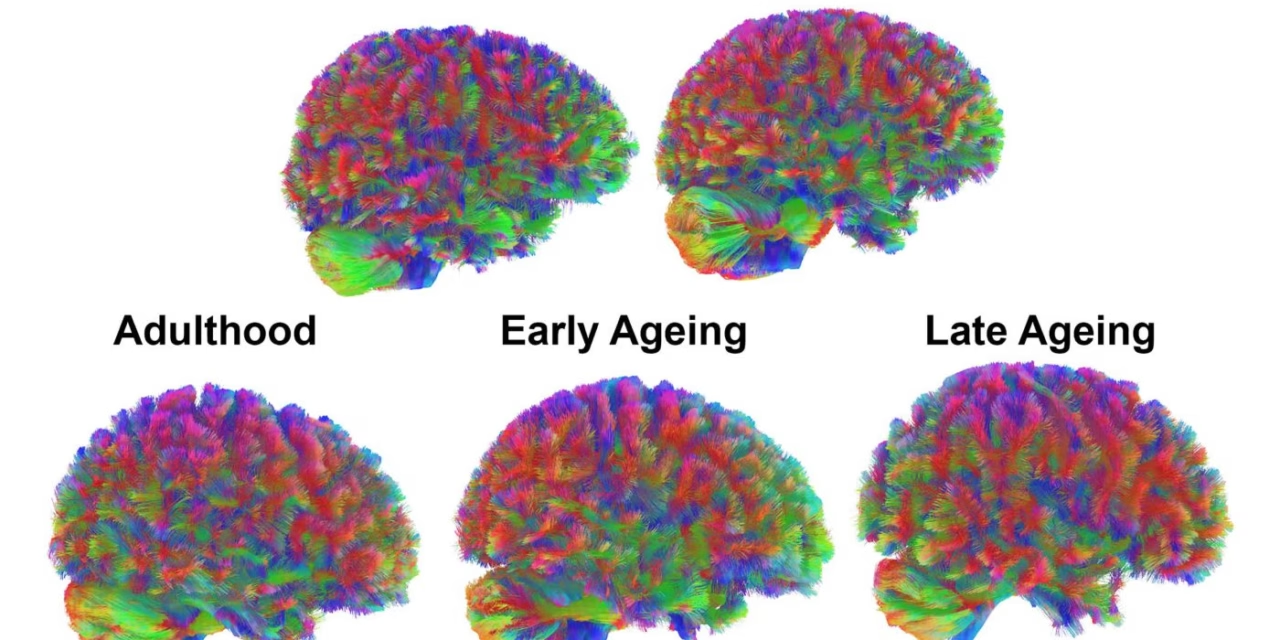
The study, published in Nature Communications, utilized advanced diffusion MRI scans to track the movement of water molecules through brain tissue. This technique allows scientists to visualize the “wiring” (white matter) and the “processors” (gray matter) of the brain in unprecedented detail.
Led by Dr. Alexa Mousley, a Gates Cambridge Scholar, the team applied “manifold learning”—a sophisticated computational method—to distill thousands of data points into a clear trajectory of brain development. The results were striking: rather than a smooth transition from youth to old age, the brain moves through “epochs” or eras characterized by stability followed by rapid reorganization.
“This study is the first to identify major phases of brain wiring across an entire human lifespan,” Dr. Mousley stated. “It shows us that the brain isn’t just growing or shrinking; it is fundamentally reconfiguring its network to meet the different cognitive demands of each life stage.”
The Five Eras of Neural Architecture
1. The Childhood Era (Birth to Age 9)
This phase is defined by “network consolidation.” The brain begins by pruning the excess synapses (connections) formed during infancy, focusing on efficiency. By age 9, the first major turning point occurs. This is a period of massive cognitive leaps but also a window of vulnerability; according to the research, this shift coincides with a heightened emergence of childhood anxiety and ADHD.
2. Extended Adolescence (Ages 9 to 32)
In perhaps the study’s most surprising finding, “adolescence” in the brain lasts far longer than previously thought, peaking only at age 32. During this era, white matter becomes increasingly myelinated—essentially “insulating” the wires to allow for faster communication. This results in peak neural efficiency and the development of complex executive functions.
3. Adult Stability (Ages 32 to 66)
This 34-year span represents the “plateau” of brain architecture. Here, the brain focuses on “segregation,” where different regions become highly specialized. This allows for the efficient performance of routine tasks and the crystallization of personality traits and intelligence.
4. Early Aging (Ages 66 to 83)
At age 66, the brain begins a subtle but definitive reorganization. Global connectivity starts to dip, often exacerbated by vascular health. “This is an age when people face increased risk for a variety of health conditions, such as hypertension, that can directly impact brain wiring,” noted Dr. Mousley.
5. Late Aging (Age 83+)
In the final era, the brain shifts from a globally integrated network to a fragmented, localized one. While the brain shows remarkable resilience, this decline in “long-distance” connectivity between brain regions is a primary hallmark of age-related cognitive decline and dementia.
Expert Perspectives: Rethinking “Adulthood”
The discovery that the brain’s most significant “adolescent” turning point happens at 32 has profound implications for how society views young adulthood.
Dr. Sarah Johnson, a cognitive neuroscientist at Johns Hopkins University, who was not involved in the study, believes this validates common social observations. “We’ve long seen that 20-somethings often struggle with impulse control or mental health shifts,” Dr. Johnson said in an interview. “This large cohort confirms that brain development is epochal. It explains why we see anxiety peaking at 30—the brain is still in the midst of its most intense topological rewiring.”
However, some experts urge caution in over-interpreting the data. Dr. Raj Patel, a geriatric psychiatrist at the Mayo Clinic, points out that the study is “cross-sectional,” meaning it compares different people of different ages at one point in time.
“While the data is robust, we must consider ‘cohort effects,'” Dr. Patel explained. “A 70-year-old today had different nutrition and education as a child than a 10-year-old does now. We need longitudinal studies—following the same people for decades—to confirm these turning points are universal across generations.”
Public Health and Daily Life: What This Means for You
The identification of these turning points provides specific “windows of opportunity” for public health interventions:
-
For Parents: The age 9 shift suggests that early mental health screenings are critical as the brain begins its first major reorganization.
-
For Young Professionals: Recognizing that the brain is still “optimizing” until 32 could shift how we approach workplace stress and mental health support for those in their 20s.
-
For Seniors: The age 66 turning point highlights the importance of managing blood pressure. According to the World Health Organization, hypertension affects roughly 60% of seniors and is a leading “accelerant” of brain aging.
“Understanding these turning points will help us identify when the brain is most vulnerable,” said Professor Duncan Astle, Senior Author and Professor of Neuroinformatics at Cambridge. “It allows us to move toward a model of preventative brain health.”
For the average reader, the message is one of lifelong plasticity. Whether it is learning a new language in your 30s to capitalize on “peak efficiency” or adopting a Mediterranean diet in your 60s to protect white matter, the brain remains an adaptive organ well into its ninth decade.
Limitations and the Road Ahead
While the study’s sample size of 3,802 is impressive, researchers acknowledge that the data is skewed toward Western populations via the UK Biobank. Furthermore, the study focused on structure (how the brain is built) rather than function (how it thinks in real-time).
The next frontier for the Cambridge team is integrating functional MRI (fMRI) data to see if these structural eras perfectly align with changes in memory, mood, and creativity.
References
Medical Disclaimer: This article is for informational purposes only and should not be considered medical advice. Always consult with qualified healthcare professionals before making any health-related decisions or changes to your treatment plan. The information presented here is based on current research and expert opinions, which may evolve as new evidence emerges.