 0
0
 0
0
A new study from Johns Hopkins University has revealed that the way a patient positions their arm during a blood pressure test can make a significant difference in the results—potentially leading to misdiagnosis and unnecessary treatment for hypertension.
Researchers found that even a small change in arm position, such as letting the arm dangle at the side instead of resting it on a desk at heart level, can increase systolic blood pressure readings by up to 7 millimeters of mercury (mmHg). This difference is enough to push a reading from “elevated” into the “stage 2” hypertension category, which could prompt clinicians to prescribe lifelong medication or alter treatment plans.
The study, published in JAMA Internal Medicine, involved 133 adults aged 18 to 80. Each participant had their blood pressure measured in three common positions: arm supported on a desk at heart level, arm resting on the lap, and arm hanging unsupported at the side. The results showed that a lap-supported arm averaged nearly 4 mmHg higher systolic and diastolic readings compared to the desk-supported standard, while an unsupported arm resulted in increases of 6.5 mmHg systolic and 4.4 mmHg diastolic.
These findings are particularly concerning given that nearly half of U.S. adults live with hypertension, a major risk factor for heart attacks and strokes. The study highlights how rushed or inconsistent measurement practices in busy clinics—or at home—can lead to inaccurate readings. For example, a blood pressure of 123 mmHg could be recorded as 130 mmHg simply due to improper arm positioning, potentially resulting in an incorrect hypertension diagnosis.
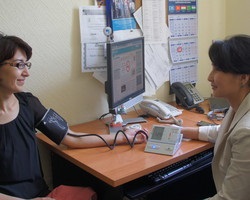
Proper technique, as recommended by the American Heart Association, involves sitting with back and feet supported, legs uncrossed, and the arm resting on a firm surface at heart level. However, the study notes that these guidelines are not always followed, both in clinical settings and at home, where kitchen tables or laps are often used instead of desks or counters at the right height.
Lead researcher Dr. Tammy Brady emphasized the importance of accurate measurement, stating that small inaccuracies can have a big impact on a person’s health journey. The team is now exploring whether simple reminders, such as prompts on blood pressure devices, could help improve measurement practices in clinics.
“If you are consistently measuring blood pressure with an unsupported arm, and that gives you an overestimated BP of 6.5 mmHg, that’s a potential difference between a systolic BP of 123 and 130,” said Sherry Liu, M.H.S., referencing the clinical jump from “elevated” to “stage 1” hypertension.
Disclaimer
This article summarizes findings from a recent scientific study and is intended for informational purposes only. It should not be used as a substitute for professional medical advice, diagnosis, or treatment. Always consult your healthcare provider for guidance specific to your health and circumstances.