 0
0
 0
0
Montreal, Canada – A groundbreaking augmented reality (AR) application developed by researchers at the Gina Cody School of Engineering and Computer Science is poised to significantly improve the safety and accuracy of ventriculostomy, a common neurosurgical procedure. This innovation holds particular promise for enhancing access to life-saving neurosurgical care in low- and middle-income countries and resource-limited settings.
Ventriculostomy, the insertion of a catheter into brain ventricles to drain cerebrospinal fluid and relieve intracranial pressure, is a delicate procedure requiring extreme precision. Misplacement of the catheter, a complication occurring in up to 30% of freehand procedures, can lead to serious consequences, including hemorrhage, infection, prolonged hospital stays, and even death.
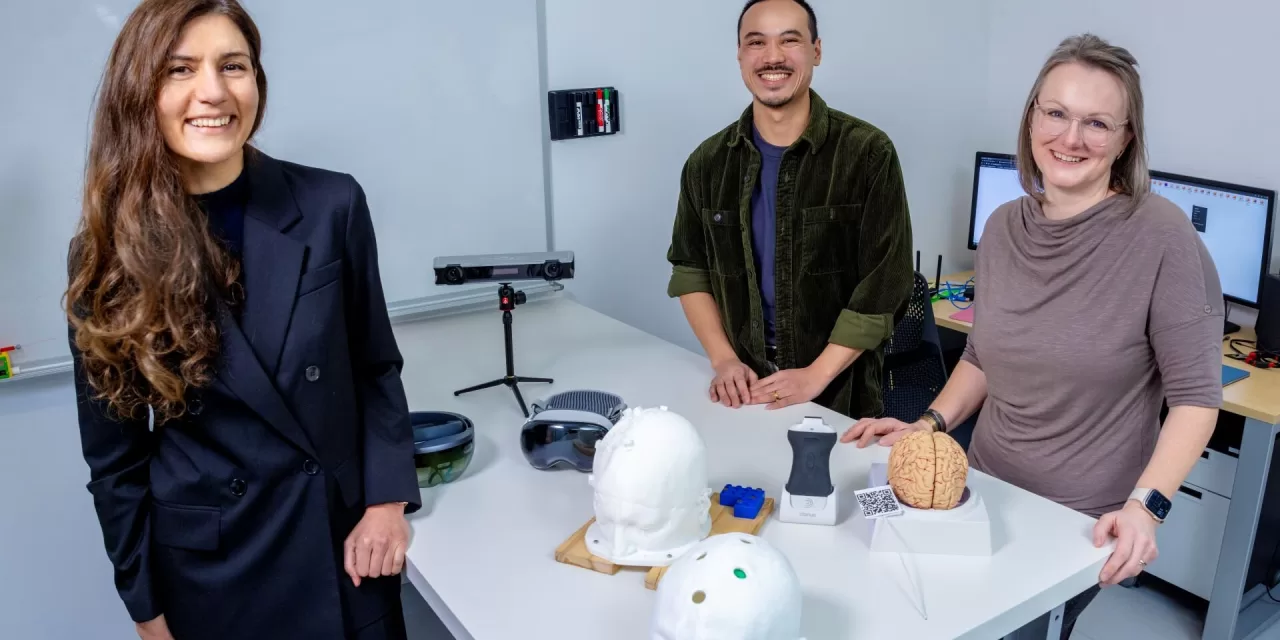
In response to this challenge, Marta Kersten-Oertel, an associate professor in the Department of Computer Science and Software Engineering, and her team have developed the iSurgARy system, an AR-based platform designed to enhance ventriculostomy accuracy.
The iSurgARy system utilizes LIDAR (light detection and ranging) technology, readily available on Apple iOS devices, to accurately map anatomical landmarks on the patient’s skull. By identifying key points such as the tragus, outer and inner eyes, and the bridge of the nose, the system aligns virtual models of the patient’s anatomy, derived from preoperative CT or MRI scans, with the actual patient.
“The technology offers better spatial awareness of patient anatomy, which provides surgeons better aim at their target points,” explains co-author Joshua Pardillo Castillo, MSc. “The augmented reality overlays the patient’s medical images to better see how they can best position the catheter.”
The AR overlay projects the ventricles onto the patient, providing a clear visualization for clinicians. This visualization guides them to the optimal location for catheter placement, while a catheter tracking tool offers spatial understanding of the distance between the catheter tip and the ventricles.
“The AR view shows where the ventricles are so clinicians can decide on the best approach,” Kersten-Oertel elaborates. “The freehand technique relies on bony landmarks of the skull, and clinicians make their decision based on them. But if there is a brain tumor that is causing pressure or a traumatic brain injury, the brain may have shifted so the ventricles are not where they are expected to be. This system allows users to see the ventricles projected on the patient and accurately target them.”
The development of iSurgARy was driven by a practical need identified by Dr. David Sinclair, a clinical professor in cerebrovascular and skull base neurosurgery at McGill University. He sought a tool to improve visualization and targeting of ventricles in emergent scenarios where time, cost, and accuracy are critical.
“This kind of collaboration with a neurosurgeon in the design and discovery phase makes this whole project unique,” says Zahra Asadi, a Ph.D. student and co-first author on the paper.
The researchers detailed their innovative technology in the journal Healthcare Technology Letters.
More information: Zahra Asadi et al, iSurgARy: A mobile augmented reality solution for ventriculostomy in resource‐limited settings, Healthcare Technology Letters (2025). DOI: 10.1049/htl2.12118
Disclaimer: This news article is based on information provided and should not be taken as medical advice. The iSurgARy system is a research project, and its widespread clinical application may require further testing and regulatory approvals. The effectiveness of the technology may vary, and results are not guaranteed. Always consult with a qualified medical professional for any health concerns or before making any decisions related to your health or treatment.