 0
0
 0
0
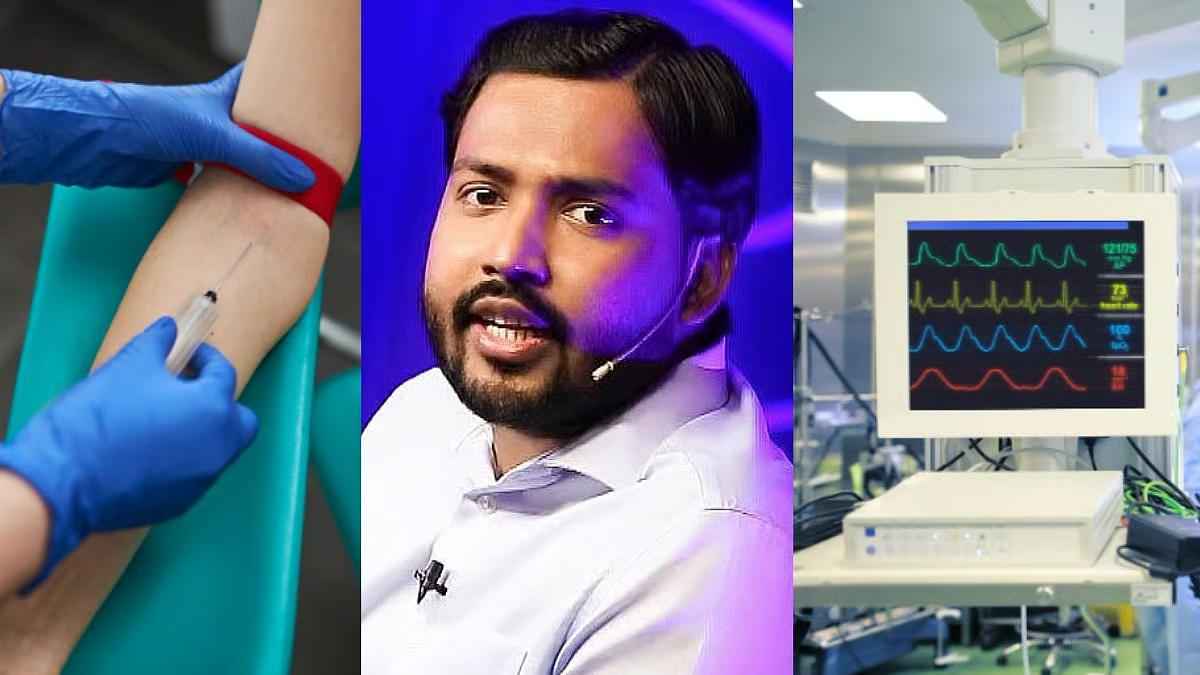
PATNA, BIHAR — In a move that has sent shockwaves through India’s healthcare sector, Faisal Khan, the celebrated educator popularly known as “Khan Sir,” has officially inaugurated a network of ultra-low-cost hospitals in Patna. With diagnostic tests priced as low as ₹7 for a blood test and ₹25 for an ECG, the initiative aims to dismantle the financial barriers that prevent millions of underprivileged families from seeking life-saving medical care.
Driven by a personal promise to his mother and funded through his successful educational ventures, Khan Sir’s “Khan GS Research Centre” hospital project represents a radical shift toward social-impact healthcare. The project arrives at a critical time for Bihar, a state where rural populations often face the stark choice between catastrophic medical debt and forgoing treatment entirely.
Breaking the Cost Barrier: A New Pricing Paradigm
For decades, the rising cost of private healthcare in India has outpaced household incomes. According to 2024-2025 market rates, a standard blood test in a private facility can range from ₹150 to ₹500, while an ECG typically costs between ₹300 and ₹800. Khan Sir’s facility is offering these services at a fraction of those prices, even undercutting government-subsidized rates.
The Current Fee Structure at Khan Sir’s Hospital:
-
Blood Test: ₹7
-
ECG: ₹25
-
X-Ray: ₹35
-
Dialysis: Significant reduction from the standard ₹4,000 per session to “minimal costs.”
“Our aim is not profit; it is service,” Khan Sir stated during the hospital’s soft launch. “My mother always believed that no person should be denied treatment because they lack a few rupees. We are building a system where the bill doesn’t become a second trauma for the family.”
Innovative Infrastructure: AI and Specialized Hubs
To maintain such low costs without compromising on quality, the hospital utilizes a unique operational model. Rather than one massive multi-specialty building, Khan Sir is establishing five specialized centers across Patna to manage patient volume and prevent overcrowding. Each hub focuses on specific areas: neurology, cardiology, cancer, kidney diseases, and diagnostics.
A key pillar of the hospital’s efficiency is the integration of Artificial Intelligence (AI) and advanced German and Japanese medical technology. “We are using AI-incorporated machines for diagnostics like ultrasound and MRI,” Khan Sir explained. “By using AI for initial screenings (priced at approximately ₹1,000), we can often rule out the need for more expensive tests like a ₹7,000 MRI, saving the patient thousands.”
Furthermore, the hospital’s operation theaters (OT) feature a specialized design. Eschewing traditional glossy tiles—where grout lines can harbor pathogens—the OTs use medical-grade anti-infection mats that resemble marble. This design choice is intended to reduce hospital-acquired infections, thereby lowering the long-term cost of patient recovery.
The Public Health Context in Bihar
Bihar’s healthcare system has long struggled with a “double burden.” While public health centers (PHCs) are affordable, they are often overcrowded and plagued by infrastructural gaps. Conversely, the private sector, concentrated in Patna, is often financially inaccessible.
Data from the National Family Health Survey (NFHS) highlights that out-of-pocket expenditure remains the primary source of healthcare funding for nearly 85% of Bihar’s population.
“This model addresses the ‘missing middle’ of Indian healthcare,” says Dr. Arunkumar Govindarajan, a radiologist and advocate for affordable diagnostics. “When you bring the cost of an ECG down to ₹25, you aren’t just saving money; you are encouraging early detection. People who would have ignored chest pain due to cost will now seek help before a massive cardiac event occurs.”
Sustainability and Limitations: Can It Last?
While the initiative has been met with widespread acclaim, some public health experts raise questions about long-term sustainability.
Potential Challenges Include:
-
Supply Chain Costs: Maintaining high-end German and Japanese machinery requires expensive annual maintenance contracts (AMCs).
-
Physician Salaries: Attracting top-tier specialists at “minimal” patient fees may require constant subsidization from Khan Sir’s educational revenue.
-
Volume Pressure: The sheer demand for ₹7 tests could lead to massive waiting lists, potentially impacting the quality of care.
To counter these concerns, Khan Sir has proposed a “Mercedes Subsidy” model. “If someone is wealthy enough to arrive in a luxury car, we might charge them a premium rate,” he noted. “They won’t mind paying for the quality, and that surplus helps us treat 100 people for free.”
The Roadmap Ahead
The project is not limited to Patna. Plans are already underway to establish dialysis centers and modern blood banks in every district of Bihar. By linking the rollout of these services to major Indian festivals like Diwali and Chhath, the initiative seeks to weave healthcare awareness into the cultural fabric of the region.
For the millions who follow Khan Sir online, this transition from “Shiksha” (Education) to “Swasthya” (Health) is a natural evolution of his mission. For the medical community, it is a bold experiment in whether “high-volume, low-margin” healthcare can truly thrive in one of India’s most challenging environments.
References
- https://www.freepressjournal.in/lifestyle/khan-sir-opens-indias-cheapest-hospital-says-our-aim-is-to-make-healthcare-accessible-to-everyone
Medical Disclaimer: This article is for informational purposes only and should not be considered medical advice. Always consult with qualified healthcare professionals before making any health-related decisions or changes to your treatment plan. The information presented here is based on current research and expert opinions, which may evolve as new evidence emerges.