 0
0
 0
0
In a groundbreaking discovery, researchers from the University of Vienna have identified viruses that infect the deadly single-celled organism Naegleria fowleri, shedding new light on potential interventions against this harmful microbe. Published in the journal Nature Communications, the study details the findings of the international collaboration led by Matthias Horn and Patrick Arthofer from the Center for Microbiology and Environmental Systems Science at the University of Vienna.
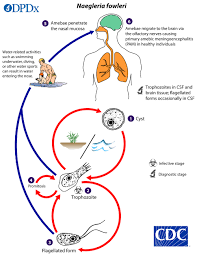
Naegleria species, ubiquitous single-celled amoebae found in water bodies worldwide, include the notorious Naegleria fowleri, which thrives in warm waters above 30°C and causes primary amoebic meningoencephalitis (PAM), a rare but often fatal brain infection. Leveraging their expertise, the research team isolated giant viruses that infect various Naegleria species, including Naegleria fowleri.
Giant viruses, scientifically classified as Nucleocytoviricota, represent a group identified only two decades ago, primarily infecting single-celled organisms. These viruses, characterized by their unusually large particles and complex genomes, challenge traditional notions of viral biology and the origins of life.
Patrick Arthofer explains, “The newly discovered Naegleriaviruses were isolated from a waste water treatment plant in Klosterneuburg near Vienna and represent only the fourth isolate from a group called Klosneuviruses.” This breakthrough was made possible through collaboration with researchers from universities in Poitiers, the Canary Islands, and the US-based Joint Genome Institute.
Naegleriaviruses, once ingested by Naegleria amoebae as a food source, swiftly destroy their hosts within hours. They utilize a unique stargate structure to infect host cells, facilitating DNA entry and initiating rapid viral replication. While replicating viral genetic material outside the nucleus, hundreds of new virus particles are assembled within a structure known as a virus factory. To prolong the host cell’s survival during this process, Naegleriaviruses likely employ special proteins that suppress the cell’s immune response, preventing premature cell death. Cell destruction and virus release occur only after successful viral replication.
While the newly identified Naegleriaviruses may not be directly applicable in treating Naegleria infections due to the challenge of accessing the brain where infections occur, the discovery opens avenues for preventative measures, such as treating at-risk water bodies. Matthias Horn emphasizes, “Regardless, the discovery of these viruses will enhance our understanding of both Naegleria biology and the viruses that infect them.”
The groundbreaking research offers a promising step forward in combating the deadly parasite Naegleria fowleri and underscores the importance of interdisciplinary collaboration in tackling complex infectious diseases.