 0
0
 0
0
NEW DELHI — In a landmark move aimed at transforming India’s healthcare landscape, the Lancet Citizens’ Commission on Reimagining India’s Health System officially released its comprehensive report on Wednesday, January 21, 2026. The report provides a strategic, rights-based roadmap to achieve Universal Health Coverage (UHC) by 2030, emphasizing that the path to a “Viksit Bharat” (Developed India) by 2047 must be paved with a health system that is owned, shaped, and governed by its citizens.
The report, the culmination of a multi-year collaborative effort involving global experts and local stakeholders, calls for a fundamental shift in how healthcare is delivered—moving away from a top-down model to one that treats patients as partners.
A Vision for 2047: Citizens as Partners, Not Just Patients
For decades, India’s healthcare system has struggled with fragmented services, high costs, and significant inequities. The new Lancet report argues that “technical fixes” are no longer enough. Instead, it proposes a “Citizen-Centred” architecture built on five strategic pillars: Financing, Governance, Human Resources, Technology, and Citizens’ Engagement.
“Recognizing people as partners rather than merely patients is essential to bringing the public into public health,” said Poonam Muttreja, Executive Director of the Population Foundation of India and a co-author of the report. “Health systems become more responsive, equitable, and compassionate when citizens participate in the planning, delivery, and accountability of services.”
Key Findings and Recommendations
The Commission’s roadmap focuses on several critical transitions:
-
Publicly Financed, Publicly Provided: The report issues a “clarion call” for an integrated delivery system where the government takes the lead as the primary provider and financier.
-
Leveraging the Private Sector: While advocating for a strong public system, the roadmap suggests “shaping” the private sector to leverage its innovation and reach, provided it operates under a robust, transparent regulatory framework.
-
Decentralization: Moving decision-making power to local levels to ensure services cater to India’s immense regional and cultural diversity.
-
Technology as an Enabler: Using digital tools not just for data collection, but to empower patients with control over their own health records and to improve primary care access.
The Economic Reality: Bridging the Funding Gap
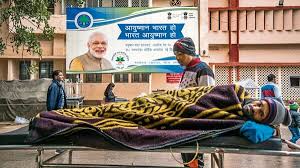
A central challenge highlighted in the report is India’s historically low investment in public health. Currently, public health expenditure stands at approximately 1.94% of GDP (as of the 2025-26 Budget), still short of the 2.5% target set by the National Health Policy of 2017.
This lack of investment has led to a high Out-of-Pocket Expenditure (OOPE), which the Economic Survey 2024-25 placed at 39.4%. For millions of Indian families, a single major illness remains a primary driver into poverty.
Dr. Anuska Kalita, a health systems expert and one of the report’s lead authors, noted that while the 2025-26 Union Budget saw an 11% increase in health allocation—reaching nearly ₹1 lakh crore—the focus must remain on primary care. “The National Health Mission remains the backbone of rural health, but its share in the total budget has seen a relative decline. We need to reverse this to ensure the last mile is covered,” she stated.
Expert Perspectives: Accountability and Potential Pitfalls
While the report has been hailed as a visionary document, it has not been without controversy. Some experts have expressed concerns about the “corporatization” of primary care.
“There is a delicate balance to strike,” says Dr. K. Srinath Reddy, former president of the Public Health Foundation of India, who was not involved in the final report. “The roadmap’s emphasis on citizen engagement is revolutionary, but the government must ensure that ‘multi-stakeholder collaboration’ does not inadvertently lead to the commercialization of essential primary services, which should remain a public good.”
Other public health advocates point out that decentralization requires more than just policy—it requires a massive upskilling of local administrative bodies and a radical increase in the number of frontline workers, such as ASHAs, whose numbers have grown but who still face challenges regarding fair pay and formal recognition.
What This Means for You: The Practical Shift
For the average citizen, the implementation of this roadmap would mean a shift from “seeking treatment” to “managing wellness.”
-
Transparency: You would have a greater say in how your local clinic operates through community-led “Jan Arogya Samitis.”
-
Continuum of Care: Instead of visiting a government hospital only for emergencies, the focus moves to your local Health and Wellness Centre for preventive screenings (diabetes, hypertension, cancer) and mental health support.
-
Digital Empowerment: Under the Ayushman Bharat Digital Mission (ABDM), you would have a unified health ID, allowing you to access your records across any hospital in the country, reducing redundant tests and costs.
Conclusion: A Call for Political Will
The Lancet Commission concludes that the transition to a citizen-centred system is not just a medical necessity but a political one. It requires a “strong political will” to move healthcare from the periphery of election manifestos to the center of national development.
As India moves toward its centenary of independence in 2047, the “Citizens’ Blueprint” offers a chance to ensure that the nation’s growth is measured not just by its GDP, but by the health and dignity of every individual.
Reference Section
Medical Disclaimer: This article is for informational purposes only and should not be considered medical advice. Always consult with qualified healthcare professionals before making any health-related decisions or changes to your treatment plan. The information presented here is based on current research and expert opinions, which may evolve as new evidence emerges.