 0
0
 0
0
LAHORE, Pakistan – In a sobering reminder of the hurdles remaining in the global quest to eradicate poliomyelitis, health authorities in Lahore reported multiple violent attacks on vaccination teams this week. These incidents coincide with newly released national data revealing that nearly one million children missed their life-saving drops during the first nationwide campaign of 2026.
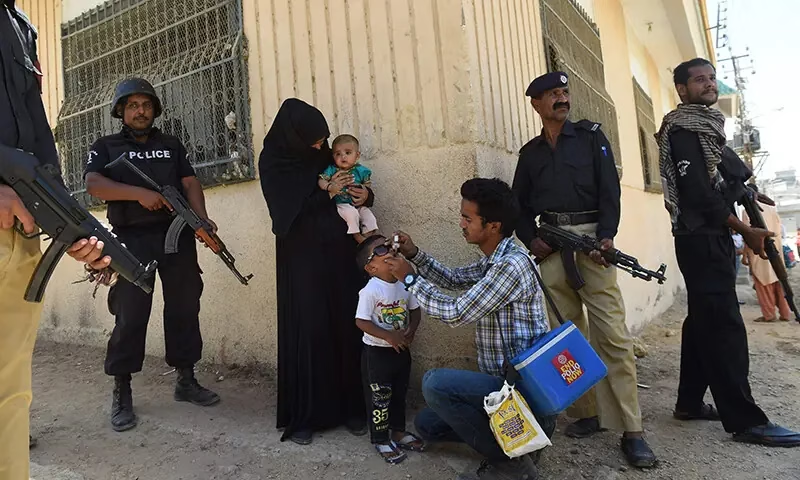
The violence, centered in the districts of Harbanspura and Shahdara, saw health workers and police personnel harassed and physically assaulted by parents and their accomplices. While Pakistan has made monumental strides toward a polio-free future, the twin shadows of vaccine hesitancy and security threats continue to haunt the program, leaving a critical window open for the virus to persist.
Frontline Under Fire: The Incidents in Lahore
On Tuesday, police in Lahore’s Harbanspura area filed a First Information Report (FIR) following a harrowing encounter where a vaccination team was barred from entering a home. According to local reports, the situation escalated when suspects allegedly tortured the health workers and called in accomplices to join the assault. Even the arrival of law enforcement did not immediately quell the violence, as the suspects reportedly turned their aggression toward the responding police officers.
In a separate incident in the Shahdara neighborhood, a second case was registered against parents for the alleged harassment of female polio workers. These “Sehat Muhafiz” (Health Guardians), who often go door-to-door in some of the world’s most difficult terrain, represent the backbone of the eradication effort.
“The safety of our frontline workers is non-negotiable,” says Dr. Arshad Iqbal, a regional public health consultant (not affiliated with the local police investigation). “When a worker is harassed or attacked, it doesn’t just stop one child from being vaccinated; it creates a ripple effect of fear that can paralyze the entire health infrastructure in that community.”
By the Numbers: The 2026 Campaign Results
Despite the violence, the scale of the January 2026 campaign was massive. More than 44.3 million children across Pakistan received the Oral Polio Vaccine (OPV). According to data published by Dawn, the campaign achieved a household coverage rate of 98%.
However, in the world of infectious disease, the remaining 2% represents a significant vulnerability.
The “Missed” Million
An estimated 0.95 million children were missed during this latest drive. The breakdown of these missed opportunities highlights a complex logistical and social landscape:
-
Absenteeism: 0.67 million children were not home when teams visited.
-
Security & Geography: 233,000 children in Khyber Pakhtunkhwa, PoJK, and PoGB were unreachable due to security constraints or heavy snow.
-
Active Refusals: 53,000 cases were recorded where parents explicitly declined the vaccine.
Notably, Karachi emerged as a hotspot for vaccine hesitancy, accounting for 58% of the total refusals nationwide.
| Region | Children Vaccinated (Approx.) |
| Punjab | 22.9 Million |
| Sindh | 10.5 Million |
| Khyber Pakhtunkhwa | 7.13 Million |
| Balochistan | 2.3 Million |
| Islamabad | 455,000 |
Understanding the “Refusal” Barrier
Why do parents refuse a vaccine that prevents permanent paralysis? Public health experts point to a “perfect storm” of misinformation and “fatigue.”
“We are dealing with deep-seated conspiracy theories and, in some cases, community boycotts where families withhold vaccination to bargain for other basic services like electricity or clean water,” explains Sarah Thompson, a global health analyst specializing in South Asian immunization programs. “In urban centers like Karachi, the challenge is often the sheer density and the influence of localized misinformation spread through social media.”
The Wild Poliovirus (WPV1) is now endemic only in Pakistan and Afghanistan. Because the virus travels through contaminated water and fecal-oral routes, any pocket of unvaccinated children acts as a reservoir, allowing the virus to mutate and potentially spill over into polio-free regions.
The Science of Eradication
Polio is a highly infectious viral disease that strikes the nervous system. According to the World Health Organization (WHO), 1 in 200 infections leads to irreversible paralysis. Among those paralyzed, 5% to 10% die when their breathing muscles become immobilized.
The Oral Polio Vaccine (OPV) used in these campaigns contains an attenuated (weakened) vaccine-virus. When a child is vaccinated, the weakened virus replicates in the intestine for a limited period, developing immunity by building up antibodies.
“There is no cure for polio,” emphasizes the WHO. “It can only be prevented. Polio vaccine, given multiple times, can protect a child for life.”
Public Health Implications and the Path Forward
The postponement of campaigns in areas like Mastung and Gwadar due to security concerns remains a critical “red zone” for the Global Polio Eradication Initiative (GPEI). When campaigns are delayed, the immunity gap widens.
To counter this, Pakistan’s National Emergency Operations Centre (NEOC) has been integrating “guest children” protocols—vaccinating children found in transit at bus stations and borders. In the recent campaign, 2.5 million guest children were reached, which likely offset a large portion of those who were not home during door-to-door visits.
However, the recent violence in Lahore—traditionally a more stable region than the border provinces—signals that the “refusal” sentiment may be shifting geographically.
What This Means for Readers
For the global community, the situation in Pakistan is a reminder that “polio anywhere is a threat everywhere.” For parents, the medical consensus remains clear: the vaccine is the only proven defense against a life-altering disability. The focus now shifts to the “High-Risk Mobile Populations” and ensuring that the 53,000 families who refused this month are reached through community elders and religious leaders who can dispel myths with facts.
Medical Disclaimer
Medical Disclaimer: This article is for informational purposes only and should not be considered medical advice. Always consult with qualified healthcare professionals before making any health-related decisions or changes to your treatment plan. The information presented here is based on current research and expert opinions, which may evolve as new evidence emerges.
References
https://www.newkerala.com/news/a/pakistan-polio-teams-targetted-parents-lahore-385.htm