 0
0
 0
0
The 70th session of the intergovernmental UN Commission on the Status of Women (CSW) – UN’s largest annual forum on gender equality – which began on 9th March 2026, is to conclude on 19th March 2026 at UN Headquarters in New York. This year’s priority theme under discussion was “Ensuring and strengthening access to justice for all women and girls, including by promoting inclusive and equitable legal systems, eliminating discriminatory laws, policies, and practices, and addressing structural barriers.”
In an historic departure from 70 years of consensus-based decision-making, the UN Commission on the Status of Women (CSW) adopted its outcome document (Agreed Conclusions) for the 70th session (CSW70/2026) through a recorded vote on 9th March 2026.
For the first time in the 70 years’ history of CSW (which consists of 45 elected member-countries), the outcome document was adopted via a formal vote rather than by consensus, thanks to the retaliatory stand taken by the USA.
USA introduced eight oral amendments aimed at altering the draft text to align with its own positions on issues including against abortion, gender identity, and diversity, equity and inclusion.
When these amendments proposed by USA weredefeated by other CSW member countries, the U.S. forced a recorded vote on the entire document.Ultimately the CSW70 document of agreed conclusions was adopted with 37 votes in favour and 1 against (the USA), and 6 abstentions (from Côte d’Ivoire, the Democratic Republic of Congo, Egypt, Mali, Mauritania and Saudi Arabia).
This rare break from consensus to a vote highlights a widening global political divide over gender rights and is a sign of increasing pressure and pushback against existing human rights language, particularly regarding gender equality.
CSW Chair Maritza Chan Valverde from Costa Rica said that every effort has been made to listen to delegations and to reflect the diversity of views expressed. Stressing that hard-won progress on gender equality must not be reversed, she said “We are convinced that the text represents the most balanced outcome achievable at this stage”.
Is the outcome document of CSW70 good enough?
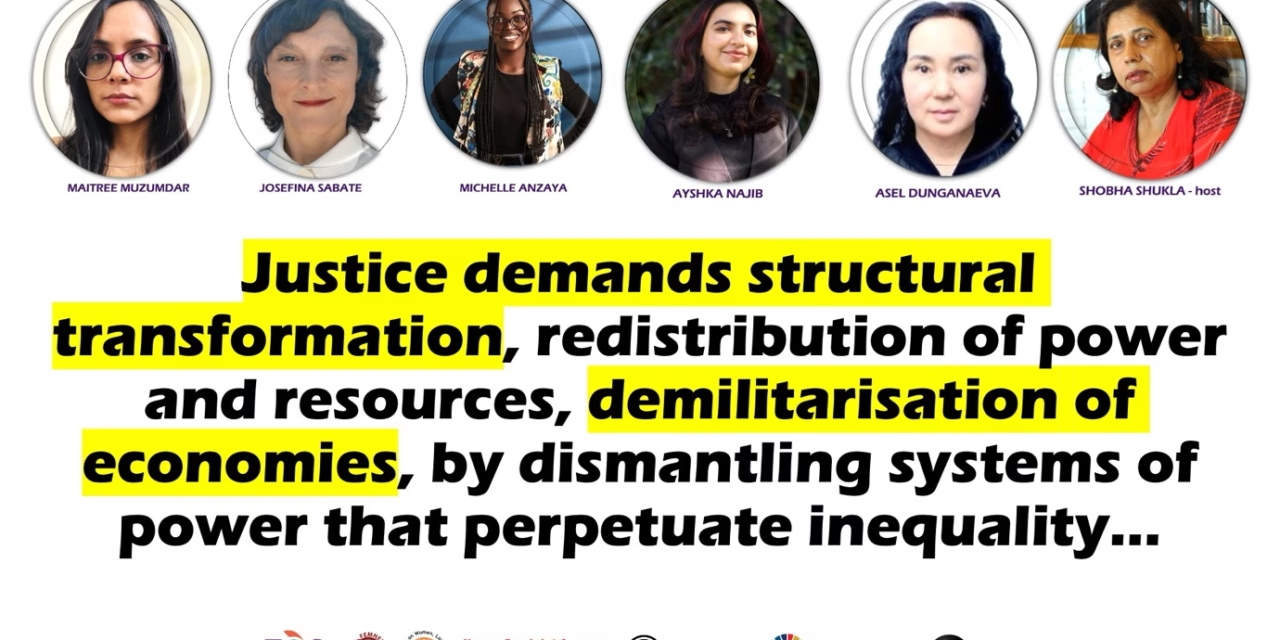
Maitree Muzumdar, co-founder Feminist Manch and co-convener of the Young Feminist Caucus and the Women’s Rights Caucus, lamented that CSW70 negotiations took place amid a global rollback of rights, shrinking civic space, rising authoritarianism and militarism, and deepening economic crisis. These dynamics shape the multilateral system including CSW.
“The decision to break consensus and proceed to a vote, underscores how deeply contested commitments to gender equality, human rights, and access to justice remain in this current geopolitical moment. While regressive amendments on sexual and reproductive health and rights, fundamental freedoms, intersectionality, and reparations were rejected because of cross-regional mobilisation by feminist civil society and supportive governments (UN member states), negotiations revealed resistance by powerful governments (UN member states) and mobilised anti-gender anti-rights actors,” she said.
Maitree criticised member states for approaching access to justice as a technical issue rather than a political issue, focusing on procedural reforms without addressing the structural conditions that produce injustice. “This allows governments to avoid confronting the political interests and power relations that sustain injustice, including systems of criminalisation, unequal economic relations, and political repression that disproportionately affects marginalised communities and countries across the global south. The refusal to name discriminatory laws, dilution of commitments under sovereignty clause, and phrases like “as applicable” allow existing social, political, and economic hierarchies to remain untouched,” said Maitree Muzumdar.
When negotiations assume that states are acting in good faith despite these realities, they risk reinforcing the barriers to access to justice and “prioritising state power over human rights and democratic participation.”
“Resourcing discussions remained disconnected from macroeconomic policies which determine whether our justice systems can function at all. These policies are often shaped through global economic governance structures and international financial institutions which impose fiscal constraints on countries across the global south. Debt burdens and austerity frequently limit public spending, resulting in underfunded courts, limited legal aid services, and reduced access to essential services and remedies. Without addressing these structural economic constraints, commitments to strengthen access to justice remain difficult to realise in practice”, added Maitree Muzumdar.
Maitree was the opening keynote speaker at a press conference hosted by Women’s Rights Caucus around 70th Session of the UN Commission on Status of Women (CSW70). This press conference was together co-hosted by co-convenors: Asia Pacific Forum on Women, Law and Development (APWLD), The African Women’s Development and Communication Network, Fòs Feminista, Outright International, and Young Feminist Caucus; Global Center for Health Diplomacy and Inclusion (CeHDI) and CNS.
No gender justice possible under war, occupation and genocide
Ayshka Najib, co-convener of the Young Feminist Caucus was “appalled by the double standards in the room (where CSO70 deliberations were taking place) as one progressive country after the other from the west, ‘called for ensuring access to justice and gender equality for all women and girls.’ These were the same very states aiding and abetting billions of dollars in military violence and occupation in global south countries displacing and murdering millions of women and girls.”
“We cannot have gender justice under war, occupation, and genocide. This is not a political agenda, but a call to action to recognise that CSW does not exist in isolation. As negotiators in that room debate repeatedly on our rights, our autonomy, our leadership, our freedom, the world is being torn to pieces,” said Ayshka.
Another speaker Josefina Sabate, a feminist activist from Argentina, agreed that the political process of CSW70 has taken place in a highly adverse political context and the CSW70 outcome document is not as progressive as we might have wished. However, she praised the CSW’s chair’s ability to ensure that the document was adopted.
For Josefina “access to justice is not merely a technical matter. Women and girls face numerous obstacles – legal, financial, geographical, and institutional barriers – that hinder their access to justice, bodily autonomy, sexual and reproductive health services, and mechanisms for redress and reparation. However, many countries in Latin America stand in opposition to this agenda”.
“Although we have laws that have been formally enacted, there remains a multitude of obstacles regarding access to these rights and services. The document in question frames this issue within a paradigm of development that places the sustainability of life – along with social and gender justice – at its very centre,” she added.
Corporate capture lurks
Commenting on the deliberations at CSW70 Maitree Mazumdar said, “There has also been reluctance to address the impunity of the private sector in the privatisation of essential public services, climate injustice, human rights violations, and development projects that deepen inequalities between countries and people. These harms are closely tied to development models that prioritise economic growth and profit over people’s rights. Yet, these models remained unquestioned, making strong corporate accountability and reparative remedies essential. These realities demand stronger accountability for human rights violations committed by both state and non-state actors. Justice cannot exist without democratising power and resources or confronting the systems that produce injustice.”
Agrees Ayshka that “Justice for all women and girls is not a service but a political, economic, and structural struggle. It is systematically obstructed by patriarchal, militarised, and fascist systems manifested through war economies, arms trade, corporate capture, and fossil fuel-based extractive models that dispossess indigenous communities. Therefore, achieving justice requires the dismantling of these systems, redistribution of power, demilitarisation, protection and expansion of civic spaces, and the meaningful leadership of feminist movements at all levels.”
Shrinking space for feminist voices of the Global South: a troubling reality
Michelle Anzaya, a feminist leader from Africa, said that civil society participation has always been central to the strength and legitimacy of CSW. But the space for civil society participation, particularly for feminist activists from the Global South, is shrinking.
Many African women and girls are facing increasingly restrictive access to participation. When feminist leaders, grassroots organisers, and community advocates cannot access spaces like CSW, the global agenda risks being shaped without the voices of those who are most directly affected by inequality and injustice.
Michelle called upon UN member states and the CSW Bureau to uphold meaningful, holistic, and inclusive participation as a core principle of CSW processes and to address the structural and systemic barriers that continue to limit the effective participation of women and civil society from the Global South, including the restrictive visa regimes. Also, the UN system must ensure that CSW outcomes reflect the lived realities and priorities of women and girls across all regions.
What do the feminists say?
Feminists call upon government leaders to deliver on gender equality and justice. They deem “governments, corporations, UN entities, and international institutions duty-bearers and feminist movements as rights holders. And as rights holders, young feminist movements must have meaningful decision-making power and protection from reprisals online and offline. These are obligations and not optional commitments.”
And as Asel Dunganaeva, a human rights activist from Kyrgyzstan said: Justice demands structural transformation, redistribution of power and resources, demilitarisation of economies, and decolonisation of global governments by dismantling systems of power that perpetuate inequality. Without transforming these structural conditions, access to justice cannot be realised.
Shobha Shukla – CNS (Citizen News Service)