 0
0
 0
0
NEW DELHI — In a landmark achievement for Indian ophthalmology, the Army Hospital (Research & Referral) in Delhi Cantt has successfully performed the nation’s first 3D Flex Aqueous Angiography integrated with iStent technology. This breakthrough procedure, conducted by the hospital’s Ophthalmology Department, introduces a level of surgical precision previously unavailable in the country, offering new hope for patients battling glaucoma—a leading cause of irreversible blindness.
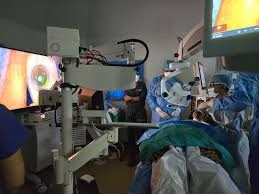
The procedure utilized a sophisticated stand-mounted Spectralis imaging system paired with a state-of-the-art 3D operating microscope. By combining real-time imaging of the eye’s fluid drainage with minimally invasive surgery, the Armed Forces Medical Services (AFMS) has positioned itself among a select group of global leaders delivering cutting-edge ophthalmic care.
A “Silent Thief” Met with High-Tech Precision
Glaucoma is often referred to by clinicians as the “silent thief of sight.” It is a group of eye conditions that damage the optic nerve, frequently due to abnormally high pressure within the eye. Because symptoms often don’t appear until the disease is advanced, the damage is often permanent.
Traditionally, surgeons relied on generalized anatomical knowledge to place drainage devices. However, the introduction of 3D Flex Aqueous Angiography changes the landscape. This technique allows surgeons to visualize the “aqueous outflow pathways”—the specific routes fluid takes to exit the eye—in real-time and in three dimensions.
“Every eye is as unique as a fingerprint,” says Dr. Ananya Sharma, a senior consultant ophthalmologist not involved in the procedure. “Being able to see exactly where the fluid is flowing during surgery allows for a ‘personalized map.’ It takes the guesswork out of where to place a stent for maximum effectiveness.”
The iStent Revolution: Minimally Invasive, Maximum Impact
The procedure’s success hinges on the integration of imaging with the iStent, a device recognized as one of the world’s smallest medical implants. Part of a category known as MIGS (Minimally Invasive Glaucoma Surgery), the iStent is designed to create a permanent opening in the eye’s primary drainage pathway.
Why this combination matters:
-
Targeted Placement: The 3D angiography identifies the most active drainage “veins.”
-
Reduced Trauma: Being minimally invasive, it avoids the extensive cutting and suturing required by traditional glaucoma surgeries (like trabeculectomy).
-
Faster Recovery: Patients typically experience quicker healing and a lower risk of post-operative complications.
-
Lower Medication Dependence: Many patients can reduce or eliminate their daily reliance on pressure-lowering eye drops.
Strategic Significance for the Armed Forces
For the Armed Forces community, this medical milestone extends beyond clinical success; it is a matter of operational readiness. Maintaining optimal vision is critical for service members, and the ability to intervene early with highly successful, low-recovery-time procedures ensures that personnel remain fit for duty.
Official statements from the hospital emphasize that this technology will serve as a benchmark for future glaucoma management across India, potentially influencing how civilian hospitals approach complex cases.
Weighing the Benefits and Limitations
While this advancement is a significant leap forward, medical experts urge a balanced perspective.
“While 3D Flex Aqueous Angiography and iStent represent the gold standard in modern care, they are typically most effective for mild-to-moderate open-angle glaucoma,” notes Dr. Rajesh Iyer, a glaucoma specialist. “Patients with very advanced scarring or specific types of closed-angle glaucoma may still require traditional surgical routes.”
Furthermore, the high cost of the Spectralis imaging system and the specialized training required for 3D microscopy mean that this technology may take time to become widely available in smaller community hospitals across India.
What This Means for Patients
For those currently managing glaucoma with multiple daily eye drops, this development signals a shift toward proactive, personalized intervention. Instead of waiting for medications to fail, surgeons can now offer a “precision strike” against eye pressure.
Key Takeaways for Readers:
-
Early Detection is Key: The benefits of 3D angiography and iStent are highest when the optic nerve is still relatively healthy.
-
Consult Your Specialist: Ask your ophthalmologist if you are a candidate for MIGS (Minimally Invasive Glaucoma Surgery).
-
Monitor Your Pressure: Regular screenings remain the only way to catch glaucoma before it causes noticeable vision loss.
The success at Army Hospital (R&R) marks the beginning of a new era in Indian eye care—one where the “silent thief” is no longer invisible, but clearly mapped and precisely treated.
Medical Disclaimer
This article is for informational purposes only and should not be considered medical advice. Always consult with qualified healthcare professionals before making any health-related decisions or changes to your treatment plan. The information presented here is based on current research and expert opinions, which may evolve as new evidence emerges.
References and Sources
https://www.newsage.in/army-hospital-first-3d-flex-aqueous-angiography-istent/