 0
0
 0
0
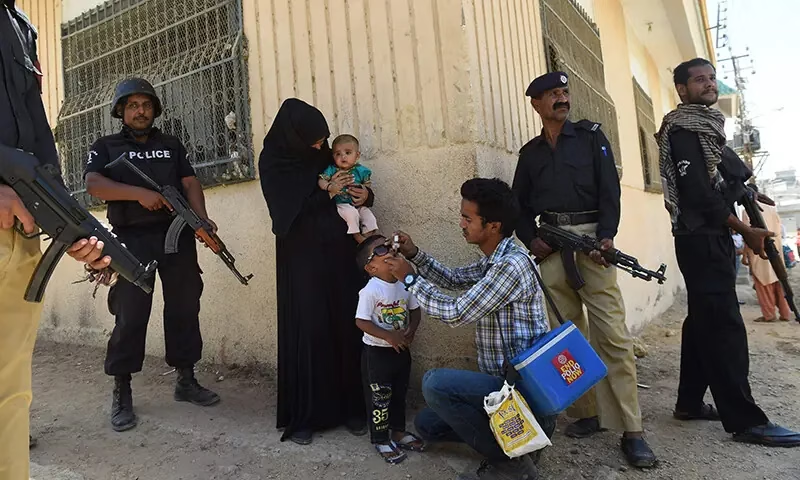
ISLAMABAD — Despite decades of global efforts and billions of dollars in investment, Pakistan remains one of the final two frontiers in the global fight against poliomyelitis. A series of recent reports, including data from the leading daily Dawn and the Pakistan Observer, suggest that the nation’s failure to cross the finish line is less a matter of medical capability and more a symptom of political paralysis, systemic operational flaws, and a failure to counter extremist narratives.
As the present government remains entangled in judicial and political maneuvering, public health experts warn that the window to eradicate the virus is closing, leaving millions of children vulnerable to irreversible paralysis.
The Numbers Behind the Crisis
The scale of the recent failure is stark. During Pakistan’s latest nationwide polio campaign, approximately one million children were not reached by vaccination teams. Even more concerning for health officials is the data on “refusals”—instances where parents actively decline the vaccine for their children. Nearly 53,000 families refused the drops during the most recent drive.
The crisis is most acute in Karachi, Pakistan’s largest and most resource-rich city. Karachi alone accounted for 31,000 refusals, representing 58% of all recorded refusals nationwide.
“The fact that 670,000 children were recorded as ‘not available at home’ defies operational logic,” noted a report in the Pakistan Observer. Critics argue that children are rarely truly “absent” from a city; they are in markets, schools, or with relatives. The reliance on a rigid door-to-door model, without adapting to the mobile nature of urban populations, represents what many call a “systemic failure.”
A Vacuum of Political Leadership
For a public health initiative of this magnitude to succeed, it requires an overarching national narrative. However, analysts suggest that successive Pakistani governments have failed to establish a coherent pro-vaccination message that can compete with local misinformation.
The vacuum left by the state has been filled by extremist propaganda. In many regions, the extreme right has spent years “brainwashing” communities into believing the vaccine is part of a foreign conspiracy or contains harmful substances.
“This is a failure of the government to pander less to fundamentalists and more to the science of public health,” says one Islamabad-based health policy analyst. Without a unified political front to counter these narratives, frontline workers—who often face immense personal risk—are left to fight a battle of ideology at every doorstep.
Understanding the Medical Stakes
Poliomyelitis is a highly infectious viral disease that largely strikes children under five years of age. The virus invades the nervous system and can cause total paralysis in a matter of hours.
-
Transmission: The virus is transmitted person-to-person spread mainly through the fecal-oral route or, less frequently, by a common vehicle (e.g., contaminated water or food).
-
The Vaccine: The Oral Polio Vaccine (OPV) is considered extremely safe and effective. It works by triggering an immune response in the gut, the primary site where the poliovirus replicates.
-
The Risk of “Small Gaps”: Because the virus is so contagious, even a 5% or 10% gap in vaccination coverage can allow the virus to circulate and mutate, threatening not just Pakistan, but global health security.
Expert Perspective: Beyond the Doorstep
While official figures provide a baseline, international health bodies suggest the true burden of the disease may be obscured. The U.S. Centers for Disease Control and Prevention (CDC) has highlighted evidence of large-scale environmental transmission in Karachi, Peshawar, Quetta, and Central Pakistan.
“When we see the virus in sewage samples but not in reported clinical cases, it tells us two things,” says Dr. Elena Rodriguez, an independent infectious disease consultant (not involved in the Pakistan program). “First, the virus is circulating widely in the community. Second, our surveillance systems are missing cases because of limited healthcare access in remote or marginalized areas.”
Dr. Rodriguez notes that “vaccine fatigue” is also a factor. “In areas with poor sanitation and no clean water, parents often ask why the government is so persistent with polio drops but nowhere to be found when the child needs basic nutrition or clean drinking water. That disconnect breeds’ mistrust.”
Barriers to Success: Misinformation and Microplanning
The persistence of polio in Pakistan is driven by a complex “triple threat”:
-
Security Concerns: Vaccination teams have frequently been targeted by militants, making it difficult to maintain consistent coverage in volatile border regions.
-
Weak Microplanning: In mega-cities like Karachi, local administrations have struggled to map out every household accurately, leading to “missed” clusters of children.
-
Conspiracy Theories: Misinformation ranging from claims that the vaccine causes infertility to allegations that it is a tool for Western espionage continues to circulate on social media and through word-of-mouth.
The Path Forward: A Call for Accountability
To turn the tide, public health experts argue that the government must move beyond routine statistics and treat every missed child as a breach of national duty. This involves:
-
Targeted Neighborhood Strategies: Especially in Karachi, engaging local religious and community leaders to vouch for the vaccine’s safety.
-
Integration of Services: Providing polio vaccines alongside other essential services—like clean water and primary healthcare—to build community trust.
-
Political Prioritization: Elevating the polio crisis from a departmental issue to a top-tier national security priority.
As long as the virus exists in the environment of Pakistan, no child, anywhere in the world, is truly safe from a potential resurgence. The medical tools to end polio have existed for decades; what remains missing in Pakistan is the political will to deploy them effectively.
References
-
World Health Organization (WHO): Polio Eradication Strategy 2022-2026.
-
Global Polio Eradication Initiative (GPEI): Pakistan Country Profile and Surveillance Data (2025-2026).
-
The Dawn: “Operational gaps and the Karachi Crisis,” published March 7, 2026.
-
Centers for Disease Control and Prevention (CDC): “Global Update on Polio Eradication,” Morbidity and Mortality Weekly Report (MMWR).
-
Expert Source: Dr. Elena Rodriguez, Infectious Disease Specialist (Independent Consultant).
Medical Disclaimer: This article is for informational purposes only and should not be considered medical advice. Always consult with qualified healthcare professionals before making any health-related decisions or changes to your treatment plan. The information presented here is based on current research and expert opinions, which may evolve as new evidence emerges.